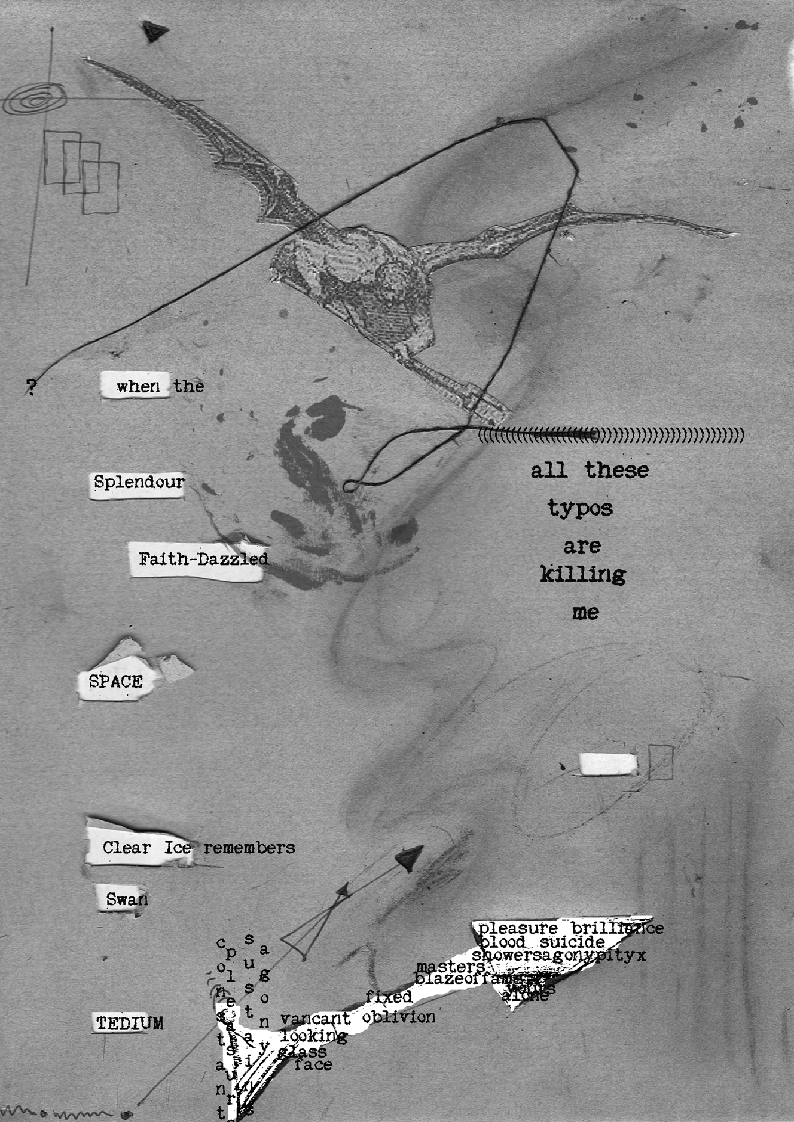
Reviews and audio for Counting Backwards 5: Phil Davenport, James Davies, Helen Shanahan and Juxtavoices available here
Events
Born After 1924 / Merzman
Exhibition Preview
BORN AFTER 1924
EXHIBITION PREVIEW: Thursday 17 February, 6-9pm – All Welcome!
EXHIBITION CONTINUES: 18 February to 10 April 2011
Tim Noble & Sue Webster Gregor Schneider
Ingo Gerken and invited artists: Matti Isan Blind, Madeleine Boschan, Rainer Ganahl, Antonia Low, Tim Noble & Sue Webster, Reto Pulfer, Gregor Schneider.
Castlefield Gallery is proud to present BORN AFTER 1924 project by German artist Ingo Gerken. Interpreting the contemporary legacy of the Merzbarn[1] and Kurt Schwitters in the UK, Castlefield Gallery has invited Gerken to respond to Schwitters’ Merz Magazine (issue 8/9) of 1924 called Nasci[2]. The theme of the magazine, Nasci, meaning ‘being born’ or ‘becoming’, was co-edited with Russian Constructivist artist El Lissitzky[3] forging an alliance of Dadaist and Constructivist ideals and included reproductions and texts by Vladimir Tatlin, George Braque, Man Ray, Piet Mondrian, Kazimir Malevich and Mies van der Rohe among others.
The exhibition will become a site-specific and physical manifestation of Gerken’s collages which will include other invited artists, from the UK and Germany as ‘articulations’ or ‘punctuations’ of his own practice thereby resulting in a group show.
[1] Kurt Schwitters’ (1887–1948) Merzbarn is located in a remote woodland in Cumbria and stands much as he left it, incomplete after his death in 1948. After considerable discussions about its future which involved the British pop artist Richard Hamilton, the surviving Merzbarn wall was removed for safe keeping and presented by its owner, Harry Pierce to Newcastle University Hatton Gallery in 1965, where it is now on public view. The Merzbarn building itself still survives and contains evidence of Schwitters’ original working methods and materials.
[2] Nasci is the Latin word for ‘nature’, ‘being born’ and ‘becoming’.
[3] El Lissitzky (1890 – 1941) was a Russian Constructivist designer and artist.
For further information please go to http://www.castlefieldgallery.co.uk
BORN AFTER 1924 is part of MERZMAN. MERZMAN is a city wide programme of exhibitions, performance and public events across Manchester exploring the contemporary legacy of Kurt Schwitters in North West England, coordinated by the Littoral Art’s Trust.
BORN AFTER 1924 is kindly supported by ATLAS Bar & Café; Manchester, Barefoot Wine’s and Mint Hotel; Manchester. Please join us for the BORN AFTER 1924 after preview party at ATLAS Bar & Café from 9pm, Thu 17 Feb 2011.
BORN AFTER 1924 visitors receive 10% of their total bill when ordering food at ATLAS Bar & Café.
——————————————————————————–
TALK
Tues 15 Feb, 11am
Ingo Gerken Talk
Location: The Whitworth Art Gallery, The University of Manchester http://www.whitworth.manchester.ac.uk
Coinciding with his exhibition BORN AFTER 1924 at Castlefield Gallery, Ingo Gerken will talk about this project and his wider practice.
FREE/BOOKING NOT REQUIRED
——————————————————————————–
PARTY & LIVE PERFORMANCE
Thurs 17 Feb, 9pm
BORN AFTER 1924 Launch Party & Mini MERZ Kabaret
Location: Atlas Bar, Deansgate, Manchester, M3 4LY
Celebrate the launch of BORN AFTER 1924 and Merzman with a live performance of Schwitters’ Ursonate sound poem by musician/composer Florian Kaplik and guests.
——————————————————————————–
TALK
Thurs 10 Mar, 6pm
Ian Hunter and artist David Medalla in conversation
The Spirit of MERZ: an interview and presentation by international artist David Medalla with Ian Hunter Director, Littoral Trust. http://www.merzman.co.uk
More on: David Medalla was born in Manila, Philippines in 1942 and is a pioneer of kinetic, land and live art. His work ranges from sculpture and kinetic art to painting, installation and performance art. He lives and works in London, New York and Paris.
More on: Littoral is a non-profit arts trust which promotes new creative partnerships, critical art practices and cultural strategies in response to issues about social, environmental and economic change.
FREE EVENT /BOOKING RECOMMENDED To book please call the gallery on 0161 832 8034 or email events@castlefieldgallery.co.uk with your contact details and number of places.
——————————————————————————–
TALK
Fri 18 Mar, 2pm
Artists’ Survival: Interview with Billy Childish
Ian Hunter Director, Littoral Trust will interview artist, poet, photographer and musician Billy Childish on working and living as an artist today. http://www.merzman.co.uk
More on: Billy Childish is a cult figure in America, Europe and Japan. A poet, musician and painter in 1999 Childish alongside Charles Thomson founded the Stuckism movement.
Writers Forum North
ADVANCE NOTICE; STARTS MARCH 5TH 2011. CLICK THE PICTURE TWICE TO ENLARGE
Ployply 7: Translation
POLYply 7: Translation
+ Tim Atkins – ‘The World’s Furious Song Flows Through My
Skirt’ (translating Lowell translating Aeschylus)
+ Peter Manson – translations from Mallarme
+ Jooyeon Park – ‘Monologues’
+ more TBC
Thursday 10th February, 7pm-9pm
The Centre for Creative Collaboration
16 Acton Street, London WC1Z 9NG
Full details soon at http://www.polyply.wordpress.com
Steve Spence and Emily Critchley book launches
Penned in the Margins launch night:
Limits of Control by Steve Spence and Love / All That / & OK by Emily Critchley
Wed 16 Feb, 7pm The Bell, 50 Middlesex Street, London E1 7EX
Free entry
Readings from Emily, Steve, Chris McCabe + more TBA
Allen Ginsberg and the story of Howl
Special Edition is pleased to present an evening exploring the groundbreaking poem by the luminary of the Beat generation. This event, celebrating the release of the film Howl later in the month, includes a reading of the poem and a talk on Ginsberg and the Beats.
Admission free but space is limited, so arrive early to avoid disappointment. To guarantee a place email specialedition@poetrylibrary.org.uk
More here. Via Steven Fowler.
Change of line up for 2nd February
Unfortunately, Andrea Brady has had to withdraw from the next Other Room event on 2nd February. The revised line-up is now:
- Stephen Emmerson
- Posie Rider
- Joseph Walton (Jow Lindsay)
Wave us Goodbye: today in Manchester at Screen at the Triangle
Poetry films on the BBC Big Screen in Manchester will commemorate the Holocaust, bringing together the memories of older Jewish people.
The project, titled BRING LIGHT TOWARDS YOU, is one of many arts projects run by the arthur+martha arts organisation. In the build-up to Holocaust Memorial Day on 27th January, poetic texts created by the older people, most of whom are Holocaust survivors, will be displayed ‘in lights’ on the Screen at The Triangle in the city centre. These films will screen in ‘sets’ roughly every half an hour between other shows and run for a week.
The Holocaust has often been linked to trains: millions of people, particularly Jews, were taken to concentration camps by train before being killed in the notorious Nazi ‘Final Solution’ during the Second World War. These 30-second films give fragments from accounts of their journeys: to destruction and journeys of escape.
Artist Lois Blackburn and poet Philip Davenport worked with older Jewish people living at The Morris Feinmann Home, Manchester, exploring issues related to the Holocaust. “To hear these stories has been a powerful, haunting experience,” said Davenport. “The poems are little pockets of emotion that bring alive one of the most notorious events in recent history. It’s hard to imagine the reality of the Holocaust because it was so huge, so brutal. What these tiny moments of remembering do is connect to ordinary people’s experience.”
Lois Blackburn added: “As in all our projects, we talked to people about the small details of their experience, because it is people’s everyday lives that collectively make history. It’s the sandwiches your mum made, or the look on your sister’s face as you said goodbye. The fact that we’ve been able to help people transform these memories into messages that will be seen my thousands is an extraordinary privilege.”
Maria Turner, Activities Co-ordinator at the Morris Feinmann Home, described arthur+martha’s work as: “Sensitive and caring.”
Some of the pieces were shown on the electronic billboard in Piccadilly Railway Station on Holocaust Memorial Day 2009, but this is the first time that the whole sequence has been seen. arthur+martha have continued to develop the project in partnership with Holocaust Memorial Day Trust, working with young people with special needs, Roma children and many others.
THE FULL SEQUENCE OF TEXT ANIMATIONS CAN BE VIEWED AT
http://www.arthur-and-martha.co.uk/pages/kindness%20samples.htm
Preview of The Other Room February 2nd reader Stephen Emmerson
Preview of The Other Room 22 (February 2nd) reader Stephen Emmerson. Next week of course is The Other room:
Publishing
Poetry
Caroline Bergvall reading at Edge Hill
Caroline Bergvall
Rose Theatre,
Edge Hill University
Wednesday 26 January, 7.30pm.
Tickets £4.
Via Openned
Counting Backwards 5
UPSCO publisher’s fair in Edinburgh, 23rd June 2011
VENUE: The Old Ambulence Depot in Edinburgh, for our first book-fair on the 23rd of July 2011.
Tables are FREE
After party.
All that publishers need to pay for is transport, a bed, food.
We STILL NEED volunteers for the event
If you would like to volunteer, please contact alecnewman@hotmail.com. WE NEED YOUR HELP.
To book your FREE table, contact alecnewman@hotmail.com.
About The Old Ambulence Depot
The Old Ambulence Depot is just 10 minutes walk from Waverley Station, the main station. It is owned by the award winning New Haven advertising agency, and it is a regular venue for arts exhibitions and literary events. So, there will be a heavy footfall of likely punters.
Publicity
We have already made contacts with local literary groups, the local media, and at Edinburgh University. Knives Forks and Spoons are donating A3 & A4 posters (as many as are required), and as many flyers as they can print, which will be distributed by a growing team of Edinburgh volunteers around poetry venues and bars. Many thanks to those kind people.
USPCO,
122 Birley Street,
Newton-le-Willows,
Merseyside,
WA12 9UN.
Alec Newman
Lee Machell – Drawings & Matches
Drawings & Matches is a series of drawn studies by Manchester-based artist Lee Machell. Synthesizing elements from a practice that incorporates sculpture, installation, and performative elements in a series of works on paper, Drawings & Matches presents Machell’s experiments with matches as a drawing media, as well as pencil studies of the artist’s sculptural work.
Works such as Bag and Kerbstone (2010) are delicate pencil drawings of Machell’s sculptural works. Stripped of their three-dimensional context, Machell depicts the essential formal characteristics of the original works in a two-dimensional space.
In Bag, a brown paper bag leans against a wall, balancing precariously atop a thin wooden pole. Rendered as a drawing on paper, Bag appears to float without a wall for support, defying gravity as it stands alone surrounded by a white mass of paper.
Kerbstone is a sculpture divided by a charred suture of marks, a horizontal line left by the ignition of adjoining matches. As a pencil drawing on paper, Kerbstone is removed from its context as a floor-based sculpture.
Machell’s use of matches to delineate various found objects is a process developed in site-specific works in which the residuum of a line of matches set ablaze creates an ephemeral vestige to a process conditioned by its impermanence. In Drawings & Matches, Machell arranges matches around quotidian, mass-produced objects such as an audio cassette and scales, and construction waste such as a piece of tarmac and eroded concrete. A thunderous riot of sparks on paper results in corpse-like traces, an asymmetric negative space framed by scorched shadows:
Lee Machell studied at the University of Salford, where he received his BA (Hons) Visual Arts in 2005. After graduating, Machell’s first solo exhibition, Workings (2006) took place at the Chapman Gallery, Salford. Machell has exhibited in group exhibitions in France, Italy, and the UK. Scheduled for November 2011 is a residency at 501 Artspace in Chongqing, China.
http://www.untitledgallerymanchester.com/exhibitions/drawingsandmatches.htm
Adrian Slatcher and JT Welsch reading
Polyply 6: the Score
POLYply 6: the Score
Thursday, 13th January, 7pm
The Centre for Creative Collaboration
16 Acton Street, London WC1Z 9NG
+ Julie Brixey-Williams and Libby Worth: “The second line of long-and-short, facing” Species of Spaces
+ Alvin Lucier: Duke of York
performed by Will Montgomery and Steve Willey
+ Manfred Werder: 2010(2) (text by Francis Ponge)
+ Elizabeth Guthrie: Visemes-Portraits
+ Brigid McLeer: Vexations (based on Erik Satie’s score)
POETRY in 1960 – A SYMPOSIUM
Video and audio up at PENN from the recent symposium.
Soundcloud Maintenant page
Recordings from the Icelandic embassy reading on 26th November 2010 featuring:
- Jeff Hilson & Audun Mortensen
- Sam Riviere
- Tamarin Norwood
- Chris Page
- Ragnhildur Jóhanns
- Bryndís Björgvinsdóttir
- Tim Atkins
- Jón Örn Loðmfjörð
- Patrick Coyle
- Holly Pester
- Eiríkur Örn Norðdahl
Avant calendar – 06
Click on the door to open it.
Counting Backwards 4 reviewed
Counting Backwards
Fuel Café, Manchester
2nd December 2010
Through the pack ice, past the ruins of the Winter Palace and desperate men eating their dogs to another Counting Backwards, the fourth of the text-sound-performance series at Fuel in Withington.
In a short space of time, Counting Backwards has opened and occupied an important space, a place where different disciplines can meet, inform and impact upon one another, creating hybrids and mutations that step off the slab and into the night like beautiful monsters. Tonight was no different, incorporating poetry, electronic collage and radical interaction with instruments. Imagine these elements as transparent colours, each overlaid and suffused with light to make new shades and you are some of the way towards what an evening at Counting Backwards feels like.
Graham Dunning began the evening. His set up was reasonably traditional: three turntables linked together, a series of records to hand. What he did with this set up, however, was altogether more surprising and interesting. He started by producing a series of percussive sounds, not by using the turntables, but by using the lid of each deck: slapping it with the flats of his hands or the heels of his hands and opening and shutting the lids. These sounds were recorded, looped and layered, producing a sound like dripping water or a roomful of crazed clocks. A static hiss was then introduced, then a crackle and the dripping water became rain upon a roof. As the soundscape became more densely populated, the feel became more subterranean: the rumble of underground trains or the landslips of the inner ear. I heard these things too: scrapyard noises of machines dismantling other machines; forest winds; poltergeists; possessions. A warped disc was then placed on one of the turntables whose clicks and scratches created a sporadic anti-rhythm: the scampering of mice or a stick being rattled along railings. Magnets were dropped onto the central turntable: the thud of objects falling from aircraft. Snatches of music drifted by, sometimes oompah band, other times lift music. A cymbal was placed on the central deck and through amplification and distortion became a Chinese gong when a metal object stuck or was allowed to strike it. A microphone was introduced, capturing a stray cough from Dunning before being hung out of the window, bringing in traffic noises and the ambient crosstalk of smokers below into the space, breaking the hermetic seal. These sounds looped, echoed, constellated and decayed as if heard through a haze of fever. More music suggested itself, this time what sounded like the sort of music a Scottish dance band might play if someone had spiked their fish suppers with acid. All in all, a very beautiful noise.
Next was Richard Parker, reading from his collection from The Mountain of California…, recently published by Openned Press. This collection comprises one hundred and twenty numbered pieces, bookended by an introductory and coda piece. The sequence interweaves text created by Parker with material drawn from a range of sources listed in an acknowledgements section, ranging from Adorno to Gordon Brown to Test Match Special, plus others which the author states have been “forgotten & concealed”. The pieces themselves are split into largely two syllable units separated by a | character, like a pipe separated data stream. Parker has allowed these characters to fall in the middle of words where the text and the system deployed dictate. This device is interesting both visually in the way that it halts the eye and encourages atomic study of the architecture of each line and in terms of content, highlighting the bricolage mode of assembly, the jump cuts of syntax and sense. Parker’s work and his delivery of it was oddly apt for the sub zero temperature night: precise, crystalline and geometric, like a snowflake studied through a microscope. By virtue of the formal methods employed and Parker’s own discipline and exactitude, the pieces have a Japanese feel of compression and concision, like postcards or Polaroids or hexagrams: elegant, gnomic, laconic and lacunaeic, demanding further scrutiny.
After an interval came Chris Gladwin performing as Wyrding Module, described in the material released by Counting Backwards to trail the event as inspired by Kosmische Musik, Mantra-rock, post-industrial ambience and the occult. The last reference was obvious visually before a sound was made, Gladwin pulling up a black hood to perform, his face blanched by the glow of his laptop screen. It was as if Max Von Sydow had blown in from the northern wastes to harvest a few souls in South Manchester. The performance began with bird noises, echoing the swooping decals on the windows. These sounds multiplied to become a dysfunctional flock, a cracked chorus. Soon, these sounds were gone, supplanted by dark, water like sounds, bells, chimes, temple ambience, inverted forest noises. The feel was shadowed, spatial, meditative. An increasingly insistent bass stratum drew these elements together, exerting attraction like the gravitational pull of a collapsed star on wandering moons. Structures formed, joined other structures and collapsed, atoms bonding, then splitting. Voices appeared: an enchanted female voice; robotic voices; spirit voices, the pulsing throb of the accreted and cohered sounds becoming ever louder, the engines of an ocean liner heard from steerage. What sounded like spooling tapes briefly re-suggested passing birds. More voices, like children in a swimming pool, a pipe organ sound and then a cacophony of melting machine noise, a spacecraft holed in the hull, crashing in a coda of sparking circuitry. Dark, complex, heavy in all the good ways and, as with Dunning, albeit in an entirely different way, beautiful. Electronic music is often dismissed as ambient shading, the aural equivalent of a nice glass of white wine to wind down after a bad day at the office or a soothing backdrop to lighten household chores. Try doing your ironing to Wyrding Module.
The last performer was Dominic Lash. After the necessary paraphernalia of the two sound performers discussed thus far, Lash cut an isolated figure, alone with a double bass and attempting an altogether different sort of interaction. He began with a series of plucked notes, loose and vibrating, and then added to this slaps and blows, awakening his instrument, forcing it into reaction. The distinct sounds of the strings being struck and the response of the strings having been struck intersected and interlaced. The introduction of a bow brought new colours to the palette: fuller sounds and occasional snatches of melody as if retrieved from the instrument’s own memory. Moves downwards to the higher notes with fluttering finger strokes brought in air. Creaking noises suggested protesting timbers. A further descent to the portion of the strings below the bridge, untouched in traditional playing, induced volatile drones, sudden bee swarms, Svankmajer soundtracks. When the wrong end of the bow was used to strike these sections of the strings, wood and fibre produced weirdly electronic sounds, Dunning or the Wyrding Module in reverse. The bow was then dispensed with and Lash used instead his palms and fingernails, sweeping the wooden body, producing scrapings and knockings, Morse messages from another sphere. Lash’s ability to surrender to chance and instability suggested a deep understanding of the double bass in general and this double bass in particular, its parameters and responses. Even the manner in which he wiped down the instrument afterwards seemed intimate.
The next Counting Backwards will be on 3rd February 2011. More here.
Tom Jenks
Kinokophonography
The second Kinokophonography event takes place on January 20th at Madlab on Edge Street. Publicitiy and registration will come out shortly. Click here to see the press release from last year’s event to get an idea of what Kinokophonography is about.