
Tom Jenks
Anselm Hollo: 1934 – 2013

2 obituaries for Anselm Hollo, who died on 29th January:
- Tom Raworth in The Independent.
- S.J. Fowler at 3AM Magazine.
The Tower of Babel

New from Like This Press, The Tower of Babel comprises a set of 24 original postcards and an essay, both by Rupert Loydell, together with an anthology of Babel poems, featuring: Philip Terry, Sheila E Murphy, Andy Brown, rob mclennan, A.C. Evans, H.L. Hix, Angela Topping, Paul Sutton, Peter Dent, Camille Martin, Ian Seed, David H.W. Grubb, Seren Adams, Andrea Moorhead, Jane Routh, John Mingay, Luke Kennard, Steven Waling, Alan Halsey, Peter Gillies, Bill O’Brien, Mike Ferguson, David Hart, Martin Stannard, Rupert M. Loydell, Mark Goodwin, Natasha Loydell, Ira Lightman. Each box is hand-stamped and lined with black tissue paper.
Bad Press Ten Year Anniversary
Friday, 8 February 2013. 19:00 until 21:00.
X Marks the Bökship, 210 Cambridge Heath Road, London, E2 9NQ.
- Sophie Robinson
- Francesca Lisette
- Connie Scozzaro
equipollence – Drew Milne
Sugar Mule

Sugar Mule 42 guest-edited by Lawrence Upton, featuring Tina Bass, Guy Begbie & Lawrence Upton, John Bloomberg-Rissman & Anne Gorrick, cris cheek, Allen Fisher, Gregorio Fontén, Jill Jones, Steve Hanson, Jeff Harrison, Kate Ladew, Jude Cowan Montague, Sheila Murphy, Simon Perchik, Tony Rickaby, Matthew Robertson, Robert Sheppard, Derek Shiel. Read it here.
Grzegorz Wroblewski and Marcus Slease
Imminent Other Room reader Marcus Slease performs some of Polish writer Grzegorz Wroblewski’s poems in English at the Jacket2 site. Marcus will perform at The Other Room on Wednesday 6th February with Linda Black and Nikolai Duffy.
Elena Rivera: On the Nature of Position and Tone

Out now from Field Press.
Penning Perfumes

Shouts from OK Glamour – Ryan Dobran
Shouts constellates the brevity of the epigraph, gloss, commentary, aphorism, and slogan, and turns them into quasi-narrative modules: bildungsroman, pedantic jakes, and allusive debris. More at Barque Press.
Sean Bonney at Penn Sound

PennSound is an ongoing project, committed to producing new audio recordings and preserving existing audio archives. The latest addition is a page dedicated to Sean Bonney, with a range of audiovisual material, including his Other Room reading in 2009.
THE DARK WOULD at the Poetry Library
A preview event at London’s Poetry Library for a new, pioneering anthology of text artists and poets ‘The Dark Would’, which includes work by over 100 contributors including Richard Long, Fiona Banner, Charles Bernstein and many more, with readings and a panel discussion by artists and poets. Chairing the discussion and fielding audience questions is ‘The Dark Would’ editor Philip Davenport and curator Tony Trehy. More at the Poetry Library site.
SPL podcast: SJ Fowler and Tomasz Rozycki
“Ryan chatted with SJ Fowler and Tomasz Rozycki during the Sofia Poetics Festival with Literature Across Frontiers. We get a chance to hear them reading from their work and they discuss their individual approaches to their work. Presented by Ryan Van Winkle. Produced by Colin Fraser. Music by Ewen Maclean.” Listen at the Scottish Poetry Library site.
Andrew Taylor: Radio Mast Horizon

This collection, the author’s first full-length book, gathers poems written over the past decade. The poems, some gathered from previous pamphlets, are concerned with place, love, identity and mortality. Nature is never far away and neither are the watchful eyes of the cities of Liverpool and New York, their tidal rivers and connections.
Radio Mast Horizon travels well. Read it on the train, in a hotel room, at the bus stop sheltering from the rain. Andrew Taylor’s absorbing, tender poems see clearly. By turns playful and moving, tender and taut, they make absence tangible. A generous collection that still leaves you, in the best sense, hungry for more. —Cliff Yates
Andrew Taylor is a poet who engages with the world—in all its affects and aspects—and says what he sees with both compassion and wry wit. These poems have a linguistic clarity and invention and observational flair which open us, his readers, into a series of vital encounters with the here and now. Taylor shows us where we live too. —Patricia Farrell
With a voice fresh and responsive, these poems’ chiselled lyricism is firmly located in terms of time and space (and often place). They speak to us from those locations, about love, about absence, about abundance. Their moods shift from the elegiac to the ecstatic and we move with them as we read. Everything is in them, it seems. Including us. At last Taylor’s impressive oeuvre is amassed for the audience it deserves: that’s us too. —Robert Sheppard.
More at the Shearsman site.
Patricia Farrell: The Zechstein Sea

“Patricia Farrell’s latest collection engages in an extended thought experiment to test the philosophical veracity of language. Needless to say, language is found wanting, yet in these extraordinary enquiries something desirable is recovered. If ‘the things I see when I read aren’t real,’ this investigation into subjects as diverse as scale, orientation, colour, light, time, animals, angels and death offers a complex and sceptical vision of a world in which ‘there is only movement.’ Via encounters with the troubadour poet Guillaume of Poitiers, Friedrich Hölderlin and the contemporary goldsmith Jivan Astfalck, Farrell offers ‘new solutions / new songs,’ whilst ‘provoking new lines of thought.’ This challenging work might make us feel ‘hardly more than poets and not who we really are’ but who cares when ‘tongue play makes sense like this’?”
—Scott Thurston
Patricia Farrell lives in Liverpool. She is a poet and visual artist.
She co-organised the SubVoicive reading series in London in the 1980s and was a member of the arts group New River Project. She has collaborated with other writers and artists, most notably Robert Sheppard, as well the installation artist Jivan Astfalck, on the project B*twixst, and with Jennifer Cobbing, and Veryan Weston on the dance piece, A Space Completely Filled with Matter. Her work is published in a range of magazines and collections, including A New Tonal language in the Reality Street “4 pack”‘ series, as well as individual pamphlets: most recently, Seven Bays of Spirituality (Knives Forks and Spoons Press). She completed a PhD thesis in 2011 on poetic artifice in philosophical writing.
More at the Shearsman site.
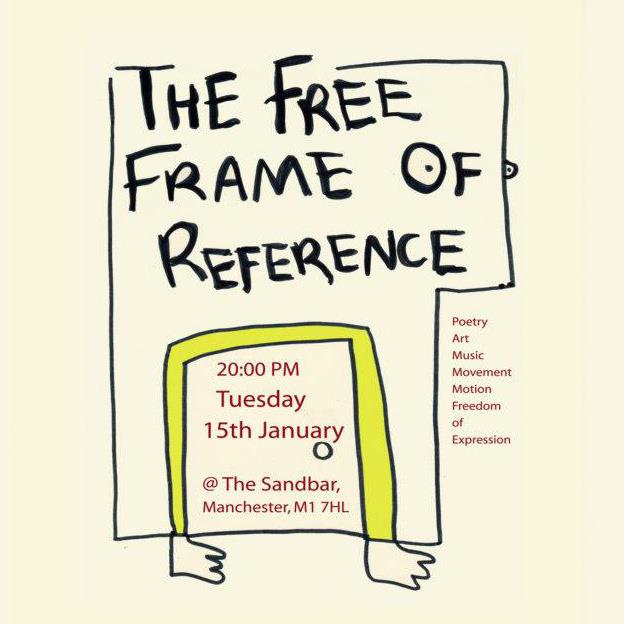
Free Frame of Reference
POLYply > 23 FELT
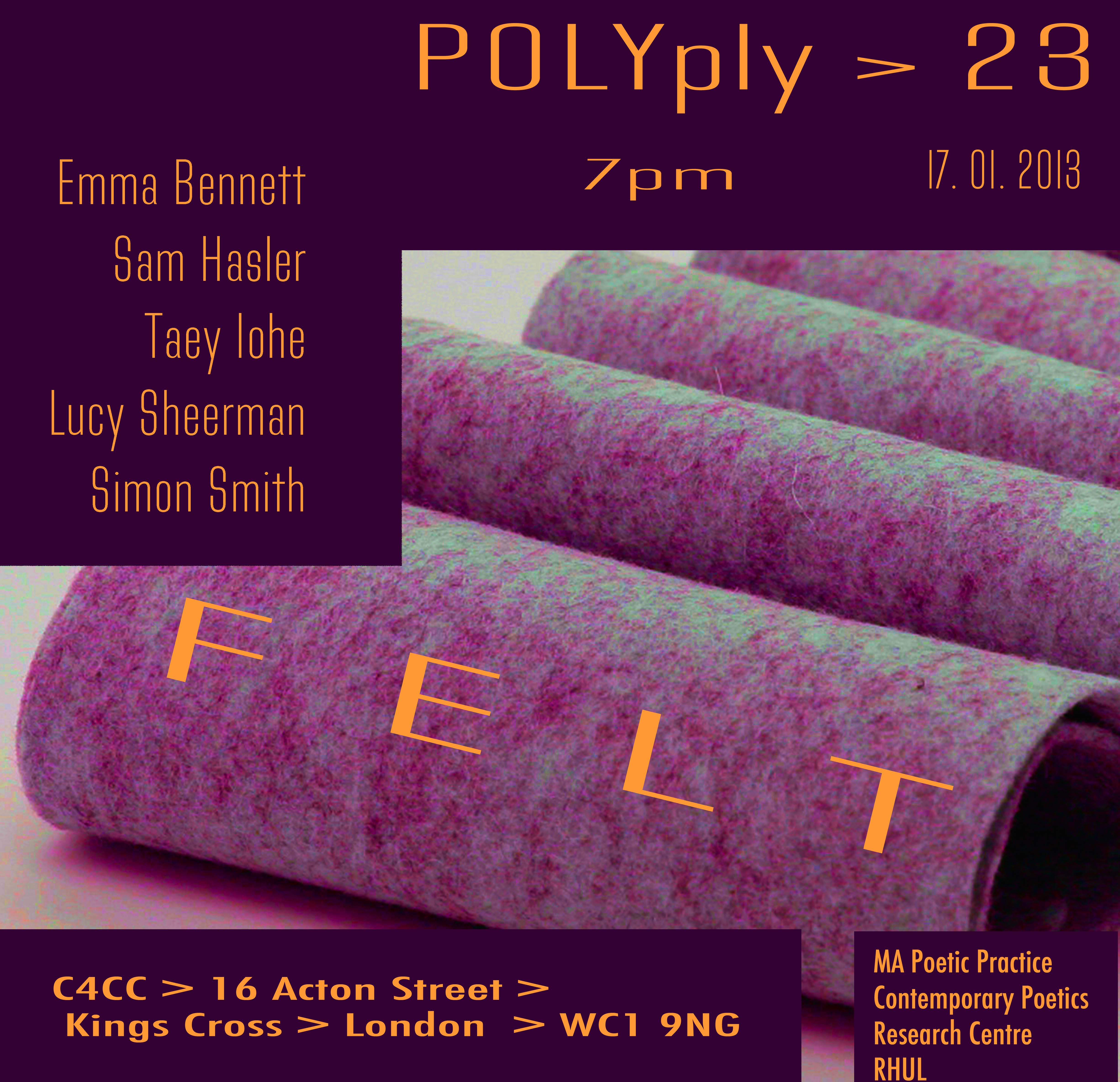
Thursday 17 January
The Centre for Creative Collaboration
16 Acton Street, London WC1X 9NGFree entry, 7pm
The Centre for Creative Collaboration
16 Acton Street, London WC1X 9NGFree entry, 7pm
Contemporary Poetics Research Centre and MA Poetic Practice, Royal Holloway
Maintenant #95 – Ivan Hristov
An instrumental figure at the core of 21st century Bulgarian poetics, Ivan Hristov’s poetics are as variable and layered as the modern history of the country itself. As an educator and organiser, Hristov has been the driving force behind the Sofia poetics festival, bringing poets from around Europe to witness and interact with a surging new generation of poets emerging from the city, and as a poet himself, his connection and fusion with English language poetry has produced a unique style and cadence within his output which has gained plaudits from across the continent and America. Another figure in European poetry who conceives of organisation as a responsibility alongside his own practise, we are pleased to introduce Ivan Hristov as the 95th respondent of the Maintenant series.
Accompanying the interview are three of Ivan’s poems, translated by Angela Rodel.
Sarah Crewe’s flick invicta reviewed by Tom Jenks
“This short book by Sarah Crewe, published by Peter Hughes’ always interesting Oystercatcher Press, poses many questions. The first is: what exactly is it? Is it a long poem, a sequence of poems or a collection of discrete pieces? Reading flick invicta, the reader is repeatedly presented with these questions and is always looking for connections, for a way of navigating the text and understanding its internal wiring. Content is constantly framed and reframed. Perhaps the most pertinent analogy is that of a Venn diagram with many circles of context, voice, syntax and style. Where these circles intersect is where the poetry happens.”
Read more. Buy a copy at the Oystercatcher site.
press free press RESPOND
A monthly series of active reading. This month:
- Sarah Crewe – ‘flick invicta’
- Philip Terry – ‘Advanced Immorality’
Online now at the press free press site.
 otherroom.org