Convolution 4

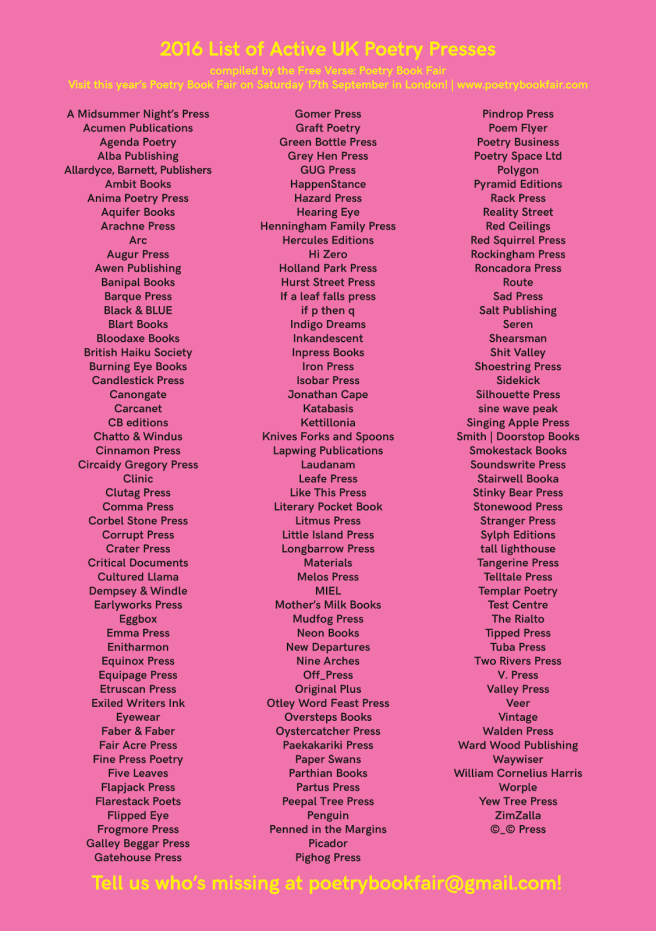
Koto y yo by Tim Atkins out now from Crater Press

new Atkins product from Crater Press!

Koto y yo documents a year in the lives of a father and daughter living in Poble Sec; a working class barrio in Barcelona. Told in luminous poetic prose, the interlinked stories – echoing the Platero y yo stories of Juan Ramon Jiminez – detail the couple’s adventures and encounters as they wander around the streets. The pages are inhabited by the plumbers, hairdressers, bakers, traveling knife grinders, mechanics, tobacconists, waiters, postmen, mangy cats, and itinerant musicians who populate the neighborhood.

£10 paperback, £15 hardback, both available at

www.craterpress.co.uk 

or

http://www.lulu.com/spotlight/craterpress
As it’s Lulu the postage is about the same wherever you are in the world, and if you use this code FWD15 when you purchase you will get 15% off (this is working today, but I’m not sure how long for as Lulu changes the codes pretty often).

Proms Extra Lates: Chrissy Williams

LONDON SW7: Proms Extra Lates: Chrissy Williams

Date: Wednesday 7 September, 2016
Time: 10:00 PM
Price: Free, but book tickets in advance.
Venue address:
Elgar Room, Royal Albert Hall, London SW7 2AP

Publicity material for this event says:

BBC Proms Extra, in association with The Poetry Society, presents a series of late-night events at the Elgar Room in the Royal Albert Hall pairing musicians with poets. Hosted by Georgia Mann, and then broadcast on BBC Radio 3.

The poet featured at this event will be Chrissy Williams.

Tickets are free, but must be booked in advance from the Royal Albert Hall website.

Contact:
info@poetrysociety.org.uk

Event website

Reading as Art

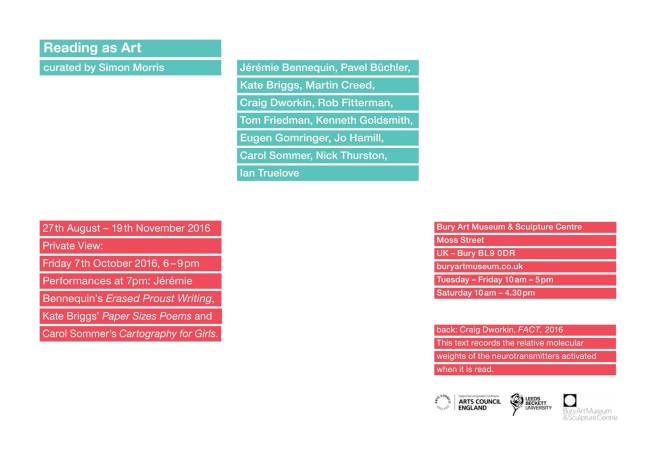
‘Reading as Art’ will be on public display from Saturday 27 August through to Saturday 19 November 2016. The works included in the exhibition find different means to foreground and to investigate the activity of reading: the forms it can take (silent reading, reading aloud, spontaneous reading, purposeful reading, and so on), the matter of reading (the book, the screen, the space of the page), the bodies that engage in it and the contexts in which it occurs. All of the works are concerned to make reading manifest in some way; in so doing, they each show – differently – how reading is its own form of making.

The image on the invitation is Fact by Craig Dworkin, 2016. The text records the relative molecular weights of the neurotransmitters activated when it is read.

Please save this date, Friday 7th October 2016 for the private view of the exhibition from 6-9pm with live performances from Jérémie Bennequin and Carol Sommer. Also, Kate Briggs’ Paper Size Poems will be performed…everyone is very welcome.

reading as art

Hugh II, The Istictiv by Clive Fencott, ebook

Other Room performer Clive Fencott has a new ebook available from Argotist

“Hugh II, The Istictiv” is an epic, multi-voice poem in the form of the libretto to a text-sound opera. It is set in a Britain that could exist as another in the multiverse: there are many resemblances as well as dissemblances to the one we variously know. This is the first publication of a work that was performed in parts in the multi-verse of the early 1980s but never …

Available as a free ebook here:

http://www.argotistonline.co.uk/HUGH%20II%20THE%20ISTICTIV.pdf

Full Argotist Ebooks catalogue here:

http://www.argotistonline.co.uk/Ebooks%20index.htm

Bill Griffiths Collected Poems reviewed by Billy Mills

When the Collected Poems Volume 3 (1992-96), the third volume in Reality Street’s vital edition of Griffith’s poetry over three decades, arrived in the post, it became evident that it would make no sense to review it in isolation. And so, what follows is a review of all three volumes, or rather a survey of Bill’s poetic career up to 1996. Griffiths is, in my view, a major poet, one of the towering figures of late 20th and early 21st century British poetry.

Read more HERE

Amodern 6: Reading the Illegible guest edited by Nick Thurston

Announcing the launch of Amodern 6: Reading the Illegible
An issue guest-edited by Nick Thurston

http://amodern.net

Amodern 6: Reading the Illegible
Nick Thurston

“Anthology of the Illegible: Poésie de Mots Inconnus, 1949, Paris,
Edités par Le Degré 41”
Johanna Drucker

“Reading the Signs: Translations: Multilingualism, and the New Regimes
of Attention.”
Michael Cronin

“On Trying: André Hodeir and the Music Essay”
John Mowitt

“Dredging the Illegible: Photogram, Phoneme, Ph…ontology”
Garrett Stewart

“Style in Quotation Marks”
Diana Hamilton

“Story the Story in It”
Kate Briggs

“Glitched in Translation: Reading Text and Code as a Play of Spaces”
Matt Applegate

“Reading the Redacted”
Stephen Voyce

“Approaching the Contemporary: On (Post-)Conceptual Writing”
Luke Skrewbowski

Currents:
“Thinking with Zoe: An Interview with Rosi Braidotti”
Heather Davis and Rosi Braidotti

Philip Terry – Quennets

Other Room reader Philip Terry has a new book out now from Carcanet HERE

In Quennets Philip Terry develops a sonnet-like form invented by the Oulipian poet Raymond Queneau. Across three sequences, the ‘quennet’ is reworked and refigured in response to three perimiter landscapes. The first sequence, ‘Elementary Estuaries’, is inspired by a series of walks along the Essex estuary, the poems’ appearance on the page suggesting the landscape’s expansive esturine vistas, its pink sail lofts and windswept gorse, beach huts and distant steeples. In the second sequence, written after a series of walks around the Berlin Wall Trail, or Mauerweg, the form changes to reflect the physical, almost bodily tension of the wall as an architectural and social obstruction. The final sequence, ‘Waterlog’, retraces the steps of W. G. Sebald through Suffolk, and here the quennet’s newely elongated shape and ragged margin evoke the region’s eroding coastline, its deserted piers and power stations, electric fences and waterlogged fields. Terry’s project is bold in scope, his poems subtle in effect, a mix of sign and song, concerete and lyric, Oulipo and psychogeography. It is a work about boundaries, political, social, and natural, and about the walk as a critical apparatus through which these fields are shown to connect.

A note on Reality Street from Ken Edwards

The two presses recognised a common interest in publishing the poetry of what I once termed the “parallel tradition”: its various formations in the UK being the British Poetry Revival (Eric Mottram’s term), the Cambridge diaspora, and what has sometimes been called “linguistically innovative” poetry – all overlapping categories. There was also a common interest in post-New American Poetry, Language Writing and related North American fields, as well as adventurous poetry in other English-speaking regions and from other languages and cultures.

Read more HERE

Iain Morrison – A Preview

Iain has a frequently collaborative practice as a writer and performer, working within live literature and live art contexts. Projects have included sung staging of texts by women Beat Generation writers, a lecture presentation and performance with classical musicians for New Media Scotland’s Syndicate series, and Subject Index a durational installation of the complete poems of Emily Dickinson developed in residency at Forest Centre+ and toured to Berlin’s SOUNDOUT! New Ways of Presenting Literature Festival in May 2014. Publishing includes poem-responses to fin de siècle Vienna included in the Kakania anthology (2015), published by Austrian Cultural Forum London and edited by S.J. Fowler and work in serial publications such as HOAX, Soanyway and Scree Magazine. In his role as Enterprise Manager at The Fruitmarket Gallery, he works within a commercial framework to grow new audiences and bring them into dialogue with the Gallery’s exhibitions programme through events and other activity.

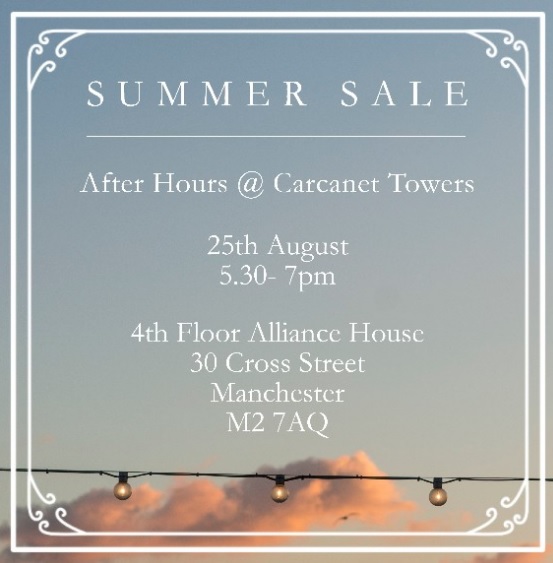
Please note that a change in circumstances means that our next event will not be at The Castle Hotel as usual, but will instead be at The Wonder Inn, 29 Shudehill, Manchester, M4 2AF. This is just a few minutes walk from The Castle. More information here.


The Start of Sentences

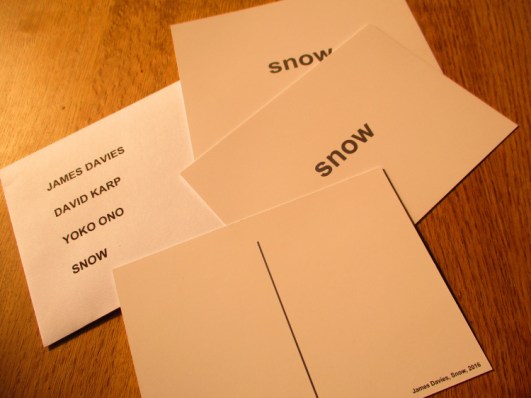
James Davies’ experiences of reading Robert Grenier’s Sentences in Bury’s Text Art Archive:

I don’t want to go into individual poems so much here as to explain the joy of reading Sentences as archived material, in the archive, and the processes of reading the poems in accordance with the way Sentences is catalogued. The copy of Sentences at Bury, “The Bury Sentences” as I now call it, is a like a “bootleg” record — just as cool as the original but with minor differences to interest the aficionado. I’ll explain why.

LINK for more.