
Some links to the work of Derek Beaulieu who reads at The Other Room 7th July with Keston Sutherland, Jeff Hilson and Nathan Thompson. Next week Keston Sutherland:
Interview
Youtube reading of How to Write
Some works
Some links to the work of Derek Beaulieu who reads at The Other Room 7th July with Keston Sutherland, Jeff Hilson and Nathan Thompson. Next week Keston Sutherland:
Interview
Youtube reading of How to Write
Some works
Some links to the work of Nathan Thompson who reads at The Other Room 7th July with Keston Sutherland, Jeff Hilson and Derek Beaulieu. Next week Derek Beaulieu:
Reviews
American Poetry With An Accent
Paul Evans, The Door of Taldir, Selected Poems
Lee Harwood
Poems
Susana Gardner reads atThe Other Room, June 2nd 2010.
Vodpod videos no longer available.
Click here to open the film in a bigger screen.
Susana Gardner interviewed for The Other Room, June 2nd 2010.
Vodpod videos no longer available.
Click here to open the film in a bigger screen.
The last reading in the Other Room series, (Susana Gardner, Peter Manson and Nicole Mauro) was easily the best that I’ve been to. I absolutely loved it. All three poets had me pretty much mesmerized for their entire set. There’s not a lot of point in me describing their performances though as they were filmed and can be viewed here on this very site. I’ve just had another quick look at the first half of Peter’s reading myself actually and am now smiling stupidly at the thought of what a brill evening was had by myself and my mate Fran (and, judging by the look of sheer joy that was on their faces, most of the other people in the room.)
Susana brought with her a little table full of exquisitely packaged poetry from her Dusie Press, on sale for a pound per item. I bought a selection, the coolest of which came in a squashed loo roll tube matching, if not beating, my collection of Matchbox poems in the funky packaging category.
I loved the Scottish and American accents of the night. I loved Peter’s fanatical flailing and precise pronunciation of lines like ‘the least dismissive of the leaf police’. I loved Nicole’s military style stance and how she seemed to smoothly slip something about a head wedged up an ass into every poem. I loved how hypnotic Susana was, especially as she repeated the word shore shore shore, turning it (for me) into sure sure sure and then back again and reminding me of Sylvia Plath, only without the woe-is-me-ishness.
The whole night was great fun with lots of naughty swear words and beer.
Jaime Birch
Things have been a little odd lately because I’ve felt quite directionless while taking a lot on. All of which means I get a little frayed. So I’m learning to relax and just accept how I feel about things, rather than trying to please other people. Which is a way of saying I might not be as generous in this review as I normally might be. So try not to take offence.
Matt Dalby’s take; for more click HERE
Yesterday was the latest reading at The Other Room, with three very good performances from Susanna Gardner, Peter Manson and Nicole Mauro. After a previous week where I was performing three times, including once in a jazz band, it was a relief to sit back and watch for a change.
Steve Waling’s comments HERE
Nicole Mauro reads at The Other Room, June 2nd 2010.
Vodpod videos no longer available.
Click here to open the film in a bigger screen.
Nicole Mauro interviewed by The Other Room, June 2nd 2010.
Vodpod videos no longer available.
Click here to open the film in a bigger screen.
Peter Manson interviewed by The Other Room, June 2nd 2010.
Vodpod videos no longer available.
Click here to open the film in a bigger screen.
Peter Manson reads at The Other Room, June 2nd 2010.
Vodpod videos no longer available.
Click here to open the film in a bigger screen.

if p then q readings & book launches
@ Odder Bar
14 Oxford Road (opposite The BBC), Manchester, UK
23rd June 2010
6.30 pm [1:30 pm Eastern Time in the US]
Free admission
Performers:
Joy as Tiresome Vandalism
Geof Huth
Tom Jenks
Lucy Harvest Clarke
Programme:
6.30: Joy as Tiresome Vandalism present Nøjagtig Pamplemousse
7.00: Geof Huth (live stream – watch at http://www.ustream.tv/channel/geof-huth)
7.45: Lucy Harvest Clarke (watch live at http://www.ustream.tv/channel/tom-jenks-lucy-harvest-clarke)
8.15: Tom Jenks: (watch live at http://www.ustream.tv/channel/tom-jenks-lucy-harvest-clarke)
If you can’t be there in person use the above URLs to watch on the internet. Please be aware that all times are approximate.
Sony believes that the ebook market has now passed the point of no return. Haber said: “I have multiple meetings with publishers and tell them paradigm shifts happen. You can say fortunately or unfortunately you haven’t had a paradigm shift in, what, hundreds of years.”
He added: “We in the consumer electronics area have a paradigm shift every year or two.”
More HERE
IF ONLY..!
Wed 9 June 8pm Free!
Bluecoat Arts Centre, School Lane, Liverpool
The LAUNCH of Liverpool’s monthly melting pot of music, performance, dance, spoken word and the otherwise unclassifiable. If Only..!’s eclectic bills are brought to you by a group of Liverpool-based artists, curators and promoters in the spirit of celebration, exploration, provocation and revelation..!
Trinity Girls Brass Band [music]
The nation’s only all female brass band in virtuoso concert
Steve Lewis [music]
Original songs created from Lewis’s signature combination of voice, unexpected texts, bric-a-brac percussion and live sampling
Robert Sheppard [spoken word]
Sheppard performs new work exploring the poetics of space and launches Looking Thru’ a Hole in the Wall, a collaborative pamphlet created with Patricia Farrell
Maria Malone and Chris Murray Cover [dance/physical theatre] A duet between a girl and her bedclothes exploring the lands where addiction and dependence can lead.
Original concept by Marcus Drummond
Choreography and performance, Maria Malone and Christopher Murray with directorial input from Yorgos Karamalegos
LIC Studio and associate artists [dance/performance/music] Some of Liverpool’s finest improvisers and performers create a multi-disciplinary performance score
MC: Mandy Romero
Links to Susana Gardner. Next week of course is The Other Room:
Poem
Blogging
Publishing
Three months ago I did a similar post on Poggioli’s early study which can be found HERE.
These notes again are mostly based on Burger’s notions but occasionally I pass comment and/or look for further examples to put in his model. There are two tables in this set of notes which are readable if you click on them.
Notes from Peter Burger, Theory of the Avant Garde
Genres are illusory although there is the study of what is called poetry/art
The audience is never passive but prejudiced
The interpreter applies his prejudice to the situation
It is inevitable that we interpret the past in terms of our own epoch
Social function of religion: religion alleviates misery but on the other hand it stops happiness
When man realised religion was illusory he redefined it as philosophy and not faith
Adorno – avant-garde art is functionless (Burger admits it has a function of leisure or to trigger discussion)
Avant-garde works only help to stabilise whatever is in place – the conditions against which it protests
“Art allows at least an imagined satisfaction of individual needs that are repressed in daily praxis.”
Individual movements should not be easily stitched together. If they are stitched together they change their function
Dada has no style, it has an ethos – is the true owner of the term historical avant-garde, attempts in this way to be outside the institution
Benjamin –reproduction in the mechanical age changes the reception of the work of art
When art takes the place of religion art generates ritual rather than existing for the ritual
WB of Dada – ‘Their poems are a ‘word salad’ containing obscenities and every imaginable waste product of language’
Art nowadays is made with profit in mind. How does poetry, the anomaly fit in?
The written word does not have a moment like painting does with photography because literature can never take a snapshot – although people have tried like say the imagists but even this is a version. Of course realist photography is a version too
Art differs from everyday life; it is magical. Therefore all arts a jumbled together as a whole. Like the vile notion poets must stick together
When art loses its functional value it gains educational value (the furtherance). But it is often light education disguised as furtherance
Model (Function, production, reception):

Thick line = major break
Thin line = minor break
In courtly art the artist becomes aware of his uniqueness
“The citizen who, in everyday life has been reduced to a partial function (means-ends activity) can be discovered in art as ‘human being’”
The institution has defined art as things which are in the institution – this happens because of a sociological rather than an aesthetic reason. Similar ideas in Return of the Real, Foster.
For Burger the true avant-garde artist wants to break with the system. This is often difficult for a modern day artist after Duchamp, as when he broke the system the art then became the system – think also L.H.O.O.Q. key-rings at The Tate.
The culture industry has brought about the false elimination of the distance between art and life
Any argument that a readymade negates the notion of the art work being produced by the individual is unfounded as it is his idea and ideas are now what art is
Tzara and Breton give instructions on how to make art. This is an attack on the notion of an individual making art – i.e. the artist is simply a worker when making a cut up poem from an arbitrary newspaper
“Today the only works which really count are those which are no longer works at all.” – Adorno
But lots of the bourgeoisie favour Jack Vettriano, photo of a dog with a speech bubble going woof, etc. How is this art given back to us from the institution?
The Flarfists treat their action as the first time in poetry rather than as the umpteenth hackneyed time in art. The problem of splitting disciplines in art: in terms of intention and manufacture
Much conceptual art (including poetry) does not give enough attention to form
The famous Flarf story that Sullivan tells of a vanity publisher accepting his Google mumbo-jumbo.
This is a peculiar notion. The vanity press, the same as the institution, does not take experimental unless there is to be money to be made in it.
Anti-tradition became tradition. So did it not win then? It did not as Fountain is now treated as part of our leisure and separate from our life praxis
The argument that arts and crafts, and cookery and gardening is art, as it is the people’s truly
“The neo avant-garde institutionalizes the avant-garde as art and thus negates genuinely avant-garde intentions.”
To remain in silence?
Things always become new but what is meant by new by the avant-garde is total newness – a radical shift.
Adorno belives that the artist’s drive to be new is analogous to the consumption of new goods by buyers in capitalist governments
Warhol and the abstract expressionists accept this and is not therefore avant garde
Just as consumption has need of fads so too does art need them. There are perhaps today many more movements and they become replaced as king movement at a quicker rate of transition – think of the coming and going of minimalism but did it really go? Was it exhausted aesthetically?
Are there ‘more’ movements because of globalisation and media coverage?
The results of some Dada works is that they are free of ideology. Say for example chance pieces but the alleatory action is not free of ideology; in fact it is heavily conceptual
For Burger Cubism isn’t anti-tradition (therefore is not the avant-garde) as it does not represent a true shift. i.e. we can all read the painting (a collective, sociable experience; see model)
In non-avant-garde works the whole needs its parts and the parts needs its whole. This is not the case in avant-garde works – think about the Jason Rhoades large detritus sculptures/installations
For the avant-garde, process and outcome are more important than content
“This refusal to provide meaning is experienced as shock by the recipient.”
Avant-garde hopes that the:
Refusal to give meaning = recipient is shocked = recipient reconsiders their life praxis / realises life praxis is separate from art
BUT
The shock is generally non-specifically directed and therefore the recipients respond with blind fury, do not know how to read the work and therefore do not change their life praxis or even consider it as separate from life
Is a solution to direct the shock? Not to tell the audience the meaning but to tell them it is OK to have an individual reading and that one can be part of a collective within individual readings – think presentation of The Other Room, if p then q
I remember reading somewhere about someone getting a Salt catalogue through their door and disliking the way it was marketed, saying it was pointless to package Alan Halsey in a glitzy way. The reason being that since Halsey’s current audience are above such marketing techniques and there is therefore no need to market the book in a glitzy way. The answer is simple they are trying to create an audience and not shock people so much so that the audience doesn’t consider the prospect of approaching the work. We must remember the Salt list is very strange now with their publications over the last two years
Burger’s book essentially ignores Futurism – both Russian and Italian. Is this because Futurism never became institutionalised as did Dada and surrealism; it simply died
The institution is happy to play Duchamp’s games as he signals that all is to be consumed and sold and therefore the institution can sell what it wants – everything
The avant-garde destroyed the notion of aesthetic hierarchy. This can often be misread as the need to consider everything
Brecht attempted to change the institution from within
Is this what innovative poetry attempted but instead weakly became part of a sub-culture of tradition in the universities and then shut shop in terms of its responsibility to tell people about the distinction of life art praxis; letting slam and story-telling (prose written in stanzas) to remain the institution in terms of festivals and media coverage?
The Other Room attempts to change the system from within, slow as that may be and with the little power it has
Is the internet an institution of sorts?
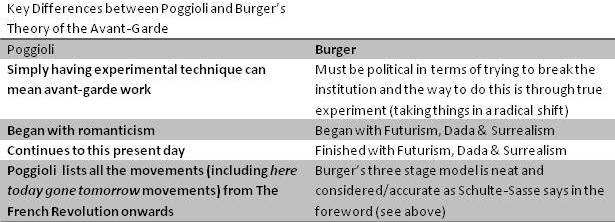
Key Differences between Poggioli and Burger’s Theory of the Avant-Garde:
Comments:
Both reach a theory of types of significant change and characteristics of a certain type of grouping. They could be labelled with different terms than avant-garde perhaps
Burger lays claim to being correct with the proof coming as his is a hermeneutical study whereas Poggioli’s theory is based on general knowledge and vague definitions
Description: Studio 20Ten are a group of 2nd Year Fine Art students from the University of Bolton. The group of students are of mixed age range and varied backgrounds.They combine to form an exciting mix of styles and approaches in their work. Work on show will include drawing, painting, printmaking and photography. Entrance is free and there will be work available to buy.
‘Splash’ is the group’s end of year external exhibition. The exhibition will be held at Victoria Baths on Hathersage Road in Manchester. and this interesting and unique venue should provide a fantastic backdrop to the exhibition.
Exhibition times are as follows:
Friday 21 May 6 – 8pm Exhibition Private View
Saturday 22 May 12 – 4pm
Sunday 23 May 12 – 4pm
Victoria Baths, Manchester
Victoria Baths, Hathersage Road, Chorlton-on-Medlock, Manchester, M13 0FE.
Links to Nicole Mauro. Next week Susana Gardner:
Poems
Reviews of others
Twittering
Interview
The culmination of work from our Voiceworks project, a six-month collaboration between poets via Birkbeck Poetics Centre and composers and singers from Guildhall School of Music & Drama, is taking place at 6pm at Wigmore Hall on Thursday 20 May, free to attend and also live streamed for the first time on the internet. Full details of this and the upcoming new website voiceworks.org.uk which is launched at the same time is at: LINK
Voiceworks 2010 participants are:
Francisco Coll Garcia, Albert Pellicer, Iria Perestrelo
Antonia Barnett-McIntosh, Emma Bennett, Adam Crockatt
David Moore, Ben Gwalchmai, Luke Tracey
Raymond Yiu, Kim Patrick, Luis Gomes, Clément Dionet
Patrick Brennan, James Wilkes, Robert Elibay-Hartog
Nick Scott, Frances Kruk, Lucy Hall
Matthew Mendez, Holly Pester, Victor Sicard
Come along in person or virtually. It lasts 45 minutes.
Via Carol Watts
May 18th, 7.30 @ The Lamb 94 Lamb’s Conduit Street, London WC1, The Blue Bus with Lucy Harvest Clarke, Nat Raha and Anna Ticehurst
Links below. Next week Nicole Mauro:
Sound
Text
Resources
 otherroom.org