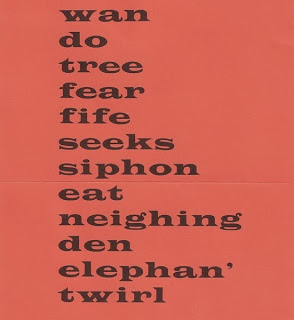
NAPE: Nathan Walker

Commissioned by Performance Space as part of ‘In Conversation’, a 6 month digital residency and performance event. The digital residency blog documented processes and methodologies leading to the presentation of NAPE: 

“Following a score of pre-recorded spoken text, the work superimposes the private performance of reading into the public performance of writing. I developed a system of writing as a score structure for the performance that installs materials as performance actions and tasks. Alongside this work I also developed a digital writing programme that infinitely generates performance texts in relation to the performance.”

Nathan Walker will perform at The Other Room in April 2014.  More about NAPE here.
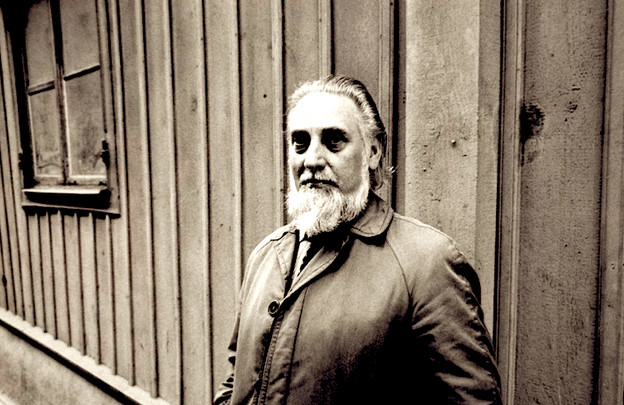
Enemies: Slovakian poetry

Videos from the recent Slovakian poetry event at the Rich Mix arts centre are now online:
Sarah Hesketh (&Cristina Viti) https://www.youtube.com/watch?v=gpLyGuU2kic
Mark Waldron & Martin Solotruk https://www.youtube.com/watch?v=84klLN9kNXc
Peter Milcak & Stephen Watts https://www.youtube.com/watch?v=ZhCVTxaNEPo

The Incredible Sestina Anthology

The first anthology of the poetic form of sestina. Here, 100 writers—from John Ashbery to David Lehman to Matt Madden and Patricia Smith—offer their sestinas. A 39-line poetic form, the sestina is the one form all poets agree can exist in a free-verse world, as formalists and avant-gardes love sestinas for their ornate, maddeningly complicated rules of word repetition.

More HERE

Videos back in the archive

A small part of our video archive, including readings and videos, hosted by MySpace has been down for a while. We’ve a couple more to sort out but meanwhile here are these videos back in action to be watched for the first time or again. Bon Appetit.

Nick Thurston December 2009

[vimeo https://vimeo.com/78619129 w=250&h=216]

Nick Thurston interview 2009

[vimeo https://vimeo.com/77545012 w=250&h=216]

Sophie Robsinon December 2009

[vimeo https://vimeo.com/78679878 w=250&h=216]

Sophie Robinson interview 2009

[vimeo https://vimeo.com/77545011 w=250&h=216]

Stuart Calton October 2009 at Oxjam

[vimeo https://vimeo.com/78618997 w=250&h=216]

Michael Haslam October 2009

[vimeo https://vimeo.com/78618999 w=250&h=216]

Typewriter – an artist book for writing

Written using ‘Q’ by mIEKAL aND, ‘W’ by Alice Simpson, ‘E’ by E – Ambassadeur d’Utopia, Ana Buigues, ‘R’ by Carl Baker, Julie Shaw Lutts, ‘T’ by Maria Pisano, Janelle Scolaro, ‘Y’ by Halvard Johnson, ‘U’ by Maria Pisano, ‘I’ by INTERLICHTSPIELHAUS, ‘O’ by Ana Buigues, ‘P’ by Dennis Ruud, Peter Bushell, ‘A’ by Margaret Lammerts, Ama Bolton, Leonard Seastone, Avril Makula, ‘S’ by Dennis Ruud, Maria Pisano, ‘D’ by Erin K. Schmidt, ‘F’ by Ana Buigues, ‘G’ by Peter Ciccariello, ‘H’ by Ana Buigues, ‘J’ by Ana Buigues, ‘K’ by Katerina Nikoltsou (MomKat), ‘L’ by Ethan Walker, ‘Z’ by Ama Bolton, ‘X’ by Bill Dimichele, Andrew Topel, Emily J. Martin, ‘C’ by Marilyn R. Rosenberg, ‘V’ by Nick Mattan, Ana Buigues, ‘B’ by Jim Andrews, ‘N’ by Bjørn Magnhildøen, ‘M’ by Jeff Harrison.

More here.

Archive of the Now

The Archive of the Now is a digital and print collection of poetry by over 140 poets, mostly based in the UK.

Inspired by resources such as UBUWeb and PennSound, we hope to represent the true diversity of poetic practice in the UK. We are dedicated to supporting emerging authors, providing a new distribution network for challenging poetry, and opening up opportunities for collaboration and exchange.

The Archive focuses on audio recordings of experimental and innovative poets performing for live audiences and in studio settings. Many of the recordings were made in the poet’s home using portable digital recording equipment. While the quality and sound-proofing may vary, each recording gives a unique insight into the sounding of this challenging and inspiring body of work.

New recordings are being added all the time. We have a substantial list of poets we hope to record in the next two years, but we welcome suggestions of other poets working within the experimental tradition in (or with ties to) the UK.

In addition to sound recordings, the Archive provides information on individual poets, with links to their publishers, online projects and other material. The print archive includes small press publications, chapbooks, little magazines, manuscripts and correspondence. The archives of the late British poet Bill Griffiths form a major part of this collection.

New additions and a re-designed website, here.

AMODERN 2: NETWORK ARCHAEOLOGY

Networks have structured our social – and media – development long before the emergence of the “network society.” From the letter-writing networks of the proto-Italian aristocracy to the electrical networks that facilitated industrialization; from the spread of woodcuts, pamphlets, and ballads that supported the Protestant Reformation to the twentieth century emergence of broadcast radio and television networks, media have always been situated in the matrices of networks of circulation and distribution, facilitating historically specific modes of connection. These histories often remain disconnected from research on digital networks, the latest to re-shape our socio-technical environment into a mesh of interconnecting nodes. An archaeological approach, one that routes between contemporary and historical networks, Alan Liu argues, has the potential to regenerate a sense of history that would temper the presentism of digital culture, all too often experienced as instantaneous and simultaneous.

This special issue of Amodern features original research, initially presented in 2012 at the “Network Archaeology” conference at Miami University of Ohio, on the histories of networks, the discrete connections that they articulate, and the circulatory forms of data, information, and socio-cultural resources that they enable. Drawing from the field of media archaeology, we conceptualize network archaeology as a call to investigate networks past and present – using current networks to catalyze new directions for historical inquiry and drawing upon historical cases to inform our understanding of today’s networked culture. In this introduction, we elaborate how network archaeology opens up promising areas for critical investigation, new objects of study, and prospective sites for collaboration within the productively discordant approach of media archaeology.

http://amodern.net/

The British Onion Marketing Board

In a secondment funded by the European Union, Chris McCabe and Tom Jenks have been charged with overhauling the site of the British Onion Marketing Board, with the aim of raising its public profile and introducing the British onion into public discourse. Selections from their work will be presented at the Camaradefest in London on 25th October, where both parties will be on hand to answer questions and make recipe suggestions.

Endless / Nameless ~ Rachel Sills & Richard Barrett

The gingerbread silhouette of my father
Is absent today I’m perspiring
Or you could say shimmering over a coastline
In a row pegged-out, colour coded
Three weeks’ worth of hearts
A Freudian couch with sponge cake perhaps?
An arrow, a narrowboat, arrowroot blot
A stair-lift stops, temperamentally
I decline to use the honesty box
But am generous for life-guards
On a good day, only on a good day
A magazine before dinner before, later, the paper
The evening smell of tobacco
‘Papa?’  I hear; to which I answer ‘yes, Nicole?’

More at The Red Ceilings.

The Figment Project

To honour the anniversary of Warhol’s birthday, August 6, 2013 The Andy Warhol Museum and EarthCam launched a collaborative project titled Figment, a live feed of Warhol’s gravesite. This live feed, viewable 24 hours a day, seven days a week worldwide is available here.

Being Dumb – Kenneth Goldsmith

“I am a dumb writer, perhaps one of the dumbest that’s ever lived. Whenever I have an idea, I question myself whether it is sufficiently dumb. I ask myself, is it possible that this, in any way, could be considered smart? If the answer is no, I proceed. I don’t write anything new or original. I copy pre-existing texts and move information from one place to another. A child could do what I do, but wouldn’t dare to for fear of being called stupid.”

More at The Awl.