What Do You Want From the Art World?

What Do You Want From the Art World? 

A new artists book by Andy Parsons & Glenn Holman

Glenn Holman and Andy Parsons of Floating World were commissioned by Visual Artists Ireland to create an artists book as part of their 20:20 vision initiative looking into the future of the visual arts in Ireland.

Through a series of workshops held on Friday 15th May 2015, during Get Together at the Irish Museum of Modern Art, artists were interviewed about what they want from the art world and their visual and verbal opinions and comments transcribed as accurately as possible in ‘real time’ as images, texts, collages and general observations. The robot is a deliberately obvious reference to the future, but it served the more useful purpose of creating a neutral place for artists to place their ideas. The comedic element helped to elicit more frank and open contributions. We thought of it something akin to Golem, a hard to define entity that will nonetheless work tirelessly for it’s creators. This art work is a compendium of peoples response to the question:


What Do You Want From the Art World?

In a first for Floating World this book is available solely as A PDF for free distribution. We hope that it entertains and contributes to the ongoing dialogue.

 Floating World are Andy Parsons & Glenn Holman with assistance on this project and with huge thanks to Glenn Gannon.
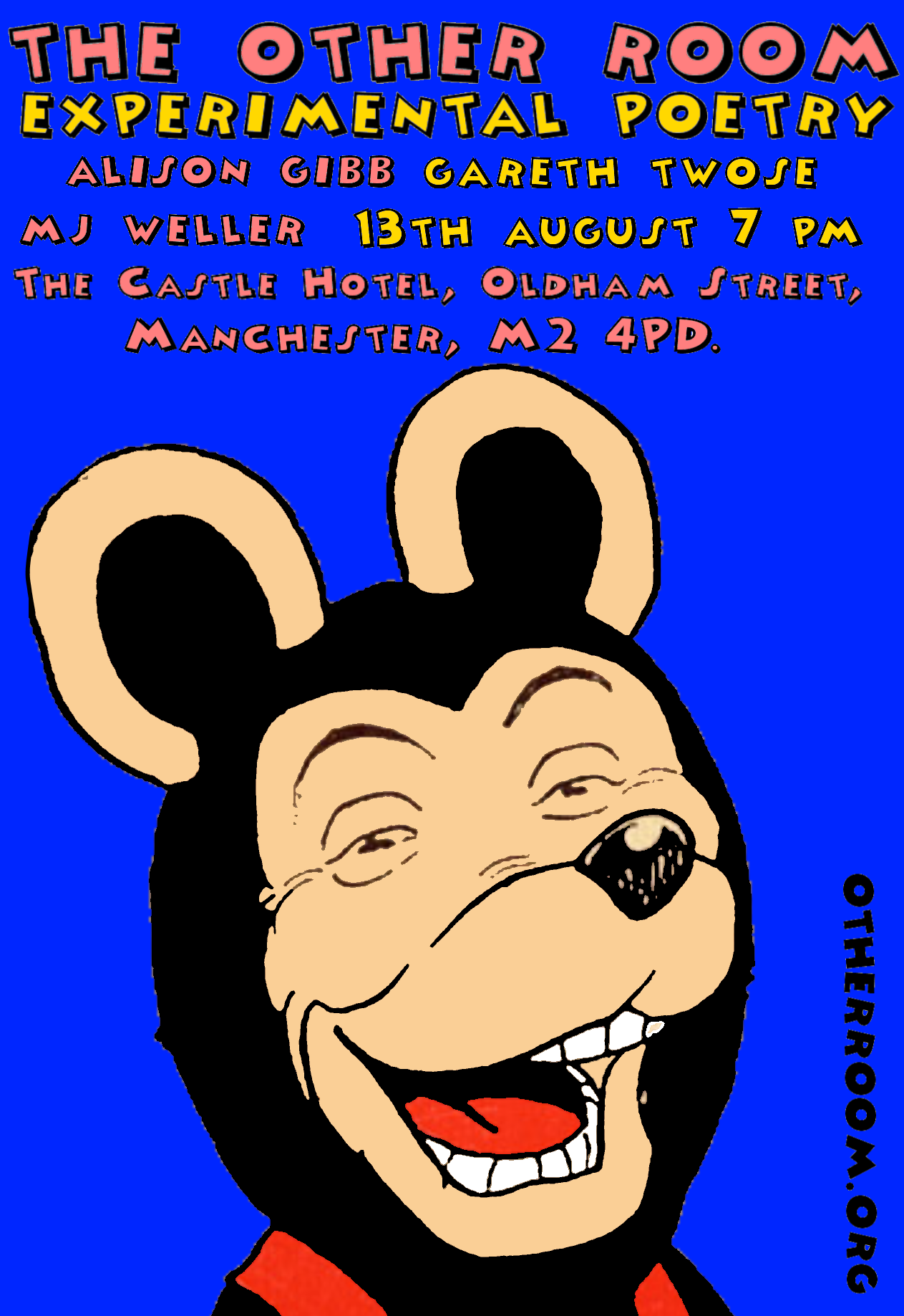
LINK to webpage LINK to book

Kenneth Goldsmith’s: The Body of Michael Brown

Conceptual poet Kenneth Goldsmith’s attempt to reframe the Michael Brown autopsy report as poetry has caused an outcry on social media. The work, he said was “in the tradition” of his previous book Seven American Deaths and Disasters. “I took a publicly available document from an American tragedy that was witnessed first-hand (in this case by the doctor performing the autopsy) and simply read it. Like Seven American Deaths and Disasters, I did not editorialize; I simply read it without commentary or additional editorializing,” he wrote. “The document I read from is powerful. My reading of it was powerful. How could it be otherwise? Such is my long-standing practice of conceptual writing: like Seven American Deaths and Disasters, the document speaks for itself in ways that an interpretation cannot. It is a horrific American document, but then again it was a horrific American death.” More here.

WFN dates

The next WFN workshop meetings are February 22nd, March 8th and April 26th, in the function room of the Terrace Bar, Edge Street, Northern Quarter, Manchester, 2 – 4 PM.

Bring a poem you like by someone else & and one of your own.

Charmless and Interesting: What Conceptual Poetry Lacks and What It’s Got

“This is a moment, then, for an assessment of the virtues and vices of conceptual poetry.  What does conceptual poetry lack, compared to other poetries, and what does it have to offer?  Any brief answer will, of course, be too general, but we can begin to sketch things out with reference to two aesthetic categories: the charming and the interesting.  Whatever else conceptualism has got going for it, it lacks—at least in its pure form—the former.  And whether one likes conceptualism or not, anyone who has engaged with it has found that it has, wonderfully or frustratingly, got plenty of the latter.”

More by Robert Archambeau at Harriet.

Steven Waling: On Conceptualism and stuff

“I’m not, I’ll freely admit, the world’s biggest fan of conceptual poetry; but I’ve recently been rather amused by the hoo-ha about in American literary magazines and blogs of late. It’s accused of being all concept and no affect: all head and no heart if you like. Which strikes me as odd because those poets conceptual poets I do like, Caroline Bergvall and Christian Bok, don’t strike me that way at all. I haven’t read much of Kenneth Goldsmith either, but he strikes me as a profoundly comic writer as much as he’s anything else.” More from Steven Waling at BrandosHat.

Being Dumb – Kenneth Goldsmith

“I am a dumb writer, perhaps one of the dumbest that’s ever lived. Whenever I have an idea, I question myself whether it is sufficiently dumb. I ask myself, is it possible that this, in any way, could be considered smart? If the answer is no, I proceed. I don’t write anything new or original. I copy pre-existing texts and move information from one place to another. A child could do what I do, but wouldn’t dare to for fear of being called stupid.”

More at The Awl.

Artist plans to print out the entire Internet

“One man has declared his ambitious plan to print out the entire Internet and in true ‘social’ fashion wants the public to help him with his impossible feat.

Avant-garde technology artist Kenneth Goldsmith has 500 square meters of space in Mexico City to fill with ceilings six meters high and has given himself a deadline of July 26th to have the entire Internet printed off and under one roof.”

More here.

The Gray Area: An Open Letter to Marjorie Perloff

“…if we take Conceptualism and Conservatism as two poles in our current poetry culture, as you are proposing, then the curious thing is that the most extreme examples at either pole converge in one very important way: in the purported transparency of their language. Both subordinate the materiality of language to other aims: for the Conservator, the goal is emotional identification achieved through either narrative, or the semblance of epiphany, or what have you, and for the Conceptualist, the goal is revelation of the framework which governs the text. ” Matvei Yankelevich responds to Marjorie Perloff at the Los Angeles Review of Books.

The death of conceptualism?

“Conceptualism is probably over now, even in its newest iterations. The generative energy has gone out of procedural work and gestures of appropriation, retranslation, transcribing, and other methods of production that take an idea as a point of departure and carry out its terms to whatever affectless effect can be realized.” Johanna Drucker.

“Johanna Drucker has suggested that Conceptual Literature has begun to enter the twilight of its eminence, on the verge of becoming yet another one of the exhausted movements in the history of the avant-garde. While I am happy to see Conceptual Literature discussed within the context of its historical precedents (even if only to suggest that such writing has merely rehashed the techniques of its more noteworthy precursors), I feel that Drucker might be underemphasizing the degree to which her own observations about the “death” of Conceptual Literature might be recycling historical complaints, no less “unoriginal,” no less “uncreative,” in their obituaries, which declare the death of a genre, long before its generative potentials have been fully explored or fully absorbed….” Christian Bök.

PS putsch

Is there anything so vicious as a fight in the literary world? The Poetry Society has just lost its director Judith Palmer, who resigned after what has been termed “an internal coup”, and the financial officer Paul Ranford has also departed, leaving no one to sign the cheques.According to sources, it is because Fiona Sampson, editor of the Poetry Review, the magazine overseen by the Society, had asked for autonomy from the director, and has been pushing the focus of the society from education to promoting high-profile poets. Sampson has also persuaded some members of the board, including Alan Jenkins, to back her. Palmer reluctantly handed in her resignation two week ago, with Ranford following shortly afterwards. The Poetry Society was founded in 1909 by Lady Margaret Sackville and the magazine has counted Dame Muriel Spark and Sir  Andrew Motion among  its editors. It also runs the Poetry Café in Covent Garden and the National Poetry competition (winners have included Helen Dunmore and Ruth Padel). There have been howls of protests from members who suggest that promoting well-known poets departs from the Poetry Society’s stated mission “to advance public education in the study, enjoyment and use of poetry”. The society gets around £260,000 from Arts Council England, due to rise to £360,000 next year, for “the welfare of poets and poetry”. The Poetry Society confirmed that both Palmer and Ranford have left, but would not comment further. “There is likely to be an extraordinary general meeting of members to try to resolve issues,” says one member, who declines to be named. “Many of us feel a necessary step would be the resignation of the board and the editor who prompted much of this dire situation.”

From the London Evening Standard

“Bibliocidal Tendencies”: British Publisher Information as Material Tears Into Literature for Art’s Sake

“Conceptual writing is a fusion of art and literature. This process-based practice involves works where the idea is the writing and the writing is the idea. It is a non-expressive poetry, a poetry of intellect rather than emotion. Non-conceptual writing involves old-fashioned ‘creative’ prose and there’s more than enough of that material in the world already. Conceptual writing appreciates the wealth of text in the world — from the highfalutin to the everyday — understanding that new meaning can be generated through re-framing extant material. Conceptual writing produces a critical relation to non-conceptual writing, and in so doing opens a space of possibility for new forms of readership. We write through the work of others, comfortable in the knowledge that all writing draws on a host of influences. As James Joyce famously remarked: “I am quite content to go down to posterity as a scissors and paste man for that seems to me a harsh but not unjust description.” In conceptual writing the references are explicit rather than implicit.”

More here.

Unoriginality

“The irony is that The Guardian reading chattering classes – the left-liberals whose tender sensibilities determine the mainstream poetry scene – would rather die than be seen as insular or parochial. But any claims to be “progressive” are certainly laughable when assessed through their literature.”

Link