
“The Other Room has come to an end. Ten years of remarkable events that have led the way in a resurgence of decidedly contemporary forward thinking poetry in the North West have wrapped themselves up as of April 2018.” SJ Fowler’s thoughts on The Other Room, here. This video is of an interview Steve did with us in 2011.

Bloomsday launch of Dedalus, a new novel by Chris McCabe, published by Hennigham Family Press. FREE entry. 5pm – 7pm. Saturday 16th June 2018. Lock-keeper’s Cottage Graduate Centre (nr. Mile End Lock), Queen Mary University of London, London
E1 4PD. Nearest Tube Mile End. More details, including how to pre-order the book, here.
The 10th edition of our annual anthology is now available to buy, featuring Joanne Ashcroft, Alan Baker, Thomas A Clark, James Davies, Erkembode, Patricia Farrell, Allen Fisher, SJ Fowler, Calum Gardner, Edmund Hardy, Jeff Hilson, Tom Jenks & Catherine Vidler, Juxtavoices, Sharon Kivland, Jazmine Linklater, Stephen Mooney, Camilla Nelson, Eiríkur Örn Norðdahl, Pascal O’Loughlin, William Rowe, Robert Sheppard, Ásta Fanney Sigurðardóttir, Vicky Sparrow, David Steans, Scott Thurston and Matthew Welton. Click here to buy.
Latest issue of the superb online magazine featuring poetry and reviews:
Now available online or in print featuring INTERIOR MINISTRY, LOUIS ARMAND, RICHARD MAKIN, DARYA KULBASHNA, RAREŞ GROZEA, VÍT BOHAL, DAVID VICHNAR, MARK DIVO, TATIANA LEBEDEVA, ELIZAVETA ARKHIPOVA, VADIM ERENT, MS MEKIBES, DMITRII SOBOLEV, GEORGIE CHEERS-ASLANIAN, GERMÁN SIERRA, VINCENT DACHY, ANDREW HODGSON, THOR GARCIA, JEROEN NIEUWLAND, VANESSA PLACE, STEWART HOME, ALAN SONDHEIM, MARK AMERIKA, NICOLA MASCIANDARO, DEREK SAYER, OLGA STEHLÍKOVÁ, MICHEL DELVILLE, KAREL PIORECKÝ, DOMINQUE HECQ, SIMONE DE BOURGEOIS, CHARLES BERNSTEIN, PIERRE JORIS, JOSEF STRAKA, ALI ALIZADEH, PHIL SHOENFELT, STEPHANIE GRAY, JAROMÍR TYPLT, FEMEN
Peter Jaeger’s stunning new book, Midamble, is out priced at the snip of £12.

420 pp
£12.00
LINK to purchase and sample pages
About the book
Midamble is a long poem that concerns Peter Jaeger’s interest in walking practice; in particular his travels on a variety of pilgrimage routes. A prose poem, it comprises two bands of text: the top level is a list of walking experiences whilst the bottom re-appropriates materials from comparative religion texts. Midamble is a poem that is clearer than crystal, and possesses a musical quality that is comparable to seminal and contemporary minimalist music.
The poem also has a life in durational performance. When read live Midamble demonstrates its consistency as well as its diversity. In such performances listeners are invited into a collective experience in which they can engage with ideas for as little as a moment or as long as several hours. Indeed, perhaps its most enduring feature is its quality of having no fixed entry or exit point.
About the author
Peter Jaeger is a Canadian poet, literary critic and text-based artist now living in the UK. His recent publications include John Cage and Buddhist Ecopoetics (Bloomsbury 2013) and 5404 (University of London Veer Press 2014). He has also published A Field Guide to Lost Things with if p then q. Jaeger is Professor of Poetics at Roehampton University in London.
Poetry Reading with Emily Critchley, Colin Herd, Jeff Hilson and Tim Atkins.
Tuesday 15 May 2018 6:00 PM
More here – https://www.facebook.com/events/1927703923938972/
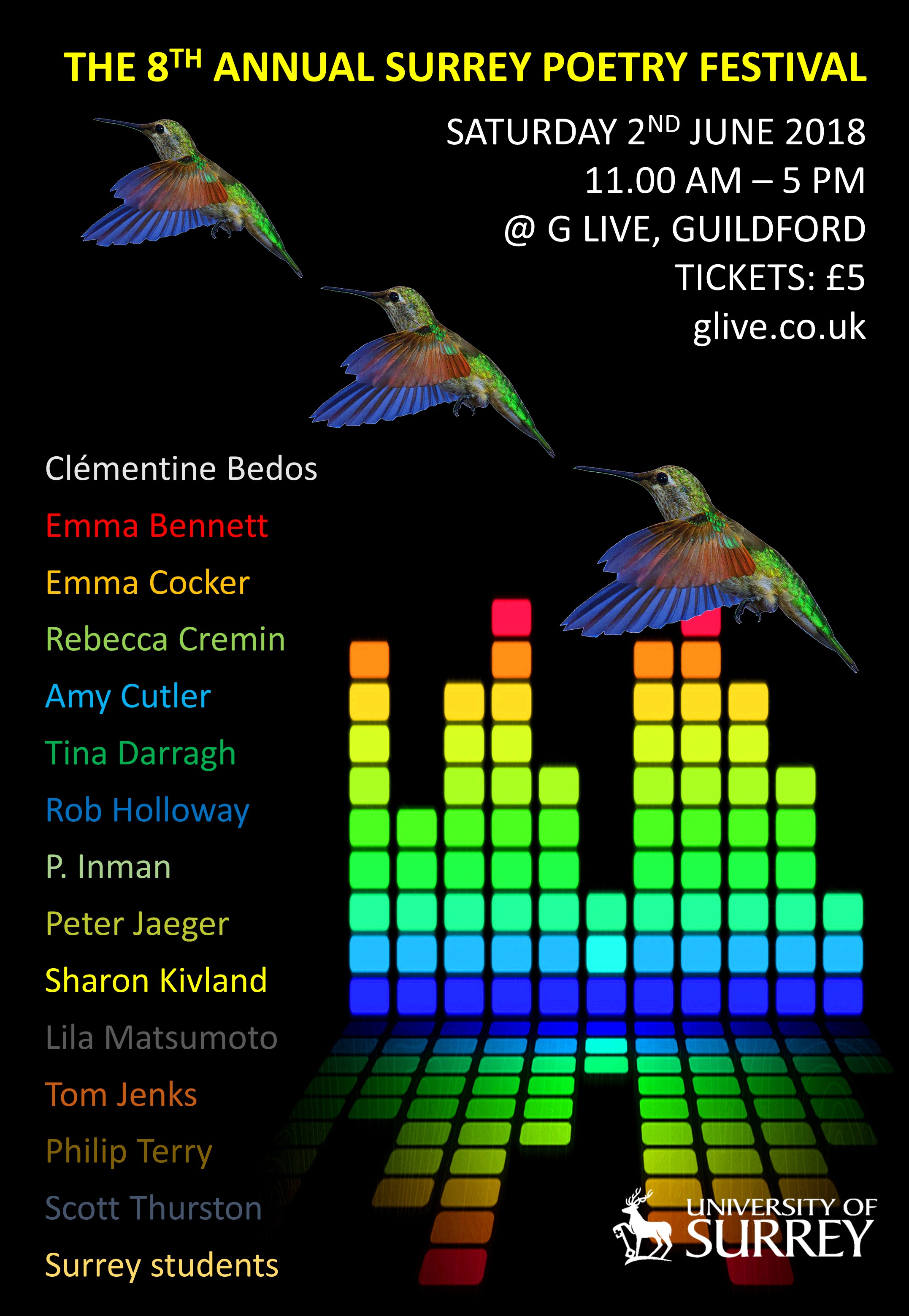
Full line-up now confirmed…
Clémentine Bedos is a multidisciplinary artist whose recent shows include a solo exhibition at the Constance Howard Gallery, London ‘Contagious Hystories’. Currently exploring themes of identity, binaries and the Other. https://www.clementinebedos.com/
Emma Bennett’s recent performances include durational piano pieces, an exploration of pining for soft things, and interpreting the words of birdsong. https://emmabennettperformance.wordpress.com/
Emma Cocker is a writer-artist whose work explores the slippage between writing on page, to performance in time, between still and moving image, between individual and collective action. http://not-yet-there.blogspot.co.uk/
Rebecca Cremin draws on traditions of live art, Fluxus, performance writing and site-specific work using language as an object to expose, to investigate, to locate. http://www.veerbooks.com/Rebecca-Cremin-LAY-D
Amy Cutler is a multi-disciplinary practitioner with a special interest in geohumanities – the engagement between geography and arts/humanities. https://amycutler.net/
Tina Darragh is one of the original members of the Language group of poets. Her work explores class, race and ecology. https://en.wikipedia.org/wiki/Tina_Darragh
Rob Holloway is currently exploring sonnets and prose poems, and has been a DJ on Resonance FM. https://vimeo.com/9383523
P. Inman is associated with language and minimalist poetry. His work has been described as ‘thick with meanings that never quite complete themselves; full of social ironies and a sly and biting humor’ http://writing.upenn.edu/epc/authors/inman/
Peter Jaeger will perform a durational version of his latest book Midamble, on the lawn at G Live. The book concerns his recently completed walk on the Camino de Santiago de Compostela. https://www.youtube.com/watch?v=jG1EUZusDTY
Sharon Kivland is an artist who has recently been called a poet, five times, to her surprise. Her work considers what is put at stake by art, politics, and psychoanalysis. http://www.sharonkivland.com/
Lila Matsumoto’s poetry explores dailyness through allegory and literalness. http://www.shearsman.com/browse-poetry-books-by-author-Lila-Matsumoto
Tom Jenks is often verbivocovisual and always hilarious. https://www.zshboo.org/
Philip Terry uses Oulipian methods and translation to examine the crimes of bureaucracy and management. http://www.carcanet.co.uk/cgi-bin/indexer?product=9781847772206
Scott Thurston’s current work responds to ongoing encounters with various dance and movement practices including Five Rhythms, Movement Medicine and Open Floor work. http://writing.upenn.edu/pennsound/x/Thurston.php
Students from The University of Surrey have been exploring a range of poetic strategies during the workshop series Making Things Happen including the use of diaries, minimalism, Oulipo and collaboration.
Tickets go on sale April 4th – available from G-Live.
Running order TBC.
There will be a wine and cheese reception at 5pm.
An evening soiree takes place at 6.30, with the Poetry Festival joining The New Writer’s Festival (also taking place at G Live) and features a variety of readers including Tom Jenks.

Paul Buck, Library. A Suitable Case for Treatment
LIBRARY contains four essays and two interviews, with the pre-dominant concern of sexual questions: the subjects in art, film, and literature—the issues tied to Rivette’s La Belle Noiseuse, Madonna’s sexual assault in Dangerous Game, Clunie Reid’s use of language, Richard Prince’s obsession with books, and Paul Mayersberg’s articulation about sex.
Riccardo Boglione, It is Foul Weather in Us All
Riccardo Boglione sent copies of Shakespeare’s The Tempest to twelve artists living in Europe and America, each copy in the language of the country of residence of the artists, asking them to leave the book outside to the weather for as long as they wanted. The pages from those mistreated volumes reconstruct a Frankensteinian version of the play. In an extension of the metaphor of the tempest, the author gathers a small collection of injured volumes, mimicking Prospero’s book. Simultaneously he produces a version of Shakespeare’s play that shakes notions of authority (who is the real author? The invited artists? The English Bard? Boglione? The translators? Bad weather? Time?) and aesthetics (the ‘work’ of rain, snow, wind, and sun transformed the text’s characteristics, giving it a sculptural dimension that obfuscates its literary one). At stake once again, the perpetual dualisms: objects and words, nature and culture, Old and New World.
Kreider & O’Leary, Field Poetics
Field Poetics explores five different places, each with a story to tell, each with a unique mode, form, and vocal register through which to tell it. The writing journeys through a sequence of Andrei Tarkovsky’s ‘film images’, the multi-dimensional, interconnected space machine of the Bonaventure Hotel in Los Angeles, maritime pockets on the edge of the city of Lisbon, a history of silence and surveillance in a derelict wing of the Cork City Gaol, and the transposition of a centuries-old landscape aesthetic through video, performance, and pop in fourteen locations across the Kansai region of Japan. Sometimes documentation, sometimes score, and sometimes the work of a poet and an architect engaging with these sites, Field Poetics spins, suspends, and extends a relation to place.
In THE GOOD READER series:
Michael Hampton, Beyond Walter Benjamin’s Paris & Kenneth Goldsmith’s New York
Why in our globalised twenty-first century the idea of a world capital city is passé. This essay examines the hypotheses promoted by Walter Benjamin’s Arcades Project and Kenneth Goldsmith’s response Capital: New York, capital of the 20th century, that Paris was the unofficial world capital city of the twentieth century—a mantle inherited by New York—and declares the model unfit for purpose in the twenty-first. Despite an apparent recrudescence of the nation state, the capital city as power base looks increasingly like a tribal relic, as digital technology rewires humans and our shared fate is thrown into stark relief by one ecological disaster after another. With the inexorable spread of the urban, pockets of sustainable business practice and hipster lifestyles suggest global capitalism is mutating from the inside, lured by the promise of an acephalic future.
An attractive pamphlet:
The Desire for Haiku
Emma Bolland, Helen Clarke, Louise Finney, Sharon Kivland, Debbie Michaels, Bernadette O’Toole, Rachel Smith
For two years we have been reading The Preparation of the Novel by Roland Barthes, the collection of the series of lectures he gave at the Collège de France between 1978 and 1980, completed shortly before his death in 1981. He declared his intention to write a novel, and in this pedagogical experiment, explores the trial of novel writing. This year we are reading his lectures on his favourite literary form, the haiku, a poem of seventeen syllables in three lines of five, seven, five, usually containing a seasonal reference. He confronts the problem of how to pass from Notation (of the Present), ‘a short fragmented form’, to the Novel, ‘a long continuous form’. For Barthes, the haiku is an ‘exemplary form of the Notation of the Present’, ‘a minimal act of enunciation’ that ‘notes […] a tiny element of “real”, present, concomitant life’.Our haikus are Barthes’s haikus, or rather, our haikus are constructed only of his words, extracted from the chapter entitled ‘The Desire for Haiku’, one from (or even for) each page. It is an experiment in writing, if not a search for a form (for thatis given), drawn from our more or less monthly meetings during the academic year around a table to talk about writing, the trial of writing, one that may show the rhythm of our reading.
A charming booklet:
Sharon Kivland, Le Bottier de la Jeunesse
The above is from a series collecting and reframing found images that casts a rather unsavoury, even sinister gaze on a representation of childhood.
MA BIBLIOTHÈQUE BOOKS ARE AVAILABLE FROMhttp://lightsculpture.pagesperso-orange.fr/sharon/publications.html OR FROM ANAGRAMhttp://www.anagrambooks.com/
MA BIBLIOTHÈQUE will be at
Miss Read, Haus der Kulteren der Welt, John-Foster-Dulles-Allee 10,
10557 Berlin, from 4 to 6 May,
and at OFF PRINT, Tate Modern, London, from 18 to 20 May
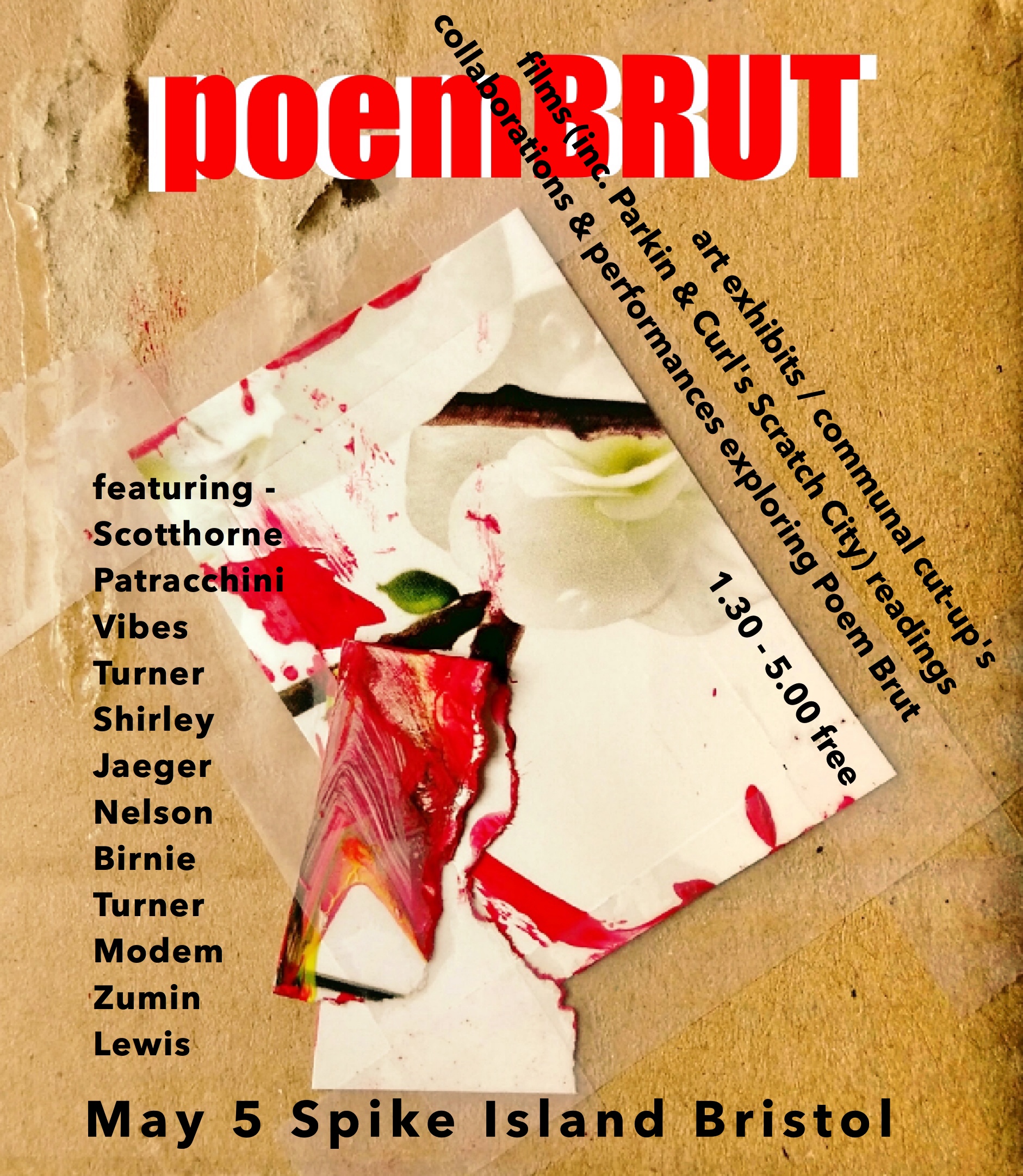
May 5: Hesterglock / Poem Brut @ SPIKE ISLAND
w/pop-up art exhibits, the making of a communal cut-up art poem, films, mass participation readings, interactions, performances, books for sale
with Sarer Scotthorne / Christian Patracchini / Isadora Vibes / David Turner / Vik Shirley / Peter Jaeger / Camilla Nelson / Clive Birnie / Lizzy Turner / Andrew Wells / Liz Zumin / Bob Modem
at Spike Island, 133 Cumberland Road, Bristol BS1 6UX.
from 1.30 – 5.00 FREE ENTRY. A Spike Island Open Studios event.
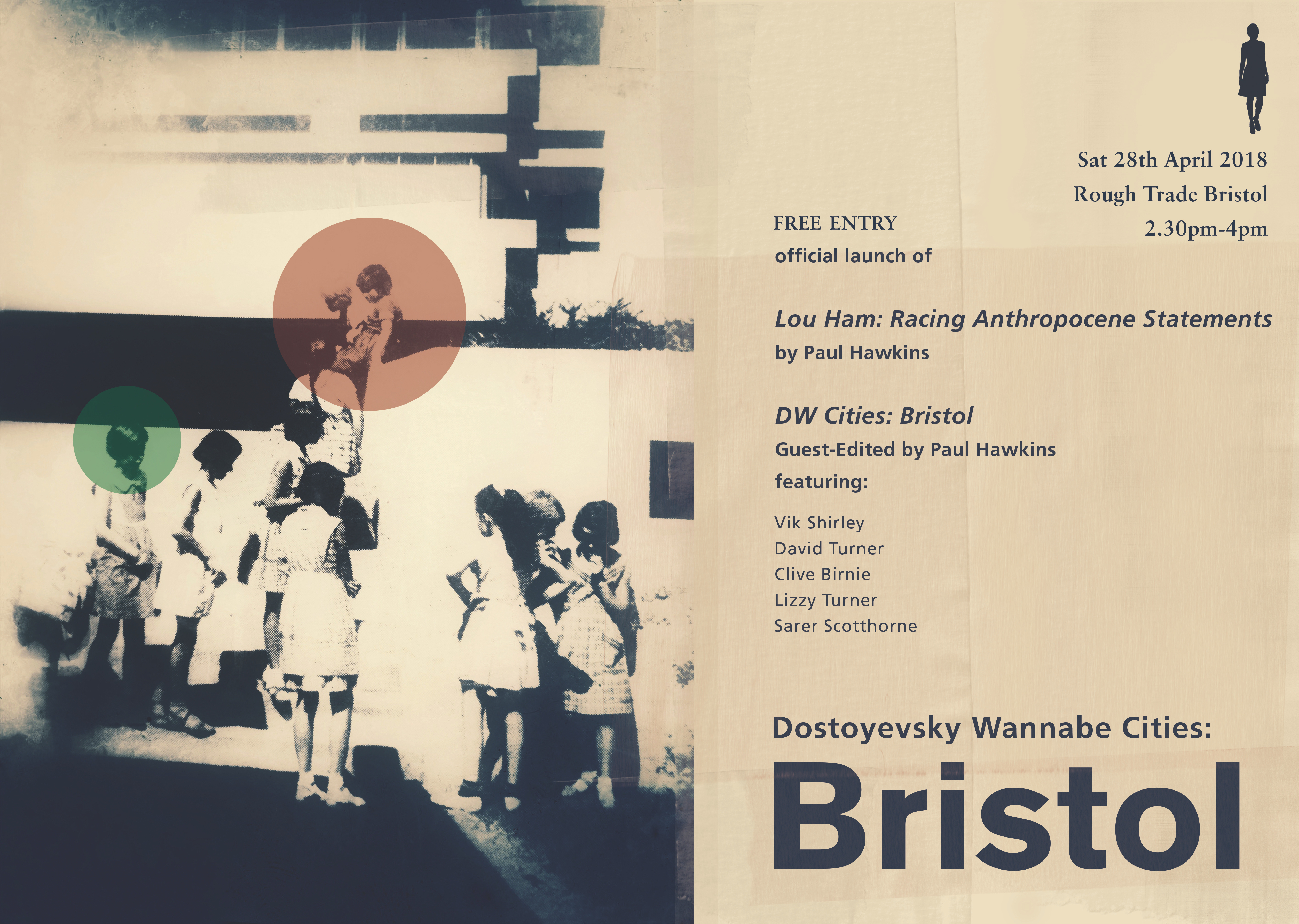
Saturday 28th April.
Cat No: DW-412 Rough Trade Bristol, 2:30pm-4pm FREE
Event Type: Dual Dostoyevksy Wannabe book launch plus readings
Cities Guest Editor[s] (Bristol): Paul Hawkins
INFO: Official launch of BOTH Lou Ham:RAS and Dostoyevsky Wannabe Cities: Bristol. Featuring readings/work from: Sarer Scotthorne, David Turner, Vik Shirley, Clive Birnie, Lizzy Turner & Paul Hawkins (Lou Ham: RAS).
Two books on sale: Lou Ham: RAS by Paul Hawkins AND Dostoyevsky Wannabe Cities: Bristol [Edited by Paul Hawkins] both published by Dostoyevsky Wannabe.
Also, obviously Rough Trade records, books, + DW Bristol Cities pamphlet (contains work by all readers) & Lou Ham:RAS on sale
EVENT NEWS: All sorted. People of Bristol (and beyond), why not come along on the 28th April?
Location Details/Address: Rough Trade Bristol, 3 New Bridewell, Nelson Street, Bristol BS1 2QD
Drinks: Coffee, beer, soft drinks available to buy from Rough Trade cafe and bar.
Food: Nah
Great new journal of visual poetry HERE, guest edited by Philip Davenport and featuring:
25th April 7.30
@ Iklectik
‘Old Paradise Yard ‘ 20 Carlisle Ln / Royal Street corner / Archbishop’s park, London SE1 7LG
More here – https://www.facebook.com/events/174227443390876/
Free here – http://www.nawe.co.uk/DB/current-wip-edition/editions/vol.-4.html
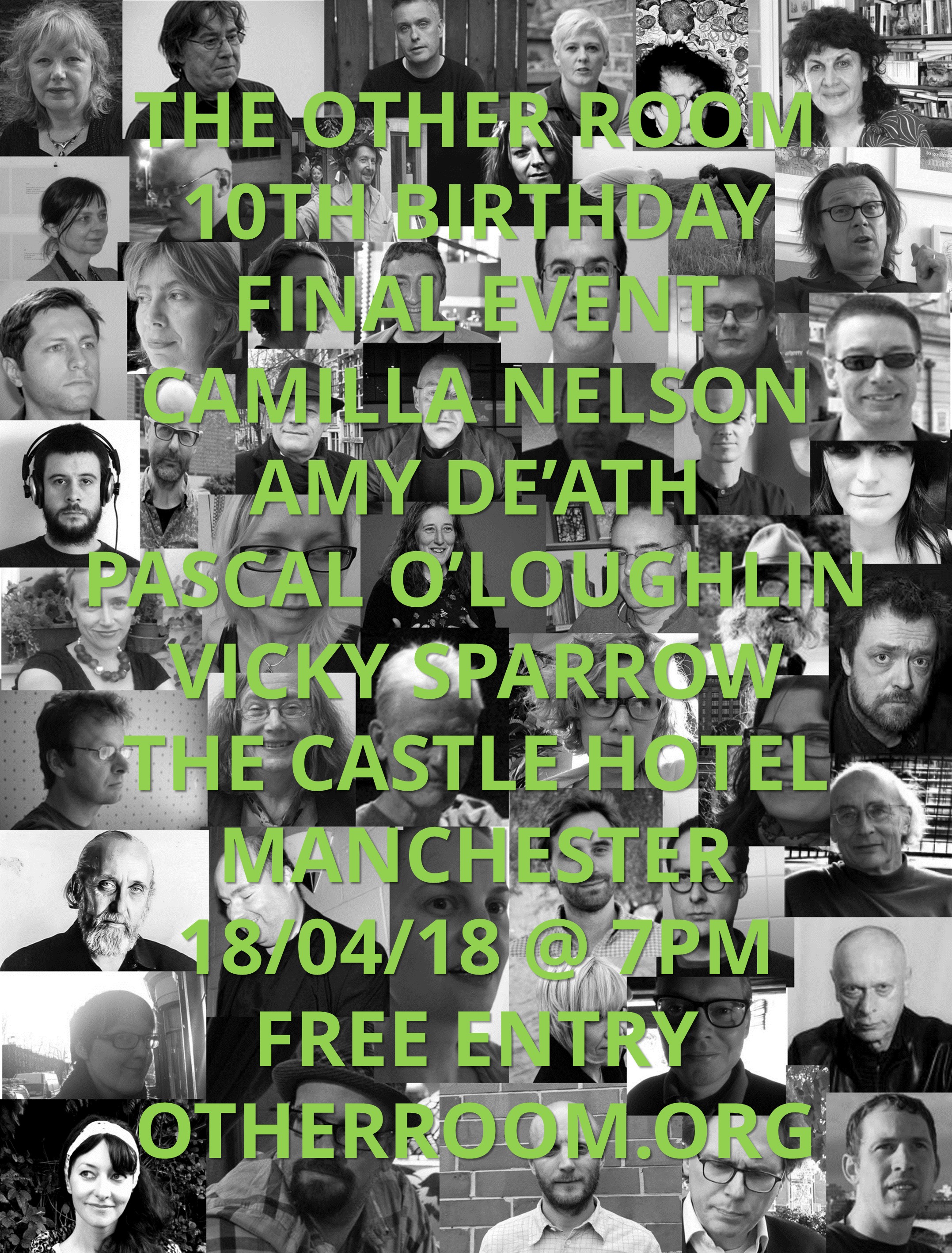
Amy De’ath will perform alongside Vicky Sparrow, Pascal O’Loughlin & Camilla Nelson on 18th April, 7pm at the Other Room. Free entry as ever. It’s our tenth birthday! Here’s part of a poem by Amy and also one of the four posters for the night below that, which shows our readers over the years:
from In Case of Sleep
I might recline like a cat but I wouldn’t sell my wares openly
I wouldn’t want to be that memory-cat with the power to die the power
to be put back on my feet I came to see you’d been eaten by tar sands
and cat didn’t exist what kind of a country is this
what did you say I missed that
I miss that cat
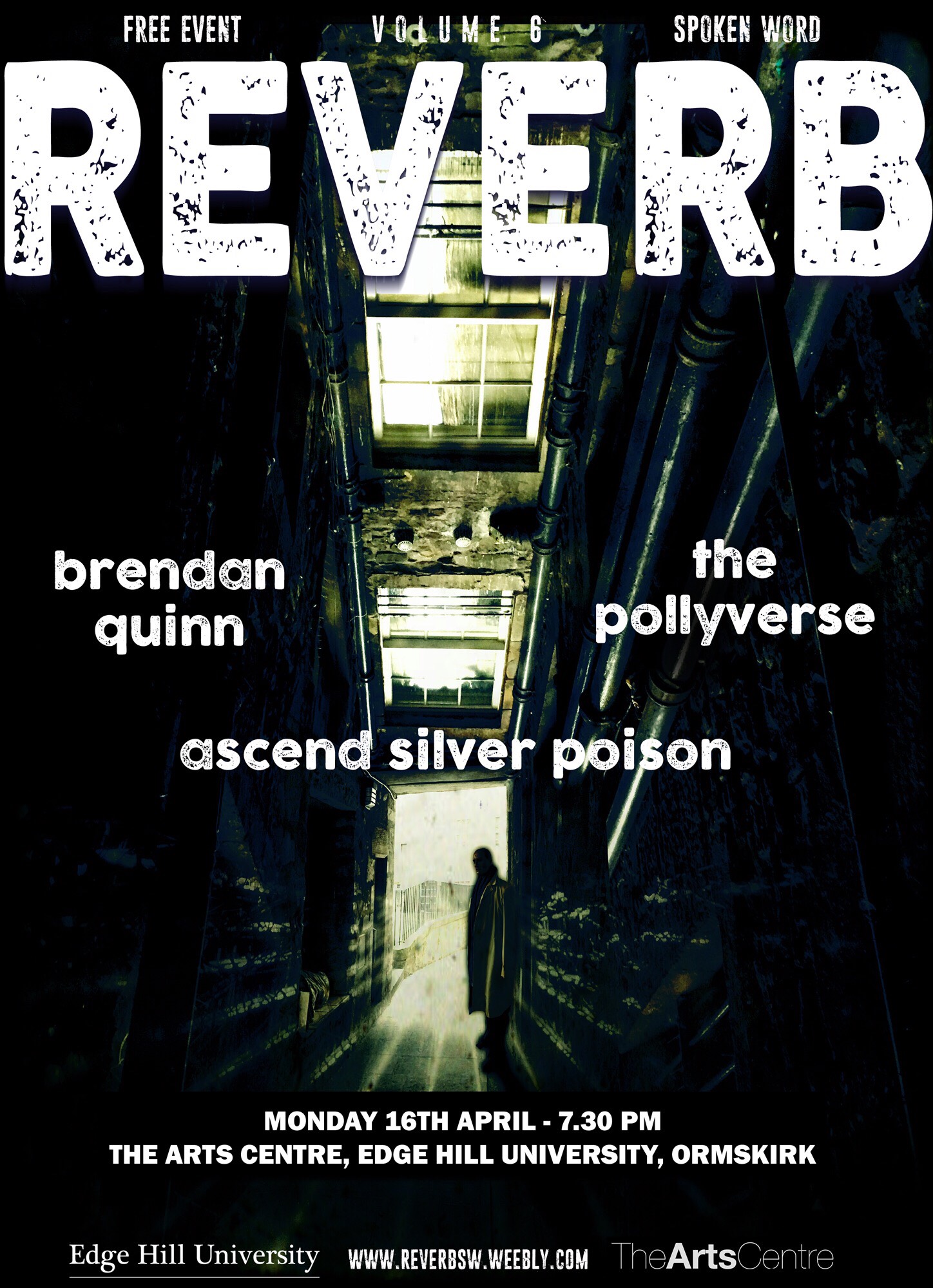
Wednesday 9th May, 6pm to 9pm, Barbican Library, Silk Street, London, EC2Y 8DS. Hosted by Lucy Hamilton, Linda Black & Claire Crowther. Readers: Robert Minhinnick, Helen Tookey, Salah Niazi, Peter Dukes, Susie Campbell, Alison Gibb, Adam Horovitz & Edwin Stockdale. More details here.
 otherroom.org