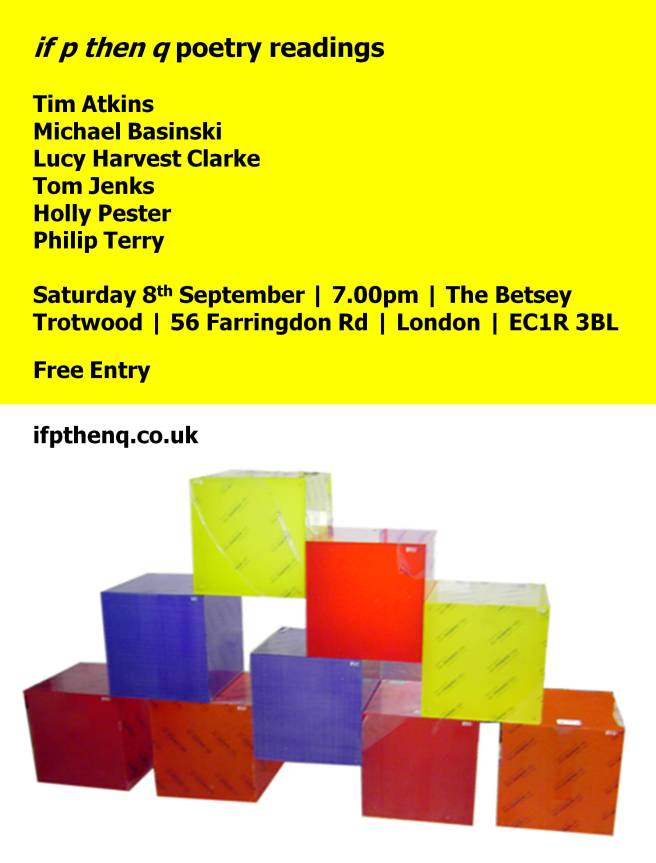
if p then q readings in London tonight

if p then q readingsTim Atkins, Michael Basinski, Lucy Harvest Clarke, Tom Jenks, Holly Pester, Philip Terry

Saturday 8 September 2012 7 PM Price: free The Betsey Trotwood 56 Farringdon Road London EC1R 3BL

if p then q is a Manchester based experimental poetry publisher with an international focus, which is especially keen on minimal and conceptual poetries. Following on from day’s events at The Free Verse Poetry Fair on 8th September, at which if p then q has a stall, an event will be held in the evening to celebrate the work of the UK based if p then q poets with a special guest appearance by the American poet Michael Basinski who has a limited edition postcard published by the press. A range of videos and sample materials are available on the website. The event is free and very welcome to all.

Tim Atkins is the author of To Repel Ghosts (Like Books, 1998), 25 Sonnets (The Figures, 2000), Oriental Tapping (Faber 2006), Horace (O Books, 2007), Folklore (Salt, 2008), and Petrarch (Crater, 2010). A selected Petrarch is forthcoming from Barque, and Honda Ode is forthcoming from Oystercatcher. He is editor of the online poetry journal onedit at http://www.onedit.net. Tim’s if p then q publication is 1000 Sonnets.

Michael Basinski is Curator of the poetry Collection, State University at Buffalo. His many books of poetry include Of Venus 93 (Little Scratch Pad) and All My Eggs Are Broken (BlazeVox). Michael’s if p then q publication is the postcard Dog Music.

Lucy Harvest Clarke was born in East Sussex in 1982. After studying Anthropology at Goldsmiths she travelled sporadically and lived by the sea. She now lives and works in London. Her poetry has featured on Great Works, Onedit, in Parameter magazine and in The Other Room Anthology Volume 1. Recently she has published a pamphlet EX3 with The Knives Forks and Spoons Press. Lucy’s if p then q publication is Silveronda.

Tom Jenks lives, works and writes in Manchester. He is the editor of zimZalla and one of the organisers of The Other Room. Tom’s if p then q publications are A Priori and *.

Holly Pester was born in Colchester in 1982. She now lives in London, teaching and researching at Birkbeck, University of London. Her PhD investigates the history of Sound Poetry and the poetics of analogue technologies. The sound texts and performance scores collected here have featured in various cross-disciplinary events, including the Serpentine Gallery Poetry Marathon, Text Festival 2011 and the Liverpool Biennial. In live scenarios her idiosyncratic vocal technique locates a poetic in between the disciplines of poetry performance, song and new media art. Holly’s if p then q publication is Hoofs.

Philip Terry is currently Director of the Centre for Creative Writing at the University of Essex. His books include the edited collection of stories Ovid Metamorphosed (Chatto and Windus, 2000), a translation of Raymond Queneau’s last book of poems, Elementary Morality (Carcanet, 2007), and the collection of poems Shakespeare’s Sonnets (Carcanet, 2010). Philip’s if p then q publication is Advanced Immorality

HI ZERO CONTEMPORARY POETRY READINGS #15

Hi Zero #15, Season 2 Opener, a night of contemporary poetry readings, featuring:

NICK POTAMITIS

Author: The Book of Night Terrors (Salt), and JUBILATE AJAX forthcoming imminently from MOUNTAIN PRESS

STEPHEN MOONEY

Author: DCLP (District and Central Line Project) (Veer), Shuddered, with Aodán McCardle & Piers Hugill (Veer)

JUSTIN KATKO

Author: The Death of Pringle (Veer/Film Forum), Finite Love (w/The Other Brother) (Critical Documents/Bad), Superior City Song (Crit. Dox), and RHYME AGAINST THE INTERNET (Crater)

Wednesday, 26th September upstairs at The Hope, Queen’s Road, BRIGHTON. Doors 7:30pm.

£4 for all

EXTENDING THE FORMS OF POETRY with PAULA CLAIRE

SPECIAL EDITION 8.00pm Wednesday 3 October 2012
The Poetry Library Royal Festival Hall South Bank Centre LONDON SE1 8XX
booking essential: www.specialedition@poetrylibrary.co.uk

Paula Claire presents an illustrated survey of international sound, visual and concrete poetry in our Collection, explaining its importance in the history of 20th-century innovative poetic forms. She offers a unique perspective on the subject supported by her Archive of Sound and Visual Poetry, over 5,000 items gathered by exchanging her Little Press Publications with exponents worldwide.
An experienced performer here and abroad in schools, colleges, arts centres, museums and festivals – Venice, Berlin, Toronto, Houston, Oporto, Cheltenham – she will then involve all present in the diversity of her poems and artists books, explorations during 50 years of writing.
At this event : Book launch to celebrate 50 years of creating poetry:
Catalogue 3: GOING FOR GOLD Poems 2001-11 an annotated and illustrated list with Introduction by Professor Robert Hampson, RHUL. The Library has Catalogue 1: DECLARATIONS Poems 1961-91; Catalogue 2: DI-VERS-ITY – Extending the Forms of Poetry 1991-2001 and nearly 30 other books etc by Paula Claire, see Library database.

Robert Sheppard on René Van Valckenborch

The ‘whole’ oeuvre of René Van Valckenborch is surrounded by mystery, perhaps of his own making. Published in fugitive publications in places as far apart as Cape Town and Montreal over the last decade, the poems of this Belgian are composed in Flemish and Walloon, and the stylistic divide between the two sets seems to reflect the societal linguistic divide of his troubled nation (although he never refers to this fact). These poems are translations from the Walloon of his ‘versions’ of Ovid, both from the unfashionable Tristia and the apocryphal ‘new’ Amores. 

More at Holdfire Press.

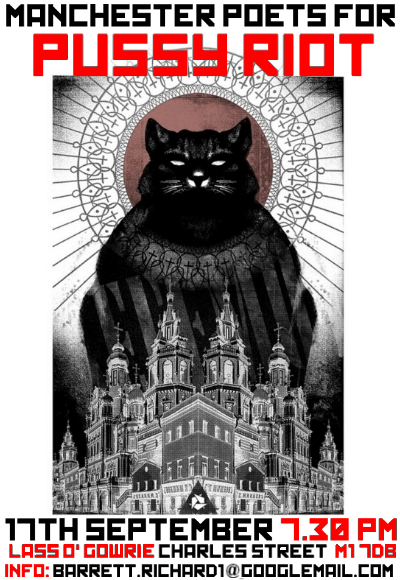
Poets for Pussy Riot – the videos

A week after the news that Nadezhda Tolokonnikova, Maria Alyokhina and Yekaterina Samutsevich of the Russian punk collective, Pussy Riot, were sentenced to two years in prison, over 30 contemporary poets came together at the Rich mix arts centre in Brick Lane, London for a unique evening of readings intended as an act of solidarity through the medium of poetry, and a celebration of the courage and spirit of fellow writers of this generation.

Films of the event are now online, including this collaborative piece by recent Other Room readers Becky Cremin and Ryan Ormonde. The full list as follows:

Becky Cremin & Ryan Ormonde – http://www.youtube.com/watch?v=-7cmQ0lnoa4

‘Efface the Traces!’ – Modernism and Influence

Durham University, 9-11 April 2013

‘[T]he poets of the nineties were entirely missed out of my personal history […] I never read any of these people until it was much too late for me to get anything out of them’.

T.S. Eliot, letter to Ezra Pound, 1924

‘[I]t was towards the end of my school days or in my first year or two at Harvard University [that] I was reading the poets of the ‘nineties, who were the only poets […] who at that period of history seemed to have anything to offer me as a beginner’.

T.S. Eliot, Saltire Review, iv, 1957

If Ezra Pound’s clamorous injunction – ‘make it new!’ – might be considered the first commandment of modernism, then Brecht’s dictum – ‘efface the traces!’ – stands as its complementary shadow statement. As the example of Eliot begins to illustrate, the Poundian urge to transfigure ‘legitimate’ influences results in a comparable urge to efface influences considered inappropriate. However, criticism has often proved inadequately alert to the motives underlying authorial advertisement and evasion of influence, instead colluding with the artist in the construction of a suspiciously orderly canonical narrative of modernist influence. We dutifully discuss Eliot as the heir of Dante and Donne; we corroborate Woolf’s departure from Wells and Bennett; we identify the Ibsen in Exiles, and the Confucianism of the Cantos.

This conference is conceived in the belief that the intersection between advertised and effaced influence operates as a particularly illuminating point of departure from which to develop new critical perspectives on the narrative(s) of modernism. This approach is also efficacious in projecting enquiry beyond the conventional spatial and temporal locus of modernism (London/Paris, 1890-1930), by drawing attention to hidden nineteenth-century proto-modernisms, and the contemporaneous cross-cultural interaction of rivalling counter-modernisms. Similarly, it encourages a nuanced handling of the vicissitudes of the mid-to-late twentieth-century reception of modernism – from Larkin’s early jettisoning of Yeats to Winterson’s strident advocacy of Woolf – by drawing attention both to the cultural investments of the modernist authors themselves, and to those of subsequent writers striving to stake out a distinct position beyond modernism’s daunting shadow.

We invite 20 minute papers on any of the following variations upon this theme, although respondents should not consider themselves restricted to these topics. Interdisciplinary research is also very much welcomed.

Negotiating anxieties of influence
Modernist self-fashioning
The response of present-day writers to modernism Influence across disciplines Effacement strategies The figuring of modernism as either a positive or negative aesthetic precursor Influence as a factor in constructing aesthetic communities The marketing of influence Originality in an age of mechanical reproduction The traffic of influence between medical discourses and modernist texts Feminist celebration of influence Other modernism(s): influence across cultural borders Authorial progression and amendment of influence The mediation of influence through parody and allusion Defining disciplines: influence within academic theory after modernism The politics of literary parentage Friendship networks, publicity conspiracies, and group-think Nineteenth-century post-Romantic culture and modernism Abstracts of no more than 250 words are invited by 1st December 2012. Please email submissions to effacethetraces@gmail.com. You can also use this address to contact us with any additional questions, such as how to arrange attendance as a non-speaking delegate. Additionally, you can visit our website at effacethetraces.wordpress.com.

The conference will take place in St. Chad’s College, Durham. Panels will follow the format of three 20-minute papers followed by questions, and each day will feature a plenary speaker. Our plenary speakers will be Dr Matthew Bevis (University of Oxford), Dr Marina MacKay (Durham University), and Professor Pat Waugh (Durham University). The registration fee is £30 for salaried academics and £15 for postgraduates and postdoctoral researchers. We will be offering three postgraduate bursaries to particularly outstanding applicants, to cover the registration fee, accommodation, and a portion of travel costs. If you are the recipient of a bursary, we will inform you when accepting your paper.

More here.

S J Fowler: Recipes

Out now on The Red Ceilings Press.

Incredibly, SJ Fowler’s recipes turn into poems as soon as you read them: exotic, nonsensical, provocative, furiously funny, but also tender and intimate (in their own way).

Don’t try this at home.   – Frédéric Forte (member of the Oulipo)
If this is some of what he ate where, then SJ Fowler also swallowed Antonin Artaud whole, calmed his stomach with bumblebees and psychedelics instead of milk of magnesia, and then started pogoing. These recipes are in the grand tradition of The Futurist Cookbook (offeringchickenfiat; elasticake; simultaneous fruit), and Harry Mathews’ famous “Country Cooking” (bludgeoned with an underwater boomerang)– and provide food for thought for the hungriest of readers. Binge and purge!  This little book has completely cured my lactose intolerance.           – Dr Tim Atkins (author of “The Atkins Diet”)
SJ Fowler squeezes the lemon and lime and shame all over Pee Wee Herman’s full English breakfast. He drops a pineapple in the Virgin Mary’s favoured bucket. He has done things you should not cook and done them deliberately with aubergines. He cleaves to the bat and the ruined ape. These are not necessarily bad things.     – Tom Jenks

Robert Hampson: out of sight

Robert Hampson’s “out of sight” now available from the crater press. Robert Hampson is Professor of Modern Literature at RHUL, where he teaches on the MA in Poetic Practice. His ‘Assembled Fugitives: Selected Poems 1973-98’ appeared from Stride in 2000. His most recent publication was ‘an explanation of colours’ (Veer, 2011).

‘out of sight’, like the poster-poem ‘map-loading: 51:31N 00:05W’ (2008), is an exercise in procedural writing and recriture. The single sentence, with its shifting phrasal linkages, responds to recent work by Vanessa Place. It’s also the record of a mis-spent decade.  £3. Copies are available at www.craterpress.co.uk.