NAPE: Nathan Walker

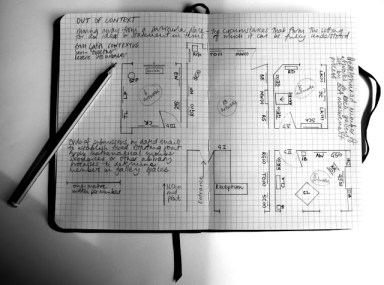
Commissioned by Performance Space as part of ‘In Conversation’, a 6 month digital residency and performance event. The digital residency blog documented processes and methodologies leading to the presentation of NAPE: 

“Following a score of pre-recorded spoken text, the work superimposes the private performance of reading into the public performance of writing. I developed a system of writing as a score structure for the performance that installs materials as performance actions and tasks. Alongside this work I also developed a digital writing programme that infinitely generates performance texts in relation to the performance.”

Nathan Walker will perform at The Other Room in April 2014.  More about NAPE here.

Enemies: Slovakian poetry

Videos from the recent Slovakian poetry event at the Rich Mix arts centre are now online:
Sarah Hesketh (&Cristina Viti) https://www.youtube.com/watch?v=gpLyGuU2kic
Mark Waldron & Martin Solotruk https://www.youtube.com/watch?v=84klLN9kNXc
Peter Milcak & Stephen Watts https://www.youtube.com/watch?v=ZhCVTxaNEPo

Book review: averbaldraftsone&otherstories by Bruno Neiva

averbaldraftsone&otherstories

Bruno Neiva

The Knives Forks and Spoons Press (2013)

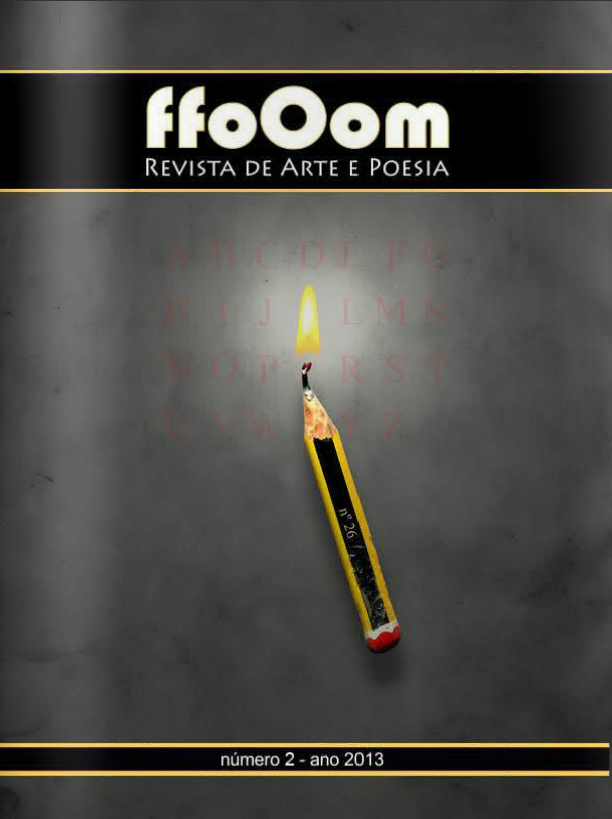
This sumptuous, sensuous, colour drenched book is, before content is addressed or even thought of, a delight to look at: rich red, mustard yellow and scorched orange abound, like looking at the world through technicolour goggles. As always with Knives Forks and Spoons, the production values are high. Neiva describes the work as illustrating his shift away from asemic practice, which can be described, albeit somewhat imperfectly, as writing without semantic content, and towards averbal practice, which we can assume means writing without words. This is not strictly true, as words do appear in averbaldraftsone&otherstrories, but they do not function as signs or signifiers. Rather they are simply part of the palate. This is language as material, forcing us to abandon our habitual linguistic norms and approach language as we would an image. Each page is as vibrant and vivid as the panel of a fresco.

The book raises interesting questions of context and the effect of context upon perception. At the end of the book is a list of where many of these pieces were exhibited in galleries. What difference would it make to see them hung on a wall, rather than presented on a page, to encounter them as visual art rather than poetry? The experience cannot but be different, for here we are studying the representation of the thing rather than the thing itself. We could think of this book as simply a catalogue, like a series of photographs of oil paintings or marble sculptures that might be sold as a memento of an exhibition, but this would be to miss the point. By presenting the work on a poetry imprint without any of the conventional surrounding text commonly found in an exhibition catalogue, this is a book that demands to be experienced as a book, a demand furthered by the presence of the word stories in the title.  When we pick up a book we are primed to expect text, but here there is, for the most part, no text. The reader is straight away thrown off centre by the realisation that they are not really a reader at all. To engage with this book, the reader cannot simply passively receive, but must instead actively engage. These pieces do not offer obvious meaning and so the reader must make their own meaning, if indeed it is meaning that they want. To read the work, we must also read the frame around the work.

Although the pieces presented here could be described as visual poetry, they cannot be located in the canonical lineage of the form – Gombringer, the de Campos brothers, Noigandres etc. – all of whom were largely typographical and worked, in the main, directly on paper. Neiva’s work, although no less visually striking, does not have the same basis. Many of the pieces here are constructed using found material, particularly the sequence &otherstories that comprises the second part of the book and was made using materials found in the vicinity of a packaging warehouse. The most obvious reference point is Kurt Schwitters, particularly the smaller collages he made shortly after coming to Britain in the 1940s, constructed from bus tickets, scraps of newspaper and other ephemera. As with Schwitters, the apparent disorder and randomness is deceptive. This is no magpie’s nest. The material here is crisp and cleanly presented on the page according to its own internal geometry. Neiva speaks elsewhere of working according to constraints, and in averbaldraftsone&otherstrories we can see that in action in two ways. Firstly, there is no clutter. Neiva has used his materials economically and with precision. Each image is sparely arranged, like an abstract painting. Secondly, each piece seems to have built according to the limits of what was to hand, Neiva restricting himself to assembly and arrangement. Here, the environment itself has become a constraint. Like a woodsman taking only the timber he can find on the forest floor to build with, so Neiva constructs the poems in the &otherstories sequence from what the world presents him with. His is a heuristic poetics. In a time of superabundance of content and previously undreamt of freedom in the manipulation of material, Neiva’s disciplined, almost ascetic approach is an interesting counterpoint, a subtle refusal of capitalism and consumerism.

The pieces in the first part of the book, whilst consistent with Neiva’s rigorous methodology, are slightly different in character. Here, we see more authorial intervention. Text is more prevalent. Materials are marked and indented and carry the trace of human activity. Still, however, we see the same attention to the character of materials, the same radical sensitivity. Constraint based work often contains one non-constrained element, what Magne and others associated with Oulipo called the clinamen. Here, Neiva breaks the spell of averbaldraftsone&otherstrories only once by placing an uncaptioned monochrome photograph of a group of men in suits, some carrying straw boater hats, in the middle of the first section of the book. The image is annotated with gnomic glyphs that may have been added by Neiva, or may have already been on the image. The presence of this spectral image has the effect of bringing the reader up short: a break in transmission, a subliminal frame. Neiva does not explain it, as he does not explain anything. No authorial guidance is offered by him throughout the book. Each of these images stands alone, allowing us to make of them what we will and to make our own connections.

averbaldraftsone&otherstrories is an example, if examples are needed, of the importance of publishers such as Knives Forks and Spoons who make it their business to get behind experimental work and give it the attention it deserves. A mainstream publisher would simply not touch a book as cryptic and tangential as this. This enigmatic, angular, elegant, paradoxical work, so Spartan in its aesthetic, yet so luxuriant in its realisation refines our ideas of what visual poetry can be.

POLYply > 27

POLYply presents Writers Forum Workshop (New Series)

  • Tom Bamford
  • Geraldine Bhoyroo
  • Johan de Wit
  • Paul Ingram
  • Doug Jones
  • Antony John
  • Robert Kiely
  • matt martin
  • Peter Philpot
  • Philip Terry

Thursday 12 December The Centre for Creative Collaboration 16 Acton Street, London WC1X 9NG Free entry, 7pm Royal Holloway Poetics Research Centre and MA Poetic Practice, Royal Holloway.

TOM JONES | MEALY BLOOM

96pp, 18.9×24.61cm, paperback. Front and back cover images by Stathis
Tsemberlidis, from his book “Transmutation: Of Human Bodies and Flora”
(2013); see more at decadencecomics.com.

6.50 GBP | 8.00 EURO | 16.50 USBUKS

For a limited time, Jones’ Perdika Press pamphlet AKHMATOVA is available
with MEALY BLOOM for the discounted price of:

8.50 GBP | 10.50 EURO | 20.00 USBUKS

All prices inc. P&P

MEALY BLOOM brings together more than ten years of work by the poet Tom
Jones. It collects the pamphlet Transactions Grotesques, and presents the
new sequence “The Punk Star Tuba”, along with sixteen other poems, including
versions of Mandelshtam and Tsvetayeva. In a prefatory “Advertisement”, the
author set outs the poetics governing this collection: “the sense that
training of the conscience is possible, and could be done through this kind
of text.”

Tom Jones teaches English literature at the University of St. Andrews. He is the author of “Pope and Berkeley: The Language of Poetry and Philosophy” (Palgrave, 2005) and “Poetic Language: Theory and Practice from the Renaissance to the Present” (Edinburgh University Press, 2012). Essays can be found in “Jacket” and “Complicities” (Litteraria Pragensia, 2007). His books of poetry and translation include “Transactions Grotesques” (Barque Press, 2002) and “Akhmatova” (Perdika Press, 2007). His poems have appeared in “Quid”, “Boxon”,
“Blackbox Manifold”, “Cambridge Poetry Summit: Some Evidence”, and “Prague Literary Review”. He can be heard reading his poems at The Archive of the Now.

See the website for an extract from the book: http://mountain-press.co.uk/mealybloom.html

Rachel Smith: a preview

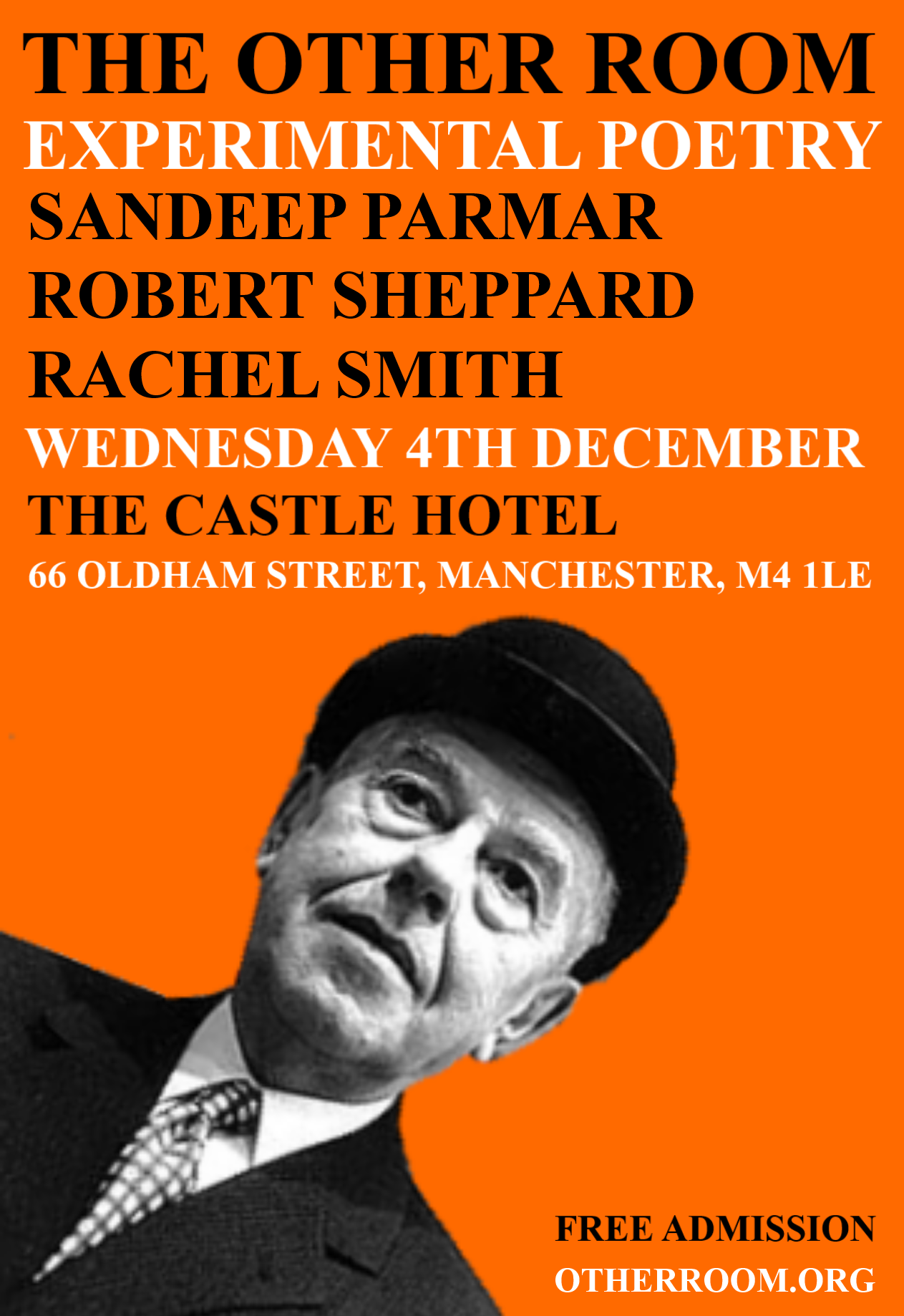
In a change to our previously advertised programme, Rachel Smith will perform at the next Other Room on Wednesday, 4th December at The Castle Hotel, 66 Oldham Street, Manchester, M4 1LE, 7 PM start, free entry. The other readers are Sandeep Parmar and Robert Sheppard.

Bio.:

Rachel Smith is an artist engaged in durational drawing processes, text art and guerrilla writing. Her artist’s statement is as follows:

“writing: reading–language–speaking :drawing

My practice involves predetermined algorithmic methodologies; generative constraints. These processes embrace the limit and freedom of restriction. The durational aspect of my artwork implies endurance and the processes are habitual, obsessive and repetitive.

Drawn lines delineate materiality, bodily presence and temporality.

The white noise din of information drive a drawing practice where the artist acts as a conduit, filtering language and re-presenting it. Readable narratives are often disrupted, creating non-communication, where intuition is used as a set of random number generators and mathematically sequenced illegibility questions our logic.

Despite never deviating from the procedural process, once it is set in motion, the visual form remains key as a document of the time spent.”

Some links:

Rachel’s blog

Ryan Dobran: Remote Carbon

Critical Documents is pleased to announce its latest publication: Ryan Dobran’s Remote CarbonSwaddled in gorge-destabilising cover images by Emir Šehanovic, this large-format 32-page collection brings together ten fugitive poems from 2008 to 2012, and includes the brand-new clutch of complicated instrumentation, ‘Ode to Dragon Bond’. It is available for the agreeable price of £4, $10, or €7 (shipping included).

MOPHE

Mopher, where performance, art, writing, poetry, voice, concept and sound meet to wither and perish in order to rise again as something else, more than the sum of its parts. Mopha is a singular art performance / live poetry collective made up of six of the UK’s most accomplished artists / poets – Holly Pester, Patrick Coyle, Emma Bennett, SJ Fowler, James Wilkes and Tamarin Norwood.

Eschewing and mulching the multiple genres of live art and experimental writing, Moffa will premiere it’s work in 2014 at multiple venues in multiple forms.

Exploring notions of fractured speech, aberrant theatre, surreal vocality, performativity and audience expectation, improvisation and its tropes, compressed communication, humour and bleak irony, Moffer aims to create powerful immediate, arresting and unique works of performance that are mindful, and responsive, to their construction and contextual environment. Wholly collaborative and essentially collective, the works of Moffar will pool and mutate the already adept live practices of six powerful performers into a uncommon mesh of theatre, art and poetry.

Here.

Robert Sheppard: a preview

Robert Sheppard will read at the next Other Room on Wednesday, 4th December 2013, 7 PM start. Entry free at The Castle Hotel, 66 Oldham Street, Manchester, M4 1LE. The other readers will be Sandeep Parmar and Gareth Twose. The clip above shows Robert reading with Patricia Farrell at the Other Room celebration of Bob Cobbing in October 2012, performing Blatant blather/virulent whoops.

Bio.:

Robert Sheppard invented René Van Valckenborch, though sometimes during the writing of the poems in A Translated Man it felt like the other way round. The poems are safely published in a book of that title, published by Shearsman in 2013. Shearsman also published Warrant Error and Berlin Bursts, poems, as well a critical work When Bad Times Made for Good Poetry. Knives Forks and Spoons have published his prose, both fiction, The Only Life and The Given, an ‘autrebiography’, and they will be bringing out an expanded version of the latter in 2014. Robert has recently collaborated with the painter Pete Clarke and the dancer Jo Blowers (after a near 20 year break). He teaches at Edge Hill University.

Some links:

Pages, a blogzine of investigative, exploratory, avant-garde, innovative poetry and poetics.
Robert’s own website.
A Translated Man at Shearsman.

Hannah Silva at the International Anthony Burgess Foundation

Hannah Silva will perform at The Other Room’s sixth birthday event in April 2014, but is in Manchester sooner than that to launch her new collection Forms of Protest. Details below via Penned in the Margins:

Thursday, December 5th, 2013, 6:30 pm | £6/£4

Three of the UK’s most exciting voices launch new collections in a night of cutting-edge modern poetry from award-winning independent literary publisher Penned in the Margins. Blackburn poet Melissa Lee-Houghton celebrates the launch of her second book, Beautiful Girls: a raw and powerful account of mental illness that has been awarded a PBS Recommendation. Hanna Silva, widely acclaimed for her innovative vocal performances, launches her debut collection Forms of Protest and Siddhartha Bose launches Digital Monsoon, where dreams trigger extraordinary visions of an apocalyptic London populated by the ghosts of a multicultural city. Hosted and introduced by Tom Chivers of Penned in the Margins www.pennedinthemargins.co.uk. Buy tickets here.