
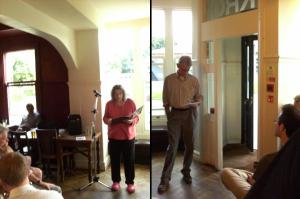
Photos from the fantastic July reading by Tina Darragh and p.inman are now online. Click here to visit the photos page.
Photos from the fantastic July reading by Tina Darragh and p.inman are now online. Click here to visit the photos page.
Five recordings from Tina Darragh’s reading at the University of Maine New Writing series in January 2007.
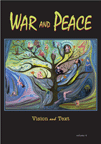
Judith Goldman and Leslie Scalapino, Eds.
Devoted to collaborations between visual works and poetry, includes collaborative works of Charles Bernstein with Susan Bee, Amy Evans McClure with Michael McClure, Kiki Smith with Leslie Scalapino, Denise Newman with Gigi Janchang, a film on paper by Lyn Hejinian, Alan Halsey’s visual texts, Simone Fattal, and Petah Coyne. Judith Goldman interviews Marjorie Welish, Lauren Shufran interviews Jean Boully, Leslie Scalapino interviews Mei-mei Berssenbrugge. Also included are E. Tracy Grinnell’s homophonic translations of Claude Cahun’s “Helene la rebelle” and poems by Fanny Howe, Thom Donovan, and others.
Cover by Susan Bee.
Absolute Elsewhere is a collaborative mixed media project by Joy As Tiresome Vandalism (poet and The Other Room co-organiser James Davies and photographer Simon Taylor). The project is updated monthly in text or image form. The lastest instalment, a photograph by Simon Taylor, is online now.
Our interviews with Tina Darragh and P.Inman will take place next week and we are still open to any questions you would like us to ask them. Questions submitted so far cover topics as diverse as politics, the nature of l=a=n=g=u=a=g=e and how to survive as experimenters and innovators in the 21st century. If you would like to add anything to the pot or just give the pot a big stir, get in touch with us at otherroomeditors@gmail.com.
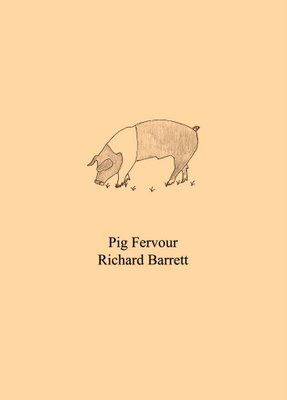
Pig Fervour, the second publication by Other Room reader Richard Barrett is available for order now from Harry Godwin;s Arthur Shilling Press.
Great US imprint with a long and interesting list of writers, including Other Room reader Caroline Bergvall and soon-to-be Other Room reader Tina Darragh.
The debut collection by Marcus Slease. Check it out on Amazon.
“Or, Why I am Alarmed at the Role the Academic Environment is Playing in Contemporary British Innovative Poetry
I like using an analogy made by Andrew Duncan to explain the disparate heterogeneity of contemporary British poetry: the SciFi topos of centuries-long space-missions, venturing out from the home planet to reach different stars, and establishing their own separate lineages and cultures. These increasingly diverge from each other and become unable to intercommunicate.”
An interesting perspective from Peter Philpott.
New publications by David Kennedy and Peter Hughes from Oystercatcher Press.
“FULCRUM: An Annual of Poetry and Aesthetics, #6 (730 pages) features uncollected Samuel Beckett; unpublished Robert Frost and Octavio Paz; essays by Christopher Ricks, Marjorie Perloff, Eliot Weinberger and many others; a feature on “Poetry and Myth”; a debate between poets John Kinsella and Rosanna Warren; translations of Seferis, Vian, Quevedo; and a great deal more.”
“A prose work in 23 sections, mislaid for 35 years and then found in an attic, this is a classic Raworth text from the era of Logbook: fast, profound, knockabout, intense, tricky, brainy, daft, those were the days once again…”
A5, 28pp (price £4.50 including P&P)
Cheques to ‘Equipage’
c/o Rod Mengham, Jesus College, Cambridge, CB5 8BL
You can also buy via Salt Publishing.
A new poetry imprint from Ricahrd Barrett.
“It will publish in a range of formats from pamphlets through to perfect bound books.
The next title scheduled for publication is * by Tom Jenks.
Submissions of complete manuscripts only are invited.”
Chapter XXXI of Richard Makin’s serial publication St. Leonards is now available from Great Works.

The next Openned night takes place at 7.15pm on Thursday 2nd July. Tina Darragh, James Davies, Harry Godwin, P. Inman, Rebecca Rosier and Steve Willey will be reading. Openned nights are held at The Foundry in London, UK. Admission is always free.
“The primary investigation of Xerolage is how collage technique of 20th century art, typography, computer graphics, visual & concrete poetry movements & the art of the copier have been combined. Each issue is devoted to the work of one artist (or set of collaborators).”
“Ours is an age of anxiety, of dissociation of sensibility, of pessimism, cynicism, incredulousness. Our state, our condition, is a constant “fight or flight.” We are a matter of excretions. Our wets. Our arts. Our poetry. Excretions, anxieties, this enormity, this Behemoth.
Ours is the age of canned laughter. (There is an analogue for this in poetry.) This has been imposed on us. We — we poets! — must struggle to be free of this.”
“The next issue of LiteRacje will concern the phenomenon of the anthropology of curiosity. We understand this as a meta-concept which despite many attempts of analysis still evades expression within the categories of universal human experience. We would like to ponder the notion of curiosity understood in a variety of ways. On the one hand we see it as one of the basic natural and adaptive functions of the human being, on the other as transgressive curiosity. The latter can be sought as cognitive combat with the essence of being where one strives to capture the mystery in order to find out what is on the other side of the mirror; to find the answer to the question of what remains veiled.
In the first part of the volume we would like to focus on the origins of the phenomenon of curiosity. Since when can we discuss a certain space of meeting between man and signs of reality and the shift of the model of cultural representation? Was it curiosity that triggered this meeting and this change? Was it motivation which can be clasped in an “untiring, unlimited and useless” longing for knowledge as says the English proverb? Or maybe it was “an unbearable curiosity experienced whilst observing a bug touched with a stick” ? – as Gombrowicz said.
In the second part attention will be cast on symptoms of curiosity both from the visible and invisible spheres. There will be space for the private and the public, for adventures of the body and the soul, for curiosity labeled as healthy and sick; noble and not noble. The point is to make use of panoramic- and micro-perspectives when pinning up this ephemeral category. We will consider curiosity in its cultural and natural context; equipped with devices such as the telescope and the microscope we are bound to make a difference.
Finally we will end up with poetry, prose and drama pieces. We encourage you also to send us graphics, comic-booklets, sketches possessing a seducing quality, and involving the spectator in a subtle game of chance, competition and bewilderment. We would like to transgress something, above all we are interested in a meeting. A meeting outside the walls each one of us carries inside, outside the curtain concealing things and forcing us to perceive our thoughts on things rather than things themselves. We invite you, curiosity-seekers.
All Humanists are welcome to send their works. We are waiting for your papers hoping to build an interesting spectrum of the “Anthropology of Curiosity” issue of LiteRacje.
Deadline: August 31st 2009
literacje@gmail.com
Instructions for authors:
Font: Times New Roman 12; space 1,5; footnotes: down on each page; bibliography: at the end of the text; maximum 15 pages. Please write a short biographic note and an abstract of your text (ca. 8 sentences).
Leading editor of the issue: Dorota Sobstel”
From Grzegorz Wroblewski
Salford, Lancashire, United Kingdom
Based in Salford, “ArtYarn is a collaborative fibre arts project coordinated by visual artists Rachael Elwell and Sarah Hardacre. ArtYarn aim to use traditional knitting and crochet techniques in contemporary visual arts projects. And aspire to promote the diversity and versatility of knitting and crochet as a medium. Interested in the artistic, social and historical contexts of knitting and crochet, ArtYarn are focused on the tactility of hand processes. Enjoying the repetitive and often obsessive nature of this work, ArtYarn view knitting and crochet as an opportunity for individual creative expression and at the same time explore the medium as a way to make art accessible through participatory making and collaborative exchange.”
 otherroom.org