Bill Griffiths’ Collected Earlier Poems (1966-80)

Bill Griffiths’ Collected Earlier Poems (1966-80) will be published in January by Reality Street.

This is the first time this great, innovative poet’s work has been properly collected. The poetry included here was originally written and published in the 1960s and 70s, and immediately predates the work included in The Mud Fort. It includes the complete “Cycles”, War W/ Windsor”, “A History of the Solar System” and other sequences, as well as a multitude of other poems and and sets of poems, previously published in fugitive editions or not at all, presented in roughly chronological order. The volume is rounded off with Alan Halsey’s meticulous endnotes, detailing the original publishing history and variant texts.

You can obtain this book by:

  • becoming a REALITY STREET SUPPORTER in 2010 – you will receive it as part of a package which also includes books by Fanny Howe, Richard Makin and Jim Goar.
  • ordering it at the pre-publication price of £17.50 post free (after January it will be £18 + p&p).
  • You can also pre-order it at http://www.amazon.co.uk at £18 post free.

    Bill Griffiths: Collected Earlier Poems (1966-80)
    Edited & introduced by Alan Halsey & Ken Edwards
    368pp
    ISBN: 978 1874400 45 5
    29 January 2010

    Ken Edwards reviews if p then q

    “In Manchester, I see, the Other Room has  been engaging new audiences too. Its co-curator, James Davies, is also editor of a magazine of “experimental poetry”, if p then q. The first two issues, which I haven’t got, were issued in envelopes. The third came in the form of a set of full-colour posters. The fourth, and current issue, is likely to cause apoplexy among some of the more austere adherents of post-avant poetry, but I love it.”

    More.

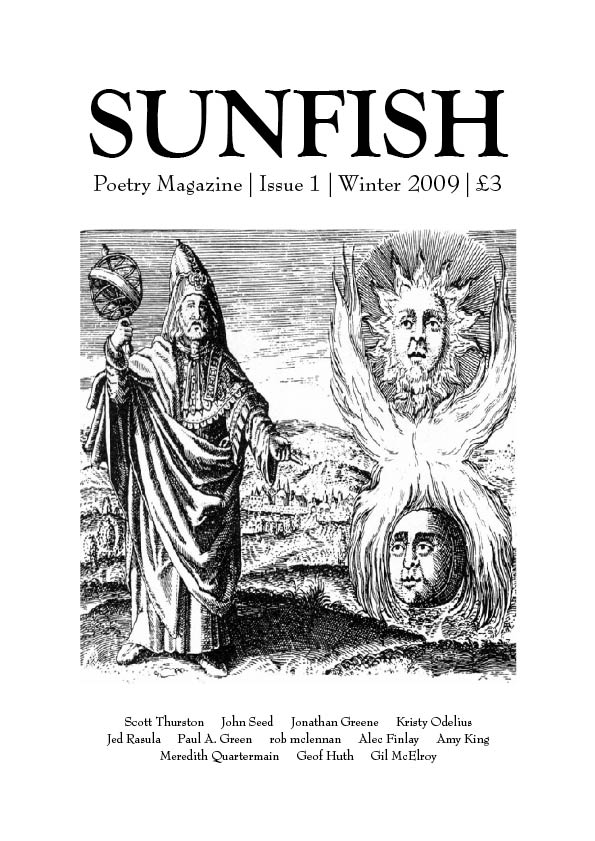
    Sunfish

    Sunfish is a new quarterly poetry magazine edited by Nigel Wood and published in Manchester. Issue 1 contains work by Scott Thurston (UK), Jed Rasula (USA), John Seed (UK), Kristy Odelius (USA), Jonathan Greene (USA), rob mclennan (Canada), Geof Huth (USA), Paul A. Green (UK), Meredith Quartermain (Canada), Amy King (USA), Gil McElroy (Canada) and Alec Finlay (UK). It’s just in from the printer and costs £3 (+50p postage). A Sunfish website is in the pipeline; in the meantime, you can get hold of a copy by sending a cheque for £3.50 (made out to Nigel Wood) to: Flat 405, 41 Old Birley Street, Hulme, Manchester M15 5RE. If you’re in Manchester you can save yourself the postage by picking up a copy at the next Other Room reading on December 2nd. For more information, email sunfishmag@googlemail.com.

    Give thanks to BlazeVox

    Thanksgiving 2009. Thanksgiving Menu Poem : guest of honor C. D. Wright.

    The ninth installment of Geoffrey Gatza’s Thanksgiving Menu Poem is now online at BlazeVox.

    “This is a concept poem structured around the thanksgiving meal I would cook for everyone I could invite to honor a great poet. This year, the guest of honor is C. D. Wright.”

    More here.

    What’s on this week

    Events this week from The Other Room calendar. The calendar is open access. If you have an experimental poetry, art or music event you want to publicise, feel free to post. If you would prefer us to post for you, email us at otherroomeditors@gmail.com

    Wednesday 25th November

    Openned – the final reading: Andrea Brady; Ian Heames; Antony John; Geraldine Monk; Linus Slug; Timothy Thornton. The Foundry, London. 7.30 PM start. Free. More here.

    Thursday 26th November

    Alec Newman at Manchester Central Library: Reading from Alec Newman, poet and editor of Knives, Forks and Spoons press, with John G. Hall and Simon Rennie. 6 PM start.

    Lemke/Gwilliam CD launch: Castlefield Art Gallery, Manchester 6-8pm. fourmill plus quarterinch is the duo of sound artists and improvising musicians Helmut Lemke and Ben Gwilliam. In this collaboration the two artists use different formats of audiotape; pre-recorded, prepared and unprepared. From individual banks of sound recordings on tape comes a subtle and often dense music that is both composed and improvised in concrete time.More here.

    Herman van Rompuy vs. Basho

    The new President of the European Union is not only a consumate political operator, but also a haiku master. For instance:

    Hair blows in the wind
    After years there is still wind
    Sadly no more hair

    and

    Puddles wait
    for warmth to evaporate.
    Water becomes a cloud

    We’d have him at The Other Room, but we couldn’t afford his expenses. Anyway, he might decide to turn it in after his work was described as having “an awful conservative, picturesque prettiness” by Andrew Motion here. That’s got to hurt.

    Diverse Deeds

    Diverse Deeds: Tuesday, December 1: Caroline Bergvall + Erín Moure + Roshi
    Café Oto, 18-22 Ashwin Street, Dalston, London E8 3DL.
    doors open at 7.30; start at 8.00; end by 10.00; entry £6 (£4 concessions).

    This new series of poetry and music performance events continues with three fascinating and innovative artists, who each blend distinctive international elements into new and exciting forms.

    Caroline Bergvall is one of Britain’s leading experimental poets, with a large international reputation. Her work blends written, spoken and graphic language and different languages – blends performance, art installation, electronic media and written text – blends challenge, information and pleasure. This is poetry really at the point where it mutates into the defining art form for the electronic information age – exciting, stimulating and astonishing. “One of the most influential experimental spoken-word artists internationally” (US Publishers Weekly).

    Caroline Bergvall describes herself as “Writer & artist. French Norwegian, based in London”. Her most recent performance in London was as part of the Serpentine Gallery Poetry Marathon in October, and she has performed or taken parts in events this year in Los Angeles, New York, Providence Rhode Island, Vienna and Ely. She is at present one of the UK’s AHRC Fellows in the Creative and Performing Arts.

    Erín Moure is a Canadian poet visiting Britain this autumn on a programme introducing two new books, Expeditions of a Chimaera (with Oana Avasilichioaei) and My Beloved Wager (essays from a writing practice). As a professional translator, her poetry is often a language

    Erín Moure was recently described as one of the 10 best English-language poets in Canada by the CBC’s Barbara Carey, who also refers to her as “one of our best – and most audacious – at expanding the possibilities of language.” She is a powerful and clear performer of her work, and Diverse Deeds is privileged to host one of her few readings on this visit.

    Roshi is an exponent of “stunningly beautiful Welsh-Iranian torch song electronica“ says Mixmag. Born in Wales to Iranian parents, Roshi Nasehi is a singer-writer who presents her own evocative songs alongside sometimes quite radical interpretations of the Iranian songs she was brought up listening to. Her songs reflect her origins, influences and experiences in a personal and unique way accompanied by unusual piano or keyboard arrangements – they are reflective, melodic and quirky – her voice airy and tender but possessed of an inner power. When she interprets Iranian song it is in a personal style bringing a contemporary twist combined with an authentic understanding of context and language.

    Roshi, with her band, or alone at the keyboard is a regular and welcome live performer especially in London, developing a loyal following. She has had a new CD out in October, The Sky and The Caspian Sea (with Pars Radio, her band), of both original and traditional Iranian songs. She has performed on Radio 3’s The Verb poetry show, and at Diverse Deeds’ predecessor, Sundays at the Oto.

    Wednesday, December 16: Angela Gardner + the voice of Harry Godwin + Mendoza + Nat Raha +  Rebecca Rosier
     
    This event links the visiting Australian poet and artist Angela Gardner with readings and performances from a group of young and innovative London poets. More information will follow nearer the date.

    Angela Gardner is an Australian poet with a prize-winning reputation in her own country (2006 Arts Queensland Thomas Shapcott Poetry Prize and 2004 Bauhinia/Idiom 23 Prize). Harry Godwin, Mendoza, Nat Raha and Rebecca Rosier are all poets in their early 20s now (or until recently) based in London and are part of the exciting innovative poetry scene based around small-scale and internet publishing, with strong elements of performance in how they present their poetry.

    Diverse Deeds is a series of poetry and music events, each featuring two or three poets and a musician or two. The emphasis is on contemporary innovative poetry, and music at least inflected by improvisation. Diverse Deeds succeeds last year’s successful afternoon Sundays at the Oto events, but now with an evening scheduling. There will be information available on the night (and beforehand online) on all the performers.

    For further information:

    Missing: 6 years of Poetry Review – reward for finder

    A counterblast to Blake Morrison from Matt Dalby:

    “Not only are we not really here, it seems we were never here. I would have posted this sooner if I’d got round to reading the weekend Guardian before now. In a review on Saturday Blake Morrison reviewed Fiona Sampson’s A Century of Poetry Review.

    Now given that things were fairly eventful round there in the 70’s you’d think there might be plenty of opportunity to mention the British Poetry Revival, Bob Cobbing and so on. Apparently not. The closest he comes are the following:

    Controversy also surrounded Eric Mottram in the 1970s, with his radical Anglo-American poetics. Which comes as an aside in a discussion of Muriel Spark’s editorship, and

    Several editors of the Poetry Review, including Mottram and later Peter Forbes, strenuously avoided little-Englandism, and there’s a reasonable showing of Americans and Europeans here, including Brodsky, Ginsberg, Ashbery and Primo Levi.

    And that’s your lot. Maybe this is reflective of the contents of the book, I can’t find a list of contents and don’t propose buying a copy to find out.”

    More Matt Dalby here.

    Working methods – speed vs. slowness

    “I have always known that I work quickly. My work whether text, visual or sound poems, essays, or whatever else emerges in brief intense bursts. I simply assumed that this was a flaw, that high quality work could only be reached through laborious and extended processes. Education and other aspects of the culture tended to support this belief…But it’s only in the last week that I’ve begun to think that this might not be a fault, it might just be the condition of my mind, the way that I work best. I think part of the reason is there’s a kind of moral supposition that the more carefully thought-out something is the better it is. We distrust pleasure, are suspicious of fun and things that seem effortless.”

    Matt Dalby, here.

    “Recollection in tranquillity, not derangement of the senses, is the sine qua non of good writing…the digital age has simply compounded a problem caused by the increasing hegemony of one school of writing (the Ionic) over another (the Platonic).”

    Andrew Gallix, here.

    Andrew Motion channels Kenneth Goldsmith

    Interesting points on the nature of ownership here, from an area of writing where we might not expect to find them. Interesting too to picture the former Poet Laureate as a “shameless burglar”, although whenever I’ve seen him he looks a bit embarrassed. Read the article in full here. If you want to read a true master of uncreative writing, check out the Kenneth Goldsmith archive at Eclipse.

    So what if I copied work says Sir Andrew Motion, Shakespeare did all the time

    Sir Andrew Motion has been accused of “shameless burglary” by a military historian whose research he lifted and put into a poem about shell-shock for Remembrance Sunday.

    The former Poet Laureate yesterday insisted that his use of quotations that he discovered in a history book belonged to a noble tradition of “found poetry” dating back to Shakespeare.

    But Ben Shephard, an expert who produced The World at War for television, complained that the poet had been “extracting sexy soundbites” from his painstaking work on military psychiatry.

    Motion’s poem, published as a tribute to war veterans in The Guardian on Saturday, uses quotations from soldiers and psychiatrists whose accounts Shephard spent ten years compiling. “He has no right to claim any sort of legal or moral ownership of the material,” Shephard said. “There is nothing original in this at all.”

    BlazeVOX2k9 Fall now online

    Work from:

    • Adam Katz and Jackie Stluka
    • Alan Botsford Saitoh
    • Alan Britt
    • April A.
    • Aryan Kaganof
    • Austin Givens
    • Avel Berumen
    • bani haykal
    • Barrie Mac Clellan
    • Bethany Price
    • Breonna Krafft
    • Brian Anthony Hardie
    • C.N. Bean           
    • Christina Manweller
    • Clay Carpenter
    • Dan Brady
    • David M. Morini
    • Dayne Duranti
    • Duane Locke
    • Ed Makowski
    • Emily Brown
    • Elizabeth Zuba
    • Elaine Kahn
    • Even
    • Heather Fowler
    • Hugh Behm-Steinberg
    • Iain Britton
    • Ivan Jenson
    • James Mc laughlin
    • James Cook

    More here.