

Parasol Unit, 14 Wharf Road, N1 7RW. Thurs 25th Oct. Event begins at 7.00pm.Arrive early to view the exhibition of sculptures by Bharti Kher. Tickets: £5/£4 conc. More here.
Parasol Unit, 14 Wharf Road, N1 7RW. Thurs 25th Oct. Event begins at 7.00pm.Arrive early to view the exhibition of sculptures by Bharti Kher. Tickets: £5/£4 conc. More here.
Durham University, 9-11 April 2013
‘[T]he poets of the nineties were entirely missed out of my personal history […] I never read any of these people until it was much too late for me to get anything out of them’.
T.S. Eliot, letter to Ezra Pound, 1924
‘[I]t was towards the end of my school days or in my first year or two at Harvard University [that] I was reading the poets of the ‘nineties, who were the only poets […] who at that period of history seemed to have anything to offer me as a beginner’.
T.S. Eliot, Saltire Review, iv, 1957
If Ezra Pound’s clamorous injunction – ‘make it new!’ – might be considered the first commandment of modernism, then Brecht’s dictum – ‘efface the traces!’ – stands as its complementary shadow statement. As the example of Eliot begins to illustrate, the Poundian urge to transfigure ‘legitimate’ influences results in a comparable urge to efface influences considered inappropriate. However, criticism has often proved inadequately alert to the motives underlying authorial advertisement and evasion of influence, instead colluding with the artist in the construction of a suspiciously orderly canonical narrative of modernist influence. We dutifully discuss Eliot as the heir of Dante and Donne; we corroborate Woolf’s departure from Wells and Bennett; we identify the Ibsen in Exiles, and the Confucianism of the Cantos.
This conference is conceived in the belief that the intersection between advertised and effaced influence operates as a particularly illuminating point of departure from which to develop new critical perspectives on the narrative(s) of modernism. This approach is also efficacious in projecting enquiry beyond the conventional spatial and temporal locus of modernism (London/Paris, 1890-1930), by drawing attention to hidden nineteenth-century proto-modernisms, and the contemporaneous cross-cultural interaction of rivalling counter-modernisms. Similarly, it encourages a nuanced handling of the vicissitudes of the mid-to-late twentieth-century reception of modernism – from Larkin’s early jettisoning of Yeats to Winterson’s strident advocacy of Woolf – by drawing attention both to the cultural investments of the modernist authors themselves, and to those of subsequent writers striving to stake out a distinct position beyond modernism’s daunting shadow.
We invite 20 minute papers on any of the following variations upon this theme, although respondents should not consider themselves restricted to these topics. Interdisciplinary research is also very much welcomed.
Negotiating anxieties of influence
Modernist self-fashioning
The response of present-day writers to modernism Influence across disciplines Effacement strategies The figuring of modernism as either a positive or negative aesthetic precursor Influence as a factor in constructing aesthetic communities The marketing of influence Originality in an age of mechanical reproduction The traffic of influence between medical discourses and modernist texts Feminist celebration of influence Other modernism(s): influence across cultural borders Authorial progression and amendment of influence The mediation of influence through parody and allusion Defining disciplines: influence within academic theory after modernism The politics of literary parentage Friendship networks, publicity conspiracies, and group-think Nineteenth-century post-Romantic culture and modernism Abstracts of no more than 250 words are invited by 1st December 2012. Please email submissions to effacethetraces@gmail.com. You can also use this address to contact us with any additional questions, such as how to arrange attendance as a non-speaking delegate. Additionally, you can visit our website at effacethetraces.wordpress.com.
The conference will take place in St. Chad’s College, Durham. Panels will follow the format of three 20-minute papers followed by questions, and each day will feature a plenary speaker. Our plenary speakers will be Dr Matthew Bevis (University of Oxford), Dr Marina MacKay (Durham University), and Professor Pat Waugh (Durham University). The registration fee is £30 for salaried academics and £15 for postgraduates and postdoctoral researchers. We will be offering three postgraduate bursaries to particularly outstanding applicants, to cover the registration fee, accommodation, and a portion of travel costs. If you are the recipient of a bursary, we will inform you when accepting your paper.
More here.
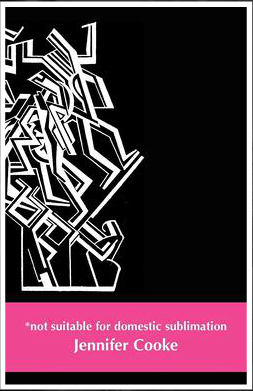
not suitable for domestic sublimation is Jennifer Cooke’s first poetry collection and features poems written over the last six years that engage in various ways with radical politics; gender norms; personal and corporate self-actualisation (and Cooke’s hatred of such discourses); sexuality; town centres; and some of the ideas of the French Freud, Jacques Lacan.
The books includes “Steel Girdered Her Musical: in several parts”, originally made for performance with music by Adam Robinson. This twelve-part poem-sequence at the heart of the collection centres on the possible impossibility of a revolution beginning at South Mimms Service Station, a motorway convenience situated on the M25 and the A1 (M) near London. Passionately, irreverently, obliquely, it explores the relationships between theory and praxis, art and revolution, anonymous space and potential resistance, and the force of rhetoric operating within these fields, themes that are also echoed by other poems in the book.
Available now from Contraband Books.
Reading, Writing and Theorising Contemporary Literature, edited by Other Room reader Jennifer Cooke.
Scholars from a range of critical perspectives explore representations of intimacy in contemporary writing, from fiction to autobiography.
Out May 16th on Continuum.
You can watch Jennifer’s October 2011 reading at The Other Room below.
Infinite Editions provides poetry postcards for free download and printing and is organised by Andrew Spragg. The latest set features Other Room reader Jennifer Cooke.
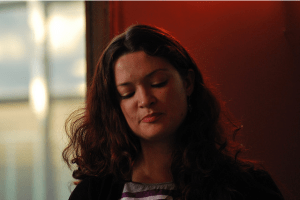
Jennifer Cooke will be reading at the next Other Room on Wednesday 26th October at The Old Abbey Inn, on Manchester Science Park. You can read some of her work in onedit issue 11, Great Works and “Intercapillary Space”. Previews of SJ Fowler and Colin Herd to follow soon.
For your diary our next scheduled events are as follows:
October 26th 2011, 7.00 @ Old Abbey Inn, Manchester, The Other Room with Jennifer Cooke, Colin Herd & Steven Fowler
February 29th 2012, 7.00 @ Old Abbey Inn, Manchester, The Other Room with Andrea Brady, nick-e melville & Tim Allen
April 19th 2012, 7.00 @ Old Abbey Inn, Manchester, The Other Room 4th birthday with Tony Lopez, Paula Claire, Becky Cremin & Elena Rivera
The date and line-up for our autumn reading are now confirmed. It will be on Wednesday 26th October and the readers will be Jennifer Cooke, Colin Herd and SJ Fowler. Between now and then, we have Chris Goode, Jonny Liron and Tamarin Norwood on 20th July and David Berridge, Rachel Lois Clapham and Phil Terry on 24th August. All three events take place at our usual venue, The Old Abbey Inn on Manchester Science Park.
Xing the Line returns with a new venue.
Wednesday, April 20 · 7:30pm – 10:30pm
The Apple Tree, 45 Mount Pleasant, London, WC1X 0AE
 otherroom.org