
Jeff Hilson, From ORGAN MUSIC: AN ANTI-MASQUE NOT FOR DANCING, a new and ongoing narrative and non-narrative sequence (not) about the English organ adding obfuscation to an already obfusced instrument. Available now at the Crater Press site.
Jeff Hilson
James Harvey memorial reading – films
On the evening of July 19th 2012, a large group of friends, family and fellow poets met in the Keynes Library, in Birkbeck college, in London’s Bloomsbury to celebrate the life and work of the British innovative poet, James Harvey.
James Harvey (1966–2012) studied biology at UCL before becoming a full-time poet in the thriving experimental and innovative poetry community in London. His interest in science, especially biology, extended into his poetry. He was fascinated by the potential of ‘science in poetry to dismantle existing structures, and then put them back together again, build them up “mechanically” while at the same time each level of complexity is acted upon equally through “the forces of nature,” questioning the integrity of the structure.’
Jeff Hilson and Holly Pester above. Full list below:
- Carol Watts http://www.youtube.com/watch?v=OWzymLZEBLw
- Edward Carey http://www.youtube.com/watch?v=7xwHGtrq59U
- Elizabeth McCracken http://www.youtube.com/watch?v=lkW7BVb5_JA
- Will Rowe http://www.youtube.com/watch?v=j-SPcopjd3Y
- Jeff Hilson & Holly Pester http://www.youtube.com/watch?v=uhZcXbPPy1o
- Gavin Selerie http://www.youtube.com/watch?v=HgL0AWEBxfY
- James Wilkes http://www.youtube.com/watch?v=D8ie6_xTo9c
- matt martin http://www.youtube.com/watch?v=hVZosMmfRQ4
- Mendoza http://www.youtube.com/watch?v=0mamUo4UpfQ
- Antony John & David Miller & Juliet Troy & Keith Jebb http://www.youtube.com/watch?v=wqE-xJ2pKe8
- Stephen Mooney http://www.youtube.com/watch?v=COiU3fizr80
- David Miller http://www.youtube.com/watch?v=-wPxlll0Fpg
- John Gibbens http://www.youtube.com/watch?v=ES2nJWKkL7I
- Michael Zand http://www.youtube.com/watch?v=4PoP3_dGXjM
- Justin Katko http://www.youtube.com/watch?v=xFMU5S9Az9E
- Stephen Emmerson http://www.youtube.com/watch?v=5vZSIOK0yA0
- Peter Philpott http://www.youtube.com/watch?v=XWlvxCqP9c8
- SJ Fowler http://www.youtube.com/watch?v=KiYXEshmEQk
- Elizabeth Guthrie http://www.youtube.com/watch?v=Qq30tnvMcHo
James Harvey Memorial reading
Veer Books / Xing the Line / Writers Forum Workshop (New Series) and The Blue Bus have come together to celebrate the life and poetry of James Harvey, who died last month. This memorial reading will take place at Birkbeck College on Thursday 19th July, from 18.00-21.00. The address is Keynes Library, Birkbeck Centre for Poetics, School of Arts, 43 Gordon Square, London WC1H 0PD. (When you come in to the foyer, ask the person on the front desk who will give directions – it’s a room on the first floor overlooking the square.) Readers/performers will include Carol Watts, Will Rowe, James Wilkes, matt martin, Jeff Hilson, Holly Pester, Michael Zand, Stephen Emmerson, Juliet Troy, John Gibbens, Keith Jebb, David Miller, Antony John, Edward Carey, Peter Philpott, S J Fowler, Elizabeth Guthrie, and The Children (Armorel Weston and John Gibbens).
Please note that this is a free event.
James Harvey
James Harvey (1966–2012) studied biology at UCL before becoming a full-time poet in the thriving experimental and innovative poetry community in London .
His interest in science, especially biology, extended into his poetry. James took part in a forum discussion with Rae Armantrout, Amy Catanzano, John Cayley, Tina Darragh, Marcella Durand, Allen Fisher, Peter Middleton, Evelyn Reilly and Joan Retallack on the interaction of poetry and science, hosted by Jacket 2. He was fascinated by the potential of ‘science in poetry to dismantle existing structures, and then put them back together again, build them up “mechanically” while at the same time each level of complexity is acted upon equally through “the forces of nature,” questioning the integrity of the structure.’
The importance of ecology in his work is evident in one of his best poems, ‘Mackerelling’. This was published in Veer Away (Veer 2007) and subsequently became his first book (Intercapillary Editions 2009). The poem ‘is a movement through water … an exercise in naming as pattern’. As James explained: ‘Marguerite White sent me cardboard cuttings out in the shapes of sea birds she had used for one of her installations, I had been watching David Attenborough’s The Blue Planet and the idea for the poem came shortly after. At the back of my mind was also Bob Cobbing’s poem “alphabet of californian fishes” … one of my favourite poems.’
James was a regular at Writers Forum Workshop and many of his poems have a strong visual element, showing Cobbing’s influence. Part of his poem ‘Living Rock Ode’ (in Freaklung 2010) included a diagram of a marine plankton that he sounded when reading the poem. James read in honour of Jennifer Pike-Cobbing in 2010 with his work featuring in AND13 (Writers Forum 2010) produced to mark the event. Later he was part of Writers Forum Workshop (New Series), his work appearing in its first publication (Writers Forearm 2011).
Veer published a chapbook Temporary Structures in 2009 and included his work in Veer Off (2008) and Veer About (2011) in addition to Veer Away. He was published in the Openned magazine (2006) and Openned Issues 2006-07 (2008). In 2009, Openned brought out an e-pamphlet, Parts Composers, and Kater Murr’s press published a broadsheet From Marx’s Capital. James was featured in the anthology In the Company of Poets (Hearing Eye 2003).
James’s readings in London included the Blue Bus in 2008 with Nina Zivancevic and Vahni Capildeo and in 2010 with Harriet Tarlo, David Miller and Ken White. He read at Crossing the Line in 2009 with James Wilkes, Jon Clay, Antony John and Out to Lunch.
James was also part of a group of poets who travelled to Newcastle upon Tyne to celebrate Barry MacSweeney in a reading at Morden Tower in 2010. James read from his Japheth series, written in collaboration with Edinburgh-based poet Jow Lindsay. Other work appeared in Herbarium (2011), also with an associated reading, or were published online in Greatworks and Jacket, with work also appearing in Brittle Star magazine, Poetry Salzburg Review and the Morning Star.
James Harvey discussing poetry and science with other poets in Jacket 2 is here http://jacket2.org/features/archive?page=1
James Harvey’s poem ‘Mackerelling’ (2007) can be downloaded free from http://www.lulu.com/shop/james-harvey/mackerelling/ebook/product-4880571.html;jsessionid=2AF6BA9D292AC56685B11016B5DC1DCF
Video of James Harvey reading in honour of Jennifer Pike-Cobbing in 2010 http://www.openned.com/writers-forum-jennifer/?currentPage=4
Veer About (Veer 2011) can be downloaded free via http://www.bbk.ac.uk/cprc/publications/Veer_Publications/Veer037
James Harvey’s work in the Openned magazine (2006) is here http://www.openned.com/epubs/2009/9/28/openned-magazine.html
James Harvey’s work in Openned Issues 2006-07 (Openned 2008) is here http://www.openned.com/epubs/2009/9/28/openned-issues-2006-2007.html
James Harvey’s Parts Composers (Openned 2009) is here: http://www.openned.com/epubs/2009/9/28/parts-composers.html
Video of James Harvey reading at Morden Tower in 2010 (including ‘Living Rock Ode’ and Japheth poems)
James Harvey
James Harvey (1966–2012) studied biology at UCL before becoming a full-time poet in the thriving experimental and innovative poetry community in London .
His interest in science, especially biology, extended into his poetry. James took part in a forum discussion with Rae Armantrout, Amy Catanzano, John Cayley, Tina Darragh, Marcella Durand, Allen Fisher, Peter Middleton, Evelyn Reilly and Joan Retallack on the interaction of poetry and science, hosted by Jacket 2. He was fascinated by the potential of ‘science in poetry to dismantle existing structures, and then put them back together again, build them up “mechanically” while at the same time each level of complexity is acted upon equally through “the forces of nature,” questioning the integrity of the structure.’
The importance of ecology in his work is evident in one of his best poems, ‘Mackerelling’. This was published in Veer Away (Veer 2007) and subsequently became his first book (Intercapillary Editions 2009). The poem ‘is a movement through water … an exercise in naming as pattern’. As James explained: ‘Marguerite White sent me cardboard cuttings out in the shapes of sea birds she had used for one of her installations, I had been watching David Attenborough’s The Blue Planet and the idea for the poem came shortly after. At the back of my mind was also Bob Cobbing’s poem “alphabet of californian fishes” … one of my favourite poems.’
James was a regular at Writers Forum Workshop and many of his poems have a strong visual element, showing Cobbing’s influence. Part of his poem ‘Living Rock Ode’ (in Freaklung 2010) included a diagram of a marine plankton that he sounded when reading the poem. James read in honour of Jennifer Pike-Cobbing in 2010 with his work featuring in AND13 (Writers Forum 2010) produced to mark the event. Later he was part of Writers Forum Workshop (New Series), his work appearing in its first publication (Writers Forearm 2011).
Veer published a chapbook Temporary Structures in 2009 and included his work in Veer Off (2008) and Veer About (2011) in addition to Veer Away. He was published in the Openned magazine (2006) and Openned Issues 2006-07 (2008). In 2009, Openned brought out an e-pamphlet, Parts Composers, and Kater Murr’s press published a broadsheet From Marx’s Capital. James was featured in the anthology In the Company of Poets (Hearing Eye 2003).
James’s readings in London included the Blue Bus in 2008 with Nina Zivancevic and Vahni Capildeo and in 2010 with Harriet Tarlo, David Miller and Ken White. He read at Crossing the Line in 2009 with James Wilkes, Jon Clay, Antony John and Out to Lunch.
James was also part of a group of poets who travelled to Newcastle upon Tyne to celebrate Barry MacSweeney in a reading at Morden Tower in 2010. James read from his Japheth series, written in collaboration with Edinburgh-based poet Jow Lindsay. Other work appeared in Herbarium (2011), also with an associated reading, or were published online in Greatworks and Jacket, with work also appearing in Brittle Star magazine, Poetry Salzburg Review and the Morning Star.
James Harvey discussing poetry and science with other poets in Jacket 2 is here http://jacket2.org/features/archive?page=1
James Harvey’s poem ‘Mackerelling’ (2007) can be downloaded free from http://www.lulu.com/shop/james-harvey/mackerelling/ebook/product-4880571.html;jsessionid=2AF6BA9D292AC56685B11016B5DC1DCF
Video of James Harvey reading in honour of Jennifer Pike-Cobbing in 2010 http://www.openned.com/writers-forum-jennifer/?currentPage=4
Veer About (Veer 2011) can be downloaded free via http://www.bbk.ac.uk/cprc/publications/Veer_Publications/Veer037
James Harvey’s work in the Openned magazine (2006) is here http://www.openned.com/epubs/2009/9/28/openned-magazine.html
James Harvey’s work in Openned Issues 2006-07 (Openned 2008) is here http://www.openned.com/epubs/2009/9/28/openned-issues-2006-2007.html
James Harvey’s Parts Composers (Openned 2009) is here: http://www.openned.com/epubs/2009/9/28/parts-composers.html
Video of James Harvey reading at Morden Tower in 2010 (including ‘Living Rock Ode’ and Japheth poems)
Xing the Line
Wednesday, 18 July 2012, 19:30, The Apple Tree, London WC1X.
- Frances Presley
- Gavin Selerie
Maintenant #92 – Jeff Hilson
Now more than ever, if there exists a measure of what one could call a national character, indelible and prescriptive, it seems unlikely it can be held in the terms we seem to utilize. The limited, faded suggestions of temperament, appearance and culture are increasingly fraught. The valuable misnomer that the poetic in poetry is that which is lost in translation is a fair indication of how national character is found in the lack of a culture’s culture. I can only truly speak of England and Englishness, and what I deem to be its immovable quality, both its worst and it’s best feature – an unpretentious melancholy, a moaning disposition laced with satire, a call to arms without action, a sadness that has not the melodrama to make it public, a desire for privacy, a wit and observational keen which is razor sharp and practically dull. When an artist can build this ungraspable quality into the very fabric of their work, you know they can only have done so without preparation or motive. Jeff Hilson, as a master of this vernacular, stands as one of the most singular and gifted poets of his generation. Hilson’s use of distinctive vocabulary, a lexicon of the banal, utilises a finesse that pales the false poetic posturing of those working in circles created by perceptions of what has come before and held as the established “tone” of English poetry. He is the creator of poetic vignettes, an imagery not of the surreal but of the proto-mundane, couched in the wry, unpretentious drawl of a fogged civil servant, tired but not fatigued, worn but not broken. Hilson elevates the speech of the lived life, accelerates it, never seeking out absurdity, rather that would be too much agency for the singular voice purveying lines of observation and reflection. His poetic is not one of alarm, not one of lamentation – it is poetry of urbanity. Hilson’s mode is to shed light on the ever present – what we seem not to have noticed in its readiness, the pitted corners of language which are fundamentally drole and bloodless. Hilson exposes too the churlishness of the poet who takes no time to examine their own position, the ego behind the pen. His honesty, his lyrical inventiveness, his affected bleakness produces a strong sensation in its readers / listeners because of its central truth. It is then a poetry that is necessary because the poet does not profess its necessity. Only the reluctant can offer the objective truth that poetry must evolve, that it must be allowed to warp and break and rejoin in order to be in anyway new, and in being new, represent a culture that is truly contemporary. And even then, only within a form of an apology. Against Hilson’s work the concept of the poetic soul, the poetic pretension, is exposed as a welcome fraud. The melodrama of poetry is refuted and we are left instead with a very English sagacity of intellect and poise. In an attempt to utilise the Maintenant series to present poets to Europe, as well as from Europe, we present, for our 92nd issue, one of most remarkable poets of his generation, Jeff Hilson.
http://www.3ammagazine.com/3am/maintenant-92-jeff-hilson/
Accompanying the interview is Jeff’s seven part poem Rinker, generously given over to the Maintenant series.
Stort Poetry Group: Jeff Hilson
The Stort Poetry Group is organised by Peter Philpott and meets monthly, first Wednesday of the month, at 7.30, upstairs in Waterstone’s, South Street, Bishops Stortford. The next meeting will feature a reading by Jeff Hilson.
The Camarade project: édition II
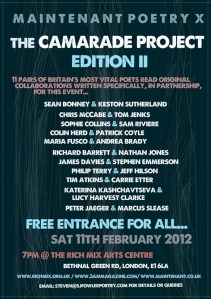
Xing the Line
Wednesday, February 15, 2012, 7:30pm, The Apple Tree, Mount Pleasant, London WC1X. Becky Cremin and Alan Halsey.
Polyply 14 > MEASURE
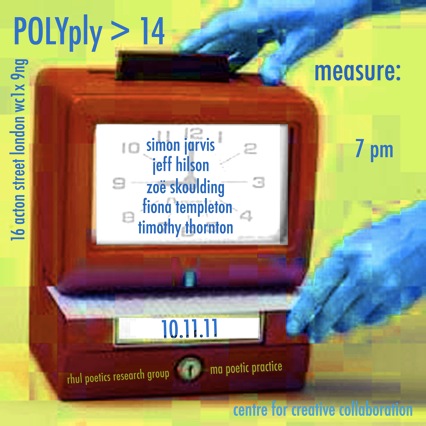
POLYply > 14: MEASURE
Jeff Hilson
Simon Jarvis
Zoë Skoulding
Fiona Templeton
Timothy Thornton
Thursday 10 November, 7pm
The Centre for Creative Collaboration
16 Acton Street, London WC1X 9NG
Free entry
Xing the Line: Amy Evans, Christie Ann Reynolds & Marcus Slease
Wednesday, July 27 · 7:30pm – 10:30pm. Upstairs @ The Apple Tree, 45 Mount Pleasant, London WC1X 0AE. More here.
Xing The Line
Xing The Line/CPRC Birkbeck presents: Karen Mac Cormack, Steve McCaffery, Bill Bissett and Adeena Karasick. Thursday 02 June 2011, 7.00pm start, 32 Tavistock Square, London WC1. More here.
Galatea Resurrects
The vital reviews journal continues to give us such goodies.
Of immediate note are reviews of P. Inman, Derek Henderson, Jeff Hilson and Place & Fitterman’s Notes on Conceptualism.
A reluctant bulldozer
S.J. Fowler reviews Jeff Hilson’s In The Assarts for 3AM, here.
Xing the Line – November 2010
Xing the Line: Eleni Sikelianos & Laird Hunt
Wednesday, November 10 at 7:30pm
Location: William IV pub, 7 Shepherdess Walk, London, United Kingdom, N1 7QE
July readings now online
3 readings from The Other Room, 7th July 2010. More to follow.
Derek Beaulieu
Vodpod videos no longer available.
Click here to open the film in a bigger screen.
Jeff Hilson
Vodpod videos no longer available.
Click here to open the film in a bigger screen.
Keston Sutherland
Vodpod videos no longer available.
Click here to open the film in a bigger screen.
July interviews
Interviews with 3 of the readers at The Other Room, 7th July 2010. More to follow.
Derek Beaulieu
Vodpod videos no longer available.Click here to open the film in a bigger screen.
Jeff Hilson
Vodpod videos no longer available.Click here to open the film in a bigger screen.
Keston Sutherland
Vodpod videos no longer available.Click here to open the film in a bigger screen.
Jeff Hilson – In the Assarts

OUT NOW from Veer
Preview of Other Room reader 7th July – Jeff Hilson
Cannibal Spices 4
Openned publish issue 4 with Jeff Hilson, Ken Edwards, Timothy Thornton & Linus Slug:
Guardian Reveals ‘Top Ten Poetry of the Noughties’
In its festive merriment, and review of the culture of the decad,e The Guardian takes a closer look at what’s been important over the last ten years in the world of poetry.
1. Miles Champion Three Bell Zero
2. Christian Bok Eunoia
3. Tim Atkins Horace
4. Peter Manson Adjunct: A Digest
5. Tom Raworth Collected Poems
6. P. Inman Ad Finitum
7. Ron Silliman The Alphabet
8. Tom Jenks A Priori
9. Caroline Bergvall Fig
10. Jeff Hilson (ed.) The Reality Street Books of Sonnets
 otherroom.org