
Rob Holloway interviewed by The Other Room, February 3rd 2010. Part of The Other Room interview series.
Vodpod videos no longer available.
Click here to open the film in a bigger screen.
Rob Holloway interviewed by The Other Room, February 3rd 2010. Part of The Other Room interview series.
Vodpod videos no longer available.
Click here to open the film in a bigger screen.
Films of all three readers who performed at The Other Room on February 3rd are now available (see below). Interviews with Rob Holloway, Holly Pester and Steven Waling will be available on Monday morning.
Rob Holloway reads at The Other Room, February 3rd 2010.
Vodpod videos no longer available.
Click here to open the film in a bigger screen.
Steven Waling’s reading for The Other Room, February 3rd 2010.
Vodpod videos no longer available.
Click here to open the film in a bigger screen.
Technical problems have dogged this upload, but should be resolved now. This version of Alan’s reading at the very first Other Room on April 9th 2008 should take seconds rather than minutes to load.
Vodpod videos no longer available.
Click here to open the film in a bigger screen.
Interesting discussion of February’s readers and notions of performance in poetry and performance in general. Snippet below:
Despite snow there were around thirty people at The Old Abbey Inn for the latest Other Room reading on Wednesday. The readers were Steven Waling, Holly Pester and Rob Holloway. To be honest I found my attention wandering a lot throughout the evening so my account will be pretty unreliable. That wasn’t the poets’ fault, it’s just been a hazy kind of a week, but it may have contributed to some of the misgivings I had that will become apparent.
Sean Bonney and I will be talking about Bill Griffiths’ Collected Earlier Poems on the BBC’s The Verb with Ian McMillan this Friday.
The programme is broadcast on BBC Radio 3 on Friday 5 February at 21:15 GMT, and is available to listen to on the BBC iPlayer for a week thereafter.
Slightly more details at
http://www.realitystreet.co.uk/kens-blog/bill-griffiths-on-radio-3
and more about the book at
http://www.realitystreet.co.uk/bill-griffiths.php
Via Ken Edwards
Absolute Elsewhere, the latest collaboration between writer James Davies and photographer Simon Taylor continues to unfold with this month’s instalment, a photograph by Simon. See the latest and catch up with the project so far here.

Out now, featuring poetry from James Davies, Julius Kalamarz and Holly Pester. Click here for more information.
Geof Huth describes the huge overhauls in edits the wonderous book has seen to date –
For the past few days, I’ve been working on the text of my next book. And I have to use the word “text,” because what I’m working on is the layout of the book, but it is also the manuscript of the book. As I work on the book, I remember other poems, tucked here and there in my life, in my memory, in my house. And I pull them out and put them in. The text has grown to 775 words, still not the longest book of pwoermds ever, which honor belongs to the marvelous Finn Karri Kokko.
The third introduction to our three February readers: Steve Waling. Click on the links.
Next week of course is The Other Room – see flier for details.
Poems
Review of Travelator
Blog
The first in a new series of audio conversations conducted by the extremely busy boys at Openned.
First off Harry Godwin. Expect more deliciousness and saucy moves very soon.
Fact sheet below.
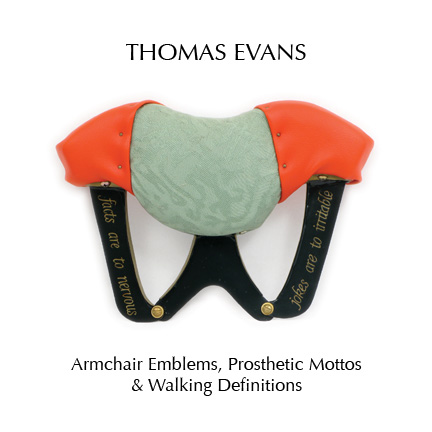
See more emblems at onedit – LINK
Armchair Emblems, Prosthetic Mottos & Walking Definitions:
Fact Sheet
“I am on the hunt for constructions. I come into a room and find them whitely merging in a corner.” –Franz Kafka, Diaries
“In my life the furniture eats me.” –William Carlos Williams, Spring & All
EMBLEM
Invented in 1531 by a Florentine legal scholar named Andrea Alciato, the emblem is a tripartite structure composed of a motto or epigram (generally moral in theme), an icon (often referred to as the emblem’s ‘body’) and a commentary on the two in prose or poem form. Many emblems made variations on this formula.
ARMCHAIR EMBLEM
The upholstered emblem or armchair emblem incorporates only the epigram/motto and image tension of the Renaissance emblem but retains its conceptual gist and glyphic structure.
PROSTHETIC MOTTO
An aspirational embodiment or transcorporation for the body-image. “Building the muscles of mind’s legs.” Enhanced mobility via an ingested foreign body.
TRANSCORPORATION
A translation from one body to another. An ingestion or introjection.
WALKING DEFINITION
An indoor walking stick that defines constituents of the built interior as allegories of mind. A measure. A ‘getting underway’ instrument, frequently ‘left around.’
BUILT INTERIOR
An indoor pedestrian structure comprised of mobile furniture for the solicitation of thinking. An allegory of mind.
SOLICITATION
The directed rousal of thinking through upholstered didactic prompts or forms (an intelligent furniture).
FORMS
Ornaments of thought. Including: the glyphic (static—the emblem); the mnemonic (transcorporable—the prosthetic); the definitive (the Walking Definition).
FURNITURE
What is lived with. “The relation of with.” Any instrument or form housing information intended to be absorbed by accompaniment.
–THOMAS EVANS
The first introduction to our three February readers: Rob Holloway. Click on the links.
Next week Holly Pester.
From Permit
Criticism
In conversation with Will Rowe
Audio
More wonderfulness from onedit:
Amina Cain
Lucy Harvest Clarke
Ray DiPalma
Tom Leonard
Joe Luna
Tim Atkins
 If in New York
Exhibition starts:
January 13 – February 12, 2010
Opening Wednesday, 13 January, 6-8 pm
Turtle Point Press
The Woolworth Building
233 Broadway, Room 946
New York, NY 10279
If you’re in China, near the Jiao Tong Teahouse, catch up with Phil Davenport’s poetry/art exhibition,Speak is Code
Jiao Tong Teahouse 27-30 December 2009
Yao Bo, Philip Davenport, Wang Jun
Jiao Tong Teahouse is a mesh of conversations, meetings, deals made, gambling, gossip and over it all, parrots swing on their perches, aping the human noise. It is an intersection and into it the work of three artists is placed for Speak is Code. The works explore the space between us all, locate the holes in language and – as Davenport’s poem says – “The impasse between skin.”
Yao Bo, ceramicist and painter premieres a version of her continuing major work On Reading Beckett: a long text response to Beckett is handwritten in Chinese script onto manuscript paper. “I was murmur-reading Beckett, muttering to myself. The poem shot sunlight from faraway into my thoughts…” As counterpoint, a series of collapsed pots – like collapsed lungs – are placed onto each piece of paper. From some of the pots comes the sound of the piece being read aloud. Yao Bo’s work explores the delicate seams of identity – where we join and where we fall apart. “These pieces of pottery are like the organs of no-body. Some silent, some murmuring, some…”
My Paintings are Invisible by Philip Davenport is a poem sequence combining Chinese and Western alphabets. The work is dedicated to Hai Zi (1965-89) the Chinese poet. Alphabets of East and West entwine to make word pictures, ‘invisible paintings’, each given an imaginary colour. They are on translucent paper, scripted half in Chinese (by Chinese artists) and half in English. The two alphabets sometimes join, sometimes separate. These are ‘paintings’ of absence, images that never grow clear – and Hai Zi becomes a symbol for all who are missing, all that we cannot say.
(txt/work, Wang Jun 2009)
Wang Jun is an artist whose works balance meaning against nothing. His recent pieces cross-breed industrial processes with the landscapes of hanzi that fill his paintings. He crunches together the Tao Te Ching, Wiggenstein and postmodernity into mould-pressed misfits. He will install a bookshelf of unreadable materials in the teashop.
Exhibition curated by Philip Davenport, artist in residence 501 Artspace. Contributing artists to My Paintings are Invisible; Dan Ting, Deng Chuan, Mao Yan Yang, Pang Xuan, Wang Jun, Xu Guang Fu, Yan Yan, Zheng Li; translation Deng Chuan, Yan Yan and Zhong Na.
In its festive merriment, and review of the culture of the decad,e The Guardian takes a closer look at what’s been important over the last ten years in the world of poetry.
1. Miles Champion Three Bell Zero
2. Christian Bok Eunoia
3. Tim Atkins Horace
4. Peter Manson Adjunct: A Digest
5. Tom Raworth Collected Poems
6. P. Inman Ad Finitum
7. Ron Silliman The Alphabet
8. Tom Jenks A Priori
9. Caroline Bergvall Fig
10. Jeff Hilson (ed.) The Reality Street Books of Sonnets
More from Absolute Elsewhere, James Davies’ and Simon Taylor’s collaborative text and image project. December’s instalment is a poem from James.
More here.
 otherroom.org