
Video of Mark Leahy’s recent performance at The Other Room –
Writing in Practice – Volume 2
Now available at NAWE – http://www.nawe.co.uk/DB/current-wip-edition-2/editions/writing-in-practice-vol.-2.html
Wayne Clements: Lives of the Saints
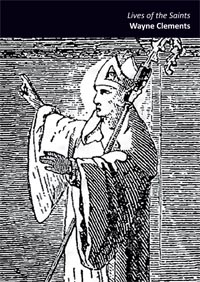
Wayne Clements, writer and artist, studied fine art at Chelsea College of Art and Design, where he researched machine methods of generating text. His artwork has been widely exhibited internationally. First published by Bob Cobbing’s Writers Forum Press in the 1990s, eight books of poetry and visual work have followed. Recent publications include: Clerical Work (2010, Veer), Western Philosophy (2011, Knives, Forks and Spoons), Archeus (2012, Depart), Variant Lines (2013, Red Ceilings), and Eutropius (2013, Hassle).
Kenya (with Johan de Wit and Antony John) is due from Veer in 2016. Lives of the Saints out now on The Red Ceilings Press.
Joey Frances: DATA/SETS
Soon to be Other Room reader Joey Frances has a website, here. Joey also co-organises the Manchester reading series Peter Barlow’s Cigarette.
Verdant Intersections
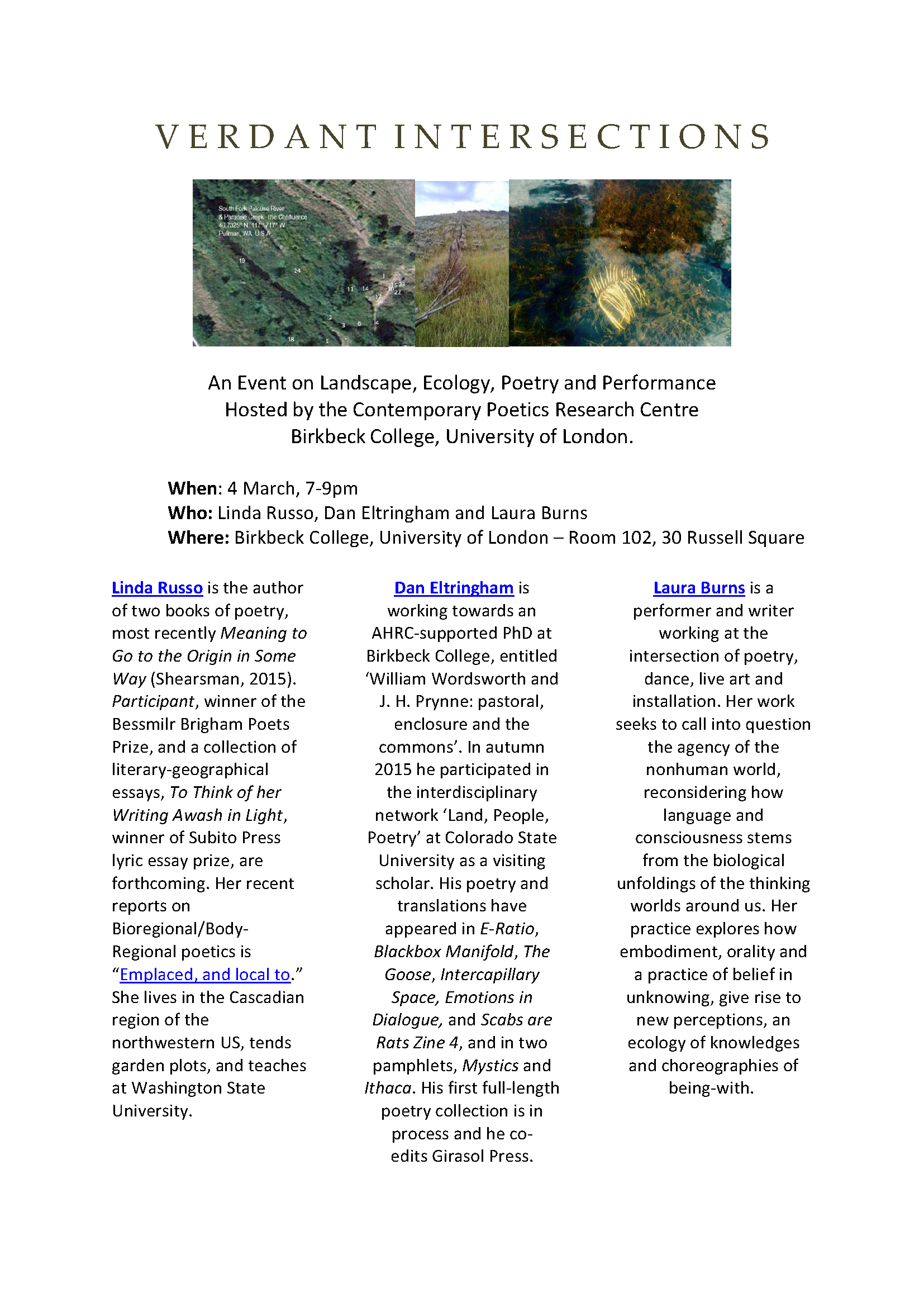
Poetry, Creativity, and Environment
26th and 27th February 2016. A collaboration between Leeds University Poetry Centre and the Environmental Humanities Research Group in the School of English
Organisers: John Whale, Fiona Becket, David Higgins, Amy Cutler
This symposium brings together poets, established scholars, and Early Career Researchers to explore the interface between poetry and the environment. It will focus in particular on the creative process and consider how poetry and the natural world are in reciprocal engagement in the business of composition. One of its primary concerns will be to discern whether there are distinctive aspects to the writing of poetry in the context of environment and in the wider frame of eco-poetics. This will include both critical and creative questions, including the politics of environmental emergency, forms and techniques of individual practice, and modes of specific work.
It will take the form of: two sessions of public readings by the poets at either end of the symposium; two round tables, one in which the poets reflect on their creative processes and another in which critics engage with Eco-poetry; a PGR/ Early Career Panel on poetry and environment ranging across historical periods, and a visual display by artist Judith Tucker.
Poets include: Madeleine Lee, Lucy Burnett, Harriet Tarlo, Zoe Skoulding, Amy Cutler, Yvonne Reddick, Melanie Challenger, and Samantha Walton
Critics include: Fiona Becket, Sam Solnick, John Parham, David Borthwick, David Farrier,
ECR/PGE Panel: Carl McKeating, Anna Fletcher, Emma Trott, Julia Tanner, Anna Antonova, Lucy Rowland, Eleanore Widger
Black Market Re-view
Produced by Creative Writing students at Edge Hill University, Black Market Re-view features poetry and prose, with contributors including Other Room reader SJ Fowler. Issue 1 out now.
Poem Talk 97 on Larry Eigner
PoemTalk #97—a discussion of three poems by Larry Eigner with Daniel Bergmann, Ron Silliman and Michael Kelleher:
Yellow Lines Drawn on Sheets of A4 Paper and then Placed in a Box – Episode 1
A performance of James Davies’ project Yellow Lines Drawn on Sheets of A4 Paper and then Placed in a Box is now available. More episodes to follow.
The Recluse now seeking submissions
We are now accepting submissions for The Recluse 12! All work must be submitted via email to info@poetryproject.org with “Recluse” in the subject line. Please title your word file submission with your last name and the word “Recluse.”
The Recluse is published annually each Spring, and edited by the staff of The Poetry Project. For PDFs of past issues, visit our website. With issue 10, The Recluse moved from print to an online journal.
We suggest that people read an issue or two before submitting work! We are primarily interested in poetry and translations, but will consider other work as well.
The Fundamental Questions
Thanks to all who came to last night’s Other Room. Part of the evening was an audience performance of Vicki Bennett and Gregor Weichbrodt’s The Fundamental Questions, which you can watch above in all its beautiful cacophony. Our next event is on Wednesday 13th April when we will be celebrating our eighth birthday with performances by THF Drenching, Linda Kemp, Gary Fisher and Roseanne Robertson.
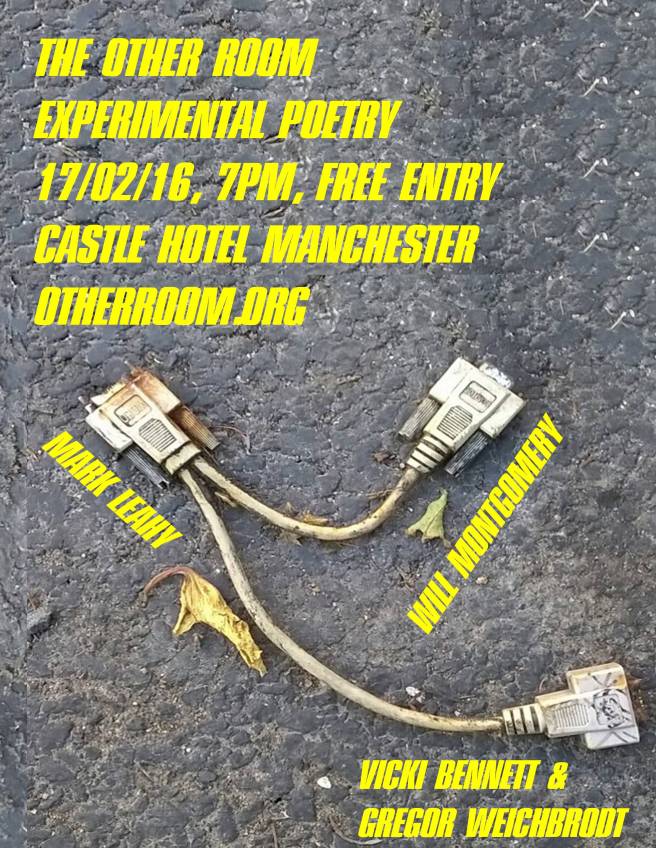
The Other Room – Tonight
Hope to see you there.
Storm and Golden Sky
FRIDAY 26th February 2016. Storm and Golden Sky at the Caledonia. Lizzie Nunnery and Scott Thurston. Up the stairs (at the back of the barroom, above the pub name, above) at the Caledonia pub, Catharine Street, in the Georgian Quarter, Liverpool, £5, 7.30 pm spot-on start (but slightly later start than previously)!
Burnt Poetry: Ivor Davies and Destruction
Conference details and late call for papers about the current exhibition on Ivor Davies’ work.
See poster below.

Cardiff Poetry Experiment
Thursday, February 25th, 7 PM. Waterloo Tea at the Wyndham Arcade, 21-25 Wyndham Arcade, Cardiff, CF10 1FH.
LYNDON DAVIES: author of A Colomber in the House of Poesy and editor of Aquifer Books
AMY McCAULEY: poetry editor at New Welsh Review
RHYS TRIMBLE: author of Swansea Automatic, Rejectamenta, and Hexerisk
About the Poets:
Lyndon Davies has published three collections of poetry, Hyphasis (Parthian Press 2006), Shield (Parthian Press 2010) and A Colomber in the House of Poesy (Aquifer 2014). He runs the Glasfryn Seminars, a series of discussion groups on aspects of literature and art, and recently set up Aquifer Books, which publishes mainly poetry-centred writing with an experimental bias. He also edits an online magazine of art and literature called Junction Box.
Amy McCauley’s poetry, essays and reviews have appeared widely in magazines and anthologies including: The Poetry of Sex (Viking), Hallelujah for 50ft Women (Bloodaxe), Best British Poetry 2015 (Salt), Poetry Wales, Magma and The Rialto. Current projects include a collection of poems (Auto-Oedipa), which re-imagines the Oedipus myth, and a verse novel (CaNToS of JoaN).
Rhys Trimble is a Welsh poet, performer, avant garde chef and honey badger enthusiast, studying for a PhD, author of 10 or more chapbooks, recents include: SWANSEA AUTOMATIC (experimental novel) (Aquifer), REJECTAMENTA (contraband) and HEXERISK (knives forks and spoons).
Clasp

Late Modernist Poetry in London in the 1970s, with contributions from: Gilbert Adair, Peter Barry, Clive Bush, Paula
Claire, Ken Edwards, P.C. Fencott, Paul A. Green, Robert Hampson, Anthony Howell, Tony Lopez, David Miller, John Muckle, Frances Presley, Elaine Randell, Will Rowe, Gavin Selerie, Robert Sheppard, Iain Sinclair, Valerie Soar, Lawrence Upton, Robert Vas Dias, Stephen Watts, John Welch. Out now on Shearsman.
Will Montgomery: February Preview
Will graduated from Emmanuel College, Cambridge, with a degree in English in 1987. After a period outside academia, he took the Literature, Culture, Modernity MA at Queen Mary, University of London, receiving the Marjorie Thompson award for outstanding academic achievement in 1999. He remained at Queen Mary for his AHRB-funded PhD, which was devoted to the writing of contemporary American poet Susan Howe. He subsequently taught poetry, modernist literature and critical theory at Queen Mary and at Southampton University. In January 2007 he joined Royal Holloway as RCUK research fellow in contemporary poetry and poetics. He is director of the department’s Poetics Research Centre and a co-organizer of that group’s POLYply reading and performance series.
Recent publications include The Poetry of Susan Howe (Palgrave, 2010) and the essay collection Frank O’Hara Now (Liverpool UP, 2010), which he co-edited with Robert Hampson. He is currently working on a study of short form in modernist and contemporary US poetry, and co-editing an edited collection on field recordings and literature. Will also works with audio, making field recordings, sound art and music.
Follow this LINK to hear some of his sound work, including pieces with Other Room reader Carol Watts.
The Anchored Terset
Not quite ‘new’ as these articles claim, remember:
frog
pond
plop!
but of interest, especially the generator that riffs on the NPL acronym, Get tweeting – Minimalism’s sticky end.
More at NORTHERN POETRY LIBRARY
And some opinions at The Guardian – yes!
The Enemies Project: spring programme
The Enemies Project Spring Programme 2016 includes Icelandic, Argentinian and Georgian Enemies projects, Camarade events in Essex and St.Andrews, the return of Kakania in London and Berlin, a collaborative exhibition in Newport, a collaborative event involving five Universities and a one day festival celebrating English PEN and their writers-at-risk project. More at the Enemies site.
B S Johnson Journal – Call for papers
Via Joe Darlington
Call for papers – The B.S. Johnson Journal – Issue 3 – Truth
The B.S. Johnson Journal is pleased to announce the new theme for our forthcoming issue : “Truth”. Johnson struggled with questions of truth his entire life and we now invite research papers, journalistic essays, creative writing, reviews and reminiscences all struggling with the same issue. These might entail readings and reassessments of Johnson’s work from contemporary theoretical perspectives, pieces utilising historical or archive research, or new works that have been created based on or responding to Johnson’s work and insights.
Johnson produced a lot of fictional and programmatic efforts aimed at telling the “truth” in the hope that it would make up for the “chaotic” nature of life. Johnson’s now famous assertion that firstly, “the two terms novel and fiction are not … synonymous” and that, secondly, he chose “to write truth in the form of a novel”, have led critics to call his position doctrinaire and solipsistic, if not boring. The third issue of The B.S. Johnson Journal seeks to see how Johnson’s quest for truth in novels extends to his short stories, poetry, journalistic pieces and films.
Julia Jordan, in her introduction to B.S. Johnson and Post-War Literature – Possibilities of the Avant-Garde (2014), points out the paradoxical tension in Johnson’s prose between dogmatism and elusiveness. This reminds us that we need a systematic reading of the treatment and presentation of Truth in Johnson’s work. Indeed, if we take the truth to mean what happened to the author – as he invites us to do in his quoting Beckett in the preface to Albert Angelo: “There is nothing else, let us be lucid for once, there is nothing else than what happens to me” – then Johnson’s prose becomes irrelevant for anyone but himself. Or does it?
Vanessa Guignery (2009) invites us to see beyond the autobiographical truth Johnson wants to lend to his work, to consider instead the phenomenological dimension of which she finds evidence in Johnson’s short story “What Did You Say The Name of the Place Was?”. We therefore invite Johnson’s readers to read beyond the author’s dogmatic judgements to question the resonance of Truth in his work :
– – How do Johnson’s most solipsistic art productions manage to engage the reader or spectator ?
– – What does Johnson’s engagement with Truth tell us about his view of the role art should or could play in Society ?
– – Can his will to tell the Truth be related to the Zeitgeist of the 1960s ?
– – Can Truth be relayed in third-person pronoun narratives ? How does it compare with first-person narratives ?
– – Can self-consciousness be synonymous for truth ?
– – Where does Johnson’s truth locate itself ?
Please submit your work for consideration, along with any enquiries, to the editors at bsjjournal@gmail.com by Monday 2nd May, 2016. We look forward to hearing from you!
 otherroom.org