
The third introduction to our three February readers: Steve Waling. Click on the links.
Next week of course is The Other Room – see flier for details.
Poems
Review of Travelator
Blog
The third introduction to our three February readers: Steve Waling. Click on the links.
Next week of course is The Other Room – see flier for details.
Poems
Review of Travelator
Blog
The first in a new series of audio conversations conducted by the extremely busy boys at Openned.
First off Harry Godwin. Expect more deliciousness and saucy moves very soon.

More here.
Nick Thurston reads for The Other Room, 2nd December 2009.
Vodpod videos no longer available.
Click here to view in a larger version.
The first issue of the new journal ‘Cleaves’ is now online at http://www.cleavesjournal.com
Fact sheet below.
See more emblems at onedit – LINK
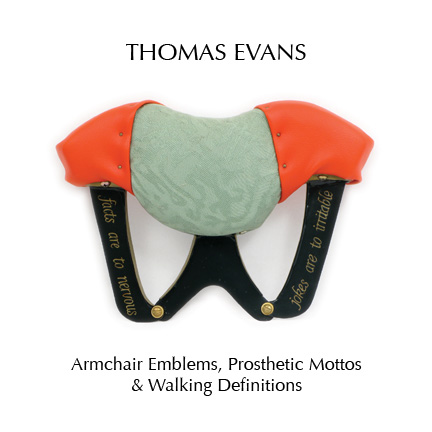
Armchair Emblems, Prosthetic Mottos & Walking Definitions:
Fact Sheet
“I am on the hunt for constructions. I come into a room and find them whitely merging in a corner.” –Franz Kafka, Diaries
“In my life the furniture eats me.” –William Carlos Williams, Spring & All
EMBLEM
Invented in 1531 by a Florentine legal scholar named Andrea Alciato, the emblem is a tripartite structure composed of a motto or epigram (generally moral in theme), an icon (often referred to as the emblem’s ‘body’) and a commentary on the two in prose or poem form. Many emblems made variations on this formula.
ARMCHAIR EMBLEM
The upholstered emblem or armchair emblem incorporates only the epigram/motto and image tension of the Renaissance emblem but retains its conceptual gist and glyphic structure.
PROSTHETIC MOTTO
An aspirational embodiment or transcorporation for the body-image. “Building the muscles of mind’s legs.” Enhanced mobility via an ingested foreign body.
TRANSCORPORATION
A translation from one body to another. An ingestion or introjection.
WALKING DEFINITION
An indoor walking stick that defines constituents of the built interior as allegories of mind. A measure. A ‘getting underway’ instrument, frequently ‘left around.’
BUILT INTERIOR
An indoor pedestrian structure comprised of mobile furniture for the solicitation of thinking. An allegory of mind.
SOLICITATION
The directed rousal of thinking through upholstered didactic prompts or forms (an intelligent furniture).
FORMS
Ornaments of thought. Including: the glyphic (static—the emblem); the mnemonic (transcorporable—the prosthetic); the definitive (the Walking Definition).
FURNITURE
What is lived with. “The relation of with.” Any instrument or form housing information intended to be absorbed by accompaniment.
–THOMAS EVANS
The first introduction to our three February readers: Rob Holloway. Click on the links.
Next week Holly Pester.
From Permit
Criticism
In conversation with Will Rowe
Audio
More wonderfulness from onedit:
Amina Cain
Lucy Harvest Clarke
Ray DiPalma
Tom Leonard
Joe Luna
Tim Atkins
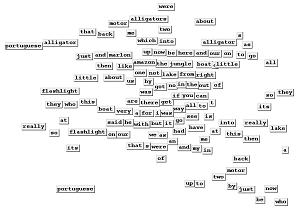
Like hallucinogenic fridge magnets. Try it here.
The next edition of BBC Radio 3’s The Verb will feature an interview with John Ashbery. 8th January 2010, 21:15.
More here.
We’ve already posted about this, but it’s well worth a reminder that Bill Griffiths’ Collected Earlier Poems (1966-80) is now available. Details of this and the upcoming Birkbeck launch event below, via Alan Halsey:
BILL GRIFFITHS: COLLECTED EARLIER POEMS (1966-80)
Published by Reality Street in association with West House Books
This volume brings together for the first time the late Bill Griffiths’ poetry up to ‘Building: The New London Hospital’. The text, edited by Alan Halsey in consultation with Ken Edwards, includes the full ‘Cycles’ and ‘War W/ Windsor’ sequences that so astonished readers when they first appeared, as well as much other poetry that was published by his own Pirate Press imprint, Writers Forum and other small presses during the 1970s; and also poems and performance texts that have only made fleeting appearances in ephemeral pamphlets and magazines, or have never been published before. The works are presented in largely chronological order. Comprehensive endnotes detail both the publishing history and (Griffiths having been an inveterate reviser) variations in texts and alternative versions.
368pp.
ISBN: 978 1874400 45 5
Publication date 29 January 2010
Pre-publication price £17.50 post free
(after January, £18 + post)
Orders to reality.street@virgin.net or info@westhousebooks.co.uk
LAUNCH at Birkbeck, Wednesday 17th February, 7.30
in Room 203, Clore Management Centre (Torrington Square, facing Birkbeck main entrance)
featuring a reading of the complete Cycles by Sean Bonney, Ken Edwards, Allen Fisher, Alan Halsey, Geraldine Monk & Maggie O’Sullivan
 If in New York
Exhibition starts:
January 13 – February 12, 2010
Opening Wednesday, 13 January, 6-8 pm
Turtle Point Press
The Woolworth Building
233 Broadway, Room 946
New York, NY 10279
One must have a mind of winter
To regard the frost and the boughs
Of the pine-trees crusted with snow;
And have been cold a long time
To behold the junipers shagged with ice,
The spruces rough in the distant glitter
Of the January sun; and not to think
Of any misery in the sound of the wind,
In the sound of a few leaves,
Which is the sound of the land
Full of the same wind
That is blowing in the same bare place
For the listener, who listens in the snow,
And, nothing himself, beholds
Nothing that is not there and the nothing that is
a noun sing e·ratio 13 · 2010 · featuring the Alan Halsey interview
with poetry by Laynie Browne, Jill Jones, Jane Adam, Jeff Encke, Joseph F. Keppler, Mark Cunningham, Jadon Rempel, Keith Higginbotham, Anne Fitzgerald, and Halvard Johnson
e·ratio editions e-chaps by Travis Macdonald and Carey Scott Wilkerson and featuring The Alan Halsey Interview
edited for real by Gregory Vincent St. Thomasino
More here.
Small, Matt Dalby’s final CD of sound poetry for 2009 is available now. More here.
If you’re in China, near the Jiao Tong Teahouse, catch up with Phil Davenport’s poetry/art exhibition,Speak is Code
Jiao Tong Teahouse 27-30 December 2009
Yao Bo, Philip Davenport, Wang Jun
Jiao Tong Teahouse is a mesh of conversations, meetings, deals made, gambling, gossip and over it all, parrots swing on their perches, aping the human noise. It is an intersection and into it the work of three artists is placed for Speak is Code. The works explore the space between us all, locate the holes in language and – as Davenport’s poem says – “The impasse between skin.”
Yao Bo, ceramicist and painter premieres a version of her continuing major work On Reading Beckett: a long text response to Beckett is handwritten in Chinese script onto manuscript paper. “I was murmur-reading Beckett, muttering to myself. The poem shot sunlight from faraway into my thoughts…” As counterpoint, a series of collapsed pots – like collapsed lungs – are placed onto each piece of paper. From some of the pots comes the sound of the piece being read aloud. Yao Bo’s work explores the delicate seams of identity – where we join and where we fall apart. “These pieces of pottery are like the organs of no-body. Some silent, some murmuring, some…”
My Paintings are Invisible by Philip Davenport is a poem sequence combining Chinese and Western alphabets. The work is dedicated to Hai Zi (1965-89) the Chinese poet. Alphabets of East and West entwine to make word pictures, ‘invisible paintings’, each given an imaginary colour. They are on translucent paper, scripted half in Chinese (by Chinese artists) and half in English. The two alphabets sometimes join, sometimes separate. These are ‘paintings’ of absence, images that never grow clear – and Hai Zi becomes a symbol for all who are missing, all that we cannot say.
(txt/work, Wang Jun 2009)
Wang Jun is an artist whose works balance meaning against nothing. His recent pieces cross-breed industrial processes with the landscapes of hanzi that fill his paintings. He crunches together the Tao Te Ching, Wiggenstein and postmodernity into mould-pressed misfits. He will install a bookshelf of unreadable materials in the teashop.
Exhibition curated by Philip Davenport, artist in residence 501 Artspace. Contributing artists to My Paintings are Invisible; Dan Ting, Deng Chuan, Mao Yan Yang, Pang Xuan, Wang Jun, Xu Guang Fu, Yan Yan, Zheng Li; translation Deng Chuan, Yan Yan and Zhong Na.
“Independent poetry press Penned in the Margins is now open to submission of manuscripts. Our authors include David Caddy, James Wilkes, Sarah Hesketh and George Ttoouli. This year we published the anthology City State: New London Poetry, featuring new work by Chris McCabe, Heather Phillipson, Steve Willey, Ahren Warner and many more. Our individual collections have been Highly Commended by the Forward Prize, featured on Newsnight and reviewed in Poetry London, Poetry Salzburg Review and Mslexia.”
More here.


