
Colin Herd reviews at 3 am magazine:
From Raymond Queneau’s audacious sequence Hundred Thousand Billion Poems to Jerome Rothenberg’s radical reimagining of the Hebrew Mystic number system in Vienna Blood, Ronald Johnson’s 99-section long poem ARK, Ron Silliman and Inger Christensen’s use of the Fibonacci sequence and Jackson Mac Low’s systematic ‘diastic’ poems, numbers and counting have been an important structural element in the work of many of the Twentieth Century’s most radical and experimental poetics. With potential for chance procedures, and taking the poem’s structural locus away from the subjective perspective, numerical systems and constraints have often slicked the engines of what William Carlos Williams famously called ‘machines made of words.’
The Other Room Anthology 3
Out now, featuring work from Neil Addison, Richard Barrett, derek beaulieu, Adrian Clarke, Emily Critchley, Ian Davidson, Stephen Emmerson, Allen Fisher, Susana Gardner, Ben Gwilliam, Jeff Hilson, Peter Manson, Craig Marchington, Nicole Mauro, Chris McCabe, Maggie O’Sullivan, Posie Rider, Jeffrey C. Robinson, Jerome Rothenberg, Zoe Skoulding, Linus Slug, Nathan Thompson, Joseph Walton and Justin Katko, and Louise Woodcock.
Click HERE to buy a copy for £6 including postage within the UK or HERE to buy a copy for £7 including postage anywhere else.
SJ Fowler book launch at the Blue Bus
Red Museum with Knives, Forks & Spoons press
www.knivesforksandspoonspress.co.uk
April Tuesday 19th 7.30pm
at The Lamb, 94 Lamb’s Conduit Street, London WC1N 3LZ<
'A tremendous and persuasive surge of the red and the black: conflicted doctrines, scorched paper. Gothic scripts and plague-year screenplays for an apocalyptic cinema. Death chess. Heretical crusades. Hurt flesh. Fire angels. Madness. A grimoire for a haunted river-city. The poetry lies in the interpretation of malfated woodcuts. It is sinewy, knotted, persistent. And true.'
Iain Sinclair
also to be released, the chapbooks:
Fights XIX: Johnny Tapia with Oystercatcher press
www.oystercatcherpress.com
Fights XX: the Songs of Salvador Sánchez with the Red Ceilings press
www.theredceilingspress.co.uk
The Other Room Tonight
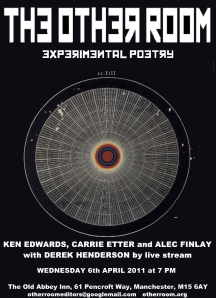
The Other Room 3rd birthday streamed out of The Old Abbey Inn
We will be attempting to stream Carrie Etter, Ken Edwards and Alec Finlay out of The Other Room to the internet at roughly 8pm UK time, 6th April, for any people unable to attend but wishing to watch online. Please convert this time for other locations.
The channel is http://www.ustream.tv/channel/otherroom3rdbirthday
Thus & live stream details for performance at The Other Room, 6th April
Derek Henderson will be live streaming from Utah to the Other Room on 6th April at 7.30 UK time and 12.30 Utah time. For other places in the world check conversion times from the UK time. This reading will feature a number of his sonnets from Thus &: An Erasure of Ted Berrigan’s the Sonnets published by if p then q
This is the link for anyone who can’t make it but would like to watch.
The Language Moment
Opening salvo of this year’s essential Text Festival in Bury and elsewhere.
Featuring Eiríkur Örn Norðdahl, Maggie O’Sullivan, Phil Minton and Ben Gwilliam & Phil Davenport
@ The Green Room, Manchester
Friday 15 April 2011
In a pre-festival partnership event with the Green Room, Manchester, the Text Festival presents an evening of virtuoso vocal performance and groundbreaking sound art.
Eiríkur Örn Norðdahl is an Icelandic poet and author of three novels. He works with performance and sound-poetry, and regularly appears at poetry and music festivals, as well as dabbling in the dark arts of the concrete. In the recent years he has explored the possibilities inherent in the European and North-American avant-garde traditions, and focused on disassembling language into its visual, social and linguistic units. Nothing can prepare you for the power and dexterity of his performance, the sonically richness of his sound poems, and his amazing control of his material. His huge contortions twist his mouth to stun the audience.
Phil Minton is a dramatic baritone with a free-form style of “extended techniques” that are extremely unsettling. His vocals often include the sounds of retching, burping, screaming, and gasping, as well as childlike muttering, whining, crying and deep-throated drones; he also has an ability to distort his vocal cords to produce two notes at once. Phil Minton’s voice occupies a category apart, as joyously accessible as it is radical.
For over thirty years, Maggie O’Sullivan has been one of the leading figures of British innovative poetry. An international performer and visual artist, she is committed to excavating language in all its multiple voices and tongues, known and unknown, in visceral gestures that collage and pulverization at the service of a rhythmic vortex.
Phil Davenport & Ben Gwilliam are artists engaged in collaborative practice across different artforms: Davenportthe poet and Gwilliam the sound artist merge experimental language through the infrathin processing of the silence between sounds.
The event will also feature specially commissioned sound art interventions in various Green Room Spaces.
Curated by:
Tony Trehy
Commissioned by:
Green Room
Ticket Prices:
£9.50/£6.50
Venue:
Green Room
54-56 Whitworth St West
ManchesterM1 5WW
0161 615 0500
The eq of revolution
Sound project featuring, amongst many other good things, Philip Davenport’s The eq of summer, a track sung by shamanic vocalist C. Johnson. This track comes from the CD Constellation of Luminous Details, which invited various sound artists to make variants on Davenport’s found poems (Ben Gwilliam, Lee Patterson, Gareth Bibby and others). Material from the CD is also to be used in an installation at the Text Festival by Holly Pester.
Counting Backwards 6
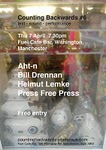
Thu 7 Apr 2011 @ Fuel, Withington, Manchester. Aht-n, Bill Drennan, Helmut Lemke. Free entry.
N.B. Press Free Press, advertised on the poster, are not performing.
Station Stories

THE EXPERIENCE
Station Stories is a unique site specific live literature promenade event using digital technology and live improvised electronic sound. From platform to platform, café to café and shop to shop, six writers take you on a tour of Piccadilly station and read specially commissioned stories inspired by the station and the people who use it and work there. It’s a unique live literature promenade performance featuring live improvised sounds using samples of ambient station noises as they happen.
Station Stories will explore the day-to-day life of the station – its platforms, its workers, the journeys people take, the waiting, the encounters, the thrill, the loneliness, the joy. It will express the peculiar, unique qualities of this marginal, in-between world, where anything can happen and often does.
HOW IT WORKS
Audiences are linked to the writer’s microphones by headsets using wireless technology, making the event unobtrusive and ensuring the audience hear every single word, whilst still experiencing the live ambience of the location. A musician accompanies the writers and improvises music using sampled live sounds from the station, manipulating these sounds and playing them into the audience’s headsets between and underneath the text. The writers interact with passing members of the public who may be unaware that a performance is taking place.
More.
Talk: Dada 1916-2016
Marc Dachy, Director of the DADA Archive in Paris will talk about Kurt Schwitters and DADA. Though it only lasted a decade from 1915, the outpourings of Dada – art, collages, plays – remain the stuff of the avant-garde, from Schwitters’s sound poems to Duchamp’s urinal. Marc Dachy will re-trace the events that lead to Schwitters departure from the movement and then focus on what might distinguish between a DADA and MERZ attitude in art. Followed by a panel discussion
FREE
8th April, International Burgess Centre (as part of Merzman ongoing exhibitions and events)
LINK
Preview of The Other Room 3rd Birthday reader, April 6th, Derek Henderson
Preview of The Other Room 3rd birthday, April 6th reader Derek Henderson. Derek Henderson will be reading from Salt Lake City via live stream. Next week of course is The Other Room.
Poems
THUS & (new if p then q title)</a>
Analysis
Station Stories
Tom Jenks and others are performing at this exciting looking event. Follow the link to book tickets.
Manchester Literature Festival is delighted to be working with the Hamilton Project and Bury Text Festival on Station Stories – a unique site specific live literature promenade event using digital technology and live improvised electronic sound. From platform to platform, café to café and shop to shop, six writers (Jenn Ashworth, Tom Fletcher, David Gaffney, Tom Jenks, Nicholas Royle and Peter Wild) take you on a creative trip of Piccadilly station and read specially commissioned stories inspired by the station and the people who use it and work there.
Audiences are linked to the writers’ microphones by headsets using wireless technology, ensuring they hear every single word, whilst still experiencing the live ambience of the location. Take a journey into this marginal, in-between world, where anything can happen and often does.
Thursday 19th May – Saturday 21st May 2011 (performances at 12noon, 3pm and 7pm)
Manchester Piccadilly Train Station
Tickets £11 book on:
Maintenant #55: Scott Thurston
Just as the radical continental poetic methodologies of the 20th century have left an indelible impact on contemporary British poetry, so, it seems, has the model of the poet as a thinker and teacher. Scott Thurston is a central facet in the recent resurgent brilliance of North Western British poetry in and around Liverpool, Leeds and Manchester. His is an innovative poetic defined by its care, intricacy and sophistication, and his reputation as a seminal and urbane poet over the last few decades has established him as a vital part of the UK’s poetry scene. In a comprehensive and generous interview he discusses his role as a poet, a teacher, his experience of European poetics and his beginnings in innovative poetry.
http://www.3ammagazine.com/3am/maintenant-55-scott-thurston
Accompanying the interview are four of Scott’s poems from the work, Sustainability.
The Poetry and Poetics Research Group at Edge Hill
Thursday 31st March at 6.30 (till 8.00) in E21 at Edge Hill University, Ormskirk, Lancashire L39 4QP
The OULIPO writers have been fascinating readers for many years now, whether through the novels of Italo Calvino or the masterpieces of Raymond Queneau, the teasing novels of George Perec or the poems of Jacques Roubaud. Experimenting with constraints (‘Write a novel without using the letter e’ or replace every noun with the seventh word after it in the dictionary’, through to complex mathematical systems) they have been slowly changing the way much mainstream writing is written. The results are often hugely funny.
The main practitioners are French and it is appropriate that the best British writer to follow this school is also one of its most adept translators into English. Now Philip Terry will be visiting Edge Hill for the first time to talk about his versions of Shakespeare’s sonnets. This hallowed work of literature is ransacked and re-written before our eyes. Come and see Philip read from, and talk about the work.
Philip Terry was born in Belfast in 1962. He has taught at the universities of Caen, Plymouth and Essex, where he is currently Director of Creative Writing. His fiction, poetry and translations have been widely published in journals in Britain and America. His books include the celebrated anthology of short stories Ovid Metamorphosed (Vintage, 2000), Fables of Aesop (Gilliland Press, 2006) and the poetry collection Oulipoems (Ahadada, 2006). In 2008 Carcanet published his acclaimed translation of Raymond Queneau’s Elementary Morality. His latest Carcanet collection Shakespeare’s Sonnets was published in 2010.
Sonnet 18
Shall I compare thee to a Smirnoff ad?
Thou art more shimmering, more full of zap;
Icy winds do freeze the Russian steppes,
And vodka’s high hath all too short a date:
Sometime too cold the eye of Yeltsin shines,
And oft is his bleached complexion dimmed;
And every drunk through drunkenness declines,
By cancer of the liver or septicaemia untrimmed:
But thy eternal glimmer shall not fade,
Nor lose possession of that zip thou ow’st,
Nor shall death brag thou sup in his shade
When in immortal lines like these thou glowest:
So long as men can drink and take a piss,
So long lives thine in this.
See also his anthology of English language Oulipo-influenced work at http://ekleksographia.ahadadabooks.com/issuethree/
Sheffield Poetry Festival
Features Harriet Tarlo, Geraldine Monk, Peter Riley, Kevin Colcoran and more.
Various venues, 26th March-8th April
Hay Jam
Run by volunteers on a shoestring, the Hay Poetry Jamboree is one of the most open-spirited, inquisitive and intimate of all the small poetry/arts festivals. It seeks above all to provide a performing space for those poetries which tend to be ignored by the big literary festivals – poetries which operate outside the margins of the mainstream. But the Jamboree is determinedly anti-doctrinaire – it showcases not only the very best radically innovative work, but welcomes writers of quality from any context, who are attempting new things, making interesting connections. The Jamboree is unique and it needs your support.
Become a Friend of the Jamboree, and simultaneously advertise your wares, your books, your business, your projects, your thoughts or simply yourself, on the Jamboree webpage, (or not, if you’d prefer) by sending us a cheque for either ten, fifteen or twenty pounds, according to the following scheme:
£10 to have your name listed on the Jamboree web-page, with up to 30 words of biography/bibliography (or any other kind of textual utterance). £15 for a textual entry of up to 60 words on the web-page. Plus, choose a free cd from any one of nine performances from the previous two Jamborees: namely, Peter Finch, Boiled String, Wendy Mulford, John James, Chris Torrance, David Greenslade, Childe Roland, Geraldine Monk, Alan Halsey, Elisabeth Bletsoe, Robert Minhinnick.
£20 for a paragraph of up to 200 words on the web-page with web-links, logos, graphics where possible, plus the option of a choice of free cd from the above list.
By becoming a Friend of the Poetry Jamboree you can now get a reduction of
25% on a one-year four-edition subscription to the amazing POETRY WALES
– £15 only! Email goodbard@yahoo.co.uk for a subscription form.
Send cheques made out to Glasfryn Seminars, to Lyndon Davies, Glasfryn, Llangattock, Nr Crickhowell, Powys, NP8 1PH with letter listing your name, address and choice of cd where applicable.
Send details for inclusion on webpage to goodbard@yahoo.co.uk
Preview of The Other Room 3rd Birthday reader, April 6th, Ken Edwards
Preview of 6th April, The Other Room 3rd birthday reader, Ken Edwards. Next week Derek Henderson.
Blog
Recent work
Interview
Rewriting Freud iOS app

Rewriting Freud has just been made as an iOS Universal app and is now for sale on the iTunes App Store.
This is the next incarnation of the conceptual artwork Re-Writing Freud by Simon Morris.
ABOUT THE WORK
For the book work, Re-Writing Freud the artist Simon Morris has re-written Sigmund Freud’s The Interpretation of Dreams. A computer programme (designed by Christine Morris) randomly selects words, one at a time from Freud’s 222,704 word text and begins to reconstruct the entire book, word by word, making a new book with the same words, every time the programme is re-started. This book is one instantiation of that process, scrupulously typeset according to the dimensions, fonts, chapter divisions and paragraph lengths of the 1976 Penguin paperback edition of Freud’s work, and printed on equivalent paper stocks.
Morris unleashes a virus. He puts a contagious process to work, intervening in Freud’s The Interpretation of Dreams, rupturing it and returning it to us in a new order. By subjecting Freud’s words to a random re-distribution, meaning is turned into non-meaning and the spectator is put to work to make sense of the new poetic juxtapositions. The world of dreams is subject to the laws of the irrational and Re-Writing Freud gives the spectator the chance to view Freud’s text in its primal state. This fine production was printed by Imschoot, Ghent, in an edition of 1000, and given their blue stamp of approval. With a conceptualist formalism, Morris’ version of Freud’s text follows the typographic layout found in the edition of Freud’s work owned by his long-term collaborator, the psychoanalyst Dr. Howard Britton, whose worn book cover and ‘Big Daddy’ sticker from a Sugar Puffs cereal packet sets the tone for Morris’ appropriation.
“With Re-Writing Freud, judgments about sense no longer themselves make any sense. The reader who responds to this book by complaining that it is nonsensical is neither right nor wrong, but asking the wrong question, posing an impossible problem in response this book’s insistent imaginary solution.” – Professor Craig Dworkin, University of Utah, from the Introduction to Re-Writing Freud, ‘Grammar Degree Zero’
Read more about the project at the Information as Material site.
Streetcake 16
Out now, featuring:
- Flora Blake
- Richard Barrett
- Sarah Bradsell
- Sophie Clarke
- Sarah Cuquemelle
- Jim Sheehan
Read it here.

