

Advanced notice of a new publication from Openned Press:
Sean Bonney – the commons
The book will be launched on Wednesday 21st September at Carnivale, east London. Further details will appear on openned.com.
Advanced notice of a new publication from Openned Press:
Sean Bonney – the commons
The book will be launched on Wednesday 21st September at Carnivale, east London. Further details will appear on openned.com.

Rachel Lois Clapham will be performing along with David Berridge and Philip Terry at the next Other Room on Wednesday 24th August. For a flavour of her work, try these three films of her diagrammatic readings: 0456461 to 0456464 2009; (W)reading The Crack-Up Fitzgerald, F. Scott 2010; Re- Rachel Lois Clapham and Emma Cocker 2010 – ongoing.
A preview of Philip Terry will appear shortly. Read this post for a preview of David Berridge.
Ongoing news poem made of breaths and words. Sourced from the Today programme’s news bulletins on BBC Radio 4. A sample:
 SJ Fowler’s new collection ‘Fights’ is now available to order from Veer books via Paypal at http://www.bbk.ac.uk/cprc/publications/Veer_Publications/Veer040. The book is £9.00 + £0.80 If paying by paypal use the payee address ESTAPHIN@HOTMAIL.COM ( Stephen Mooney – editor of Veer).
Via Michael Pedersen:
Friday, August 26 at 7:00pm – August 27 at 10:00pm
Scottish Book Trust Trunk’s Close, 55 High Street, Royal Mile, Edinburgh, EH1 1SR
The night promises to shock and stun, playing host to the sinister and sanguine.
WE’RE DOING A FESTIVAL DOUBLE BILL
FRIDAY 26TH AUGUST – 19:00 – 22:00
– Poetry by –
ROSS SUTHERLAND – www.rosssutherland.co.uk
DES DILLION – www.desdillon.com
– Films by –
TORSTEN LAUCSHMANN – www.torstenlauschmann.com
CARLA EASTON – starring DUGLAS T. STEWART & NORMAN BLAKE
www.carlajennifereaston.com
– Music from –
BILLY PAGE – www.billypage.com
EMELLE – www.myspace.com/emellebros
SATURDAY 27TH AUGUST – 19:00 – 22:00
Poetry by:
KEVIN CADWALLENDER – www.redsquirrelpress.com
MICHAEL PEDERSEN – www.michaelpedersen.co.uk
GRAHAM HARDIE – www.grahamhardie.co.uk
Film by:
EWAN MORRISON- www.ewanmorrison.com
Music from:
PAUL HAIG (EX JOSEF K) – www.rolinc.co.uk
ALAN MCKIM – www.alanmckim.com
Both night will feature animations from across the globe.
COST
One Show: £5 or £4 concession
Both Shows: £7 or £6 concession
DRINKS £2 ALL NIGHT – An absurdity in itself.
email: Michael_eats_oranges@hotmail.com to reserve tickets NOW!
Tickets will be available from Elvis Shakespeare (specialist record and book store) on 347 Leith Walk as of Monday 1 August – www.elvisshakespeare.co.uk
Márton Koppány’s opus of visual poetry stands as a remarkable entry into the ledger of post WWII European poetic innovation and expression. Behind him sits a life’s work, denoted by intellectual rigour and brilliance, as he has quietly, but indelibly, edged his medium forward. Producing work of immense quality, consistently, in the field of visual poetry for over thirty years, he has inspired new generations of poets while working from the inside out of his environs in Budapest and with a capacity for profound inflection and wholly accurate understatement (to a level of humorous / satirical reverence so poorly missing from much experimental poetry) he has tackled the nature of his own family history and it’s entwining with the darker days of modern Hungary. His work is thus indicative of the possibilities, and even the necessities, of visual poetry, his fundamental mode one of honesty in expression, led by a suspicion and engagement with the limits of language. Koppány has always maintained an incisiveness that has attracted the plaudits from poets in his field, and his sophicated, intellectual and urbane corpus has rendered him simply one of Europe’s finest poets and an immense contributor to often the most stimulating field of contemporary poetry.
http://www.3ammagazine.com/3am/maintenant-69-marton-koppany/
Incorporated into the interview are 13 poems by Marton, selected to display the width and evolution of his work over the last 30 years.
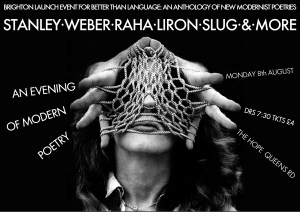
We are delighted to announce an extra Other Room evening, this autumn at Manchester’s Anthony Burgess Centre on September 26th. This will feature Phil Hall, Alan Halsey performing six works of Hugo Ball accompanied by Mick Beck on bassoon and saxophone and Vanessa Place. More details to follow.
This review was originally published in Department Magazine, issue 1. A number of ammendments have been made from that version. David Berridge reads at The Other Room on August 24th.
This is better read as a PDF to see the layout of the poem.
The Moth Is Moth This Money Night Moth
By David Berridge
The Knives Forks and Spoons Press
Reviewed by James Davies
David Berridge’s The Moth Is Moth This Money Night Moth is a real delight. The work seems to me to mix minimalist and expressionist concerns. It is a work that chooses and places words which stand for themselves and also work pragmatically. Words also often seem to stand for the materiality of other words. This is achieved in misspellings, use of brackets and asterisks, thus extending the connotations within a single set of graphemes much in the same way that Geof Huth’s ntst does and some of Aram Saroyan’s seminal work from the 60s. So for example the second page reads:
gleen gnouth fnow
t (longue) l (lake)
night (night)
The words in the poem are easily readable as other words. So that gleen = ‘green’. gnouth = ‘mouth’. fnow = ‘snow’ and ‘for now’ as in ‘f’now’. t (longue) = a long tongue. l (lake) can be read as an example of stuttering, perhaps a reconfirmation that the word on the page, and that the image denoted, is indeed ‘lake’ – maybe a specific lake to Berridge but in leaving the lake unlabeled it is very much the reader’s lake, whether that is a named lake or the concept of ‘lake’.
The book reads as a sequence, not of fragments but as a whole; a sort of narrative. Yet the memories are not totally cohesive. The events are blurred or disguised in order to make the sensations stronger for the reader and make the experience far more democratic. It is the reader’s responsibility to choose whether they make the work confessional or not; confessional from Berridge’s point of view, or whether Moth triggers an event which the reader remembers. By this I mean that ‘lake’ in this poem seems to be a romantic symbol. By not being labeled it is so open that it can be substituted for any other romantic symbol of the reader’s making: beach, hill, bedroom, etc. With leanings towards romance (and also Buddhism) one is transported into one’s own memories – not Berridge’s. A minimalist poem has this power – we are the subject. DB gives something to me. A gift. However Berridge’s experience is clearly in there and thus Moth has expressionist tendencies too.
Moth is a world full of sense and cross-sense sensations, of feeling the inner light of the body or that of another’s body. On page 1 it is suggested that the body is integrated with/within the lake:
feet lake green lake mouth lake felt lake night night lake tongue lake
Reading left to right 13 words are strung across the page with every other one being ‘lake’ until the pattern is broken on the tenth word with ‘night’ replacing ‘lake’. This could be seen as the lake disappearing from eyesight as the night falls. ‘night’ is also the ninth word and this also promotes the idea that night falls. But ‘lake’ then reappears as the eleventh word. Perhaps this represents the coming of morning. Or perhaps a viewer focuses on ‘night’ and then switches his gaze to ‘lake’. The lake then reappears out of sequence and is taken over by the twelfth word ‘tongue’ and then consumes ‘tongue’ in the thirteenth word ‘lake’; surely an erotic image. Also ‘lake’ coming out of sequence is a glitch; again the reader chooses the implications of this glitch. It could be read as the haziness of memory or perhaps the way ‘perfect events’ have ‘wobbles’ in them.
Page 4 in part reads:
wnow outh
These work as heavy signs for ‘wow’, ‘snow’, ‘now’, ‘know’, ‘south’, ‘mouth’, ‘moth’ where again the reader chooses referents whilst being aware that what is actually on the page is actually a nonsense of no semantic value. As we move through Moth there are recurring motifs: ‘night’, ‘green’, ‘tongue’, ‘star’. But there are intrusions: ‘money’ and ‘fashion’ which appear often after page 4. A Money Moth by the way is a moth which is often associated with bad luck as it eats crops. This use of the word ‘money’ and its association with ‘the moth’ is a sudden negation, and imperfection, into what has been up until now idyllic landscape and mood; there is no such thing as perfection it suggests, all joy is transient.
However these intrusions never dominate in Moth. If we look at part of the middle pages:
t*o*n*
g*u*e
we see a visual play of snow falling on the tongue. And later on the same page:
snow = star
Snow is star and vice versa. The mass noun of ‘snow’ stops this image being personal as it is not fixed in a particular moment. It is about the idea of ‘snow’ and therefore we have to read star as the idea of ‘star’; perhaps their equivalence and perhaps combination. The reading of this short passage is made more difficult as it could be we are meant to assume an article is attached to ‘star’ and if it is we are not sure if ‘star’ is definite or indefinite. The same ambiguity applies to ‘snow’ as it could be ‘the snow’. This again shows that we can take the objects/words in Moth for what they are and also for what they could be.[1]
It is true that a sadness pervades here and there in the collection, Berridge’s landscape is not completely filled with joy – ‘money’ and ‘fashion’ interrupt ‘snow’, ‘stars’ and ‘lakes’ – but more regularly than not we move beyond colour , and experience happiness. That’s good. The Moth Is Moth This Money Night Moth is a really fine book. Go experience it.
[1] Similarities to other poems immediately occur. Yoko Ono’s poems/proposed performances in Grapefruit memorably use these two key elements of snow and star: yellow and white; the celestial. And Robert Grenier’s drawing poems are also connected. See http://www.parametermagazine.org/grenier.htm for my take.
April 2011 reader Alec Finlay has many irons in many fires. For details of his current projects, see below.
* * *
Mountaineering in Counterpane
Alec will read ‘Mountaineering in Counterpane: a Report to the Armchair Mountaineering Club; other speakers include Misha Myers and Matthew Beaumont.
One-day symposium, presented by the University of Sunderland W.A.L.K. research initiative, seeking to interrogate the practice of walking in all its cultural, ethnographic, poetic, and geographical ramifications.
The Gymnasium, Gallery of Modern Art, Edinburgh
Thursday 28th July 2011, 12.30 – 17.00
For information contact Heather Yeung at: WALK@sunderland.ac.uk
____________________
the road north
St Weems http://the-road-north.blogspot.com/2011/06/33-st-weems_23.html
Killin and Acharn http://the-road-north.blogspot.com/2011/06/7-killin-acharn_27.html
Monreith http://the-road-north.blogspot.com/2011/06/9-monreith.html
the hidden gardens http://the-road-north.blogspot.com/2011/07/53-hidden-gardens_07.html
You can follow Ken and Alec’s steps on their blog http://the-road-north.blogspot.com/
Visit The Road North website, where you can read Basho’s Oku-no-Hosomichi, the work that inspired the project http://www.theroadnorth.co.uk/
__________________________
mapping the road north
This hand-drawn map documents all of the ‘stations’ visited by Alec and Ken on their year-long journey, with a mirror-map listing Basho’s Japanese place-names.
You can view or download the full-size map here http://dl.dropbox.com/u/1599958/TRN%20mirror-map%20%28final%29.jpg
For a free map, send an A4 SAE to Luke Allan, Studio Alec Finlay, 36 Lime Street, Newcastle Upon Tyne, NE1 2PQ.
___________________________
the road north ‘sampler’
As part of the programme for this year’s Edinburgh International Festival, Alec and Ken will present a ‘sampler’ of The Road North, displaying hokku-labels, tea-prints and whiskies that characterized their 53 visits. The sampler can be viewed at the Scottish Poetry Library, Edinburgh from 5 August, running till 3 September. Edinburgh http://www.spl.org.uk/about/find.html
On 28 August, 12:00pm, Alec and Ken will be reading from the project, accompanied by director of SPL Robyn Marsack: @ The Hub (Royal Mile, Edinburgh) http://www.edinburghfestivals.co.uk/venues/hub?page=1
_____________________________
T/H/E/C/I/T/Y/S/A/S/T/O/N/E/B/O/O/K
Alec has created a new civic grove for Victoria Gardens, Leeds. Three inter-related works on the theme of the city & pastoral have now been installed outside Leeds City Art Gallery. Among the formal screen of London Plane trees, 10 nest-boxes painted with QR codes offer e-links to field-recordings of birdsong by Chris Watson; in the Red Oak trees by the gallery entrance, S/I/N/G W/I/L/D K/I/N/D W/O/O/D is an arrangement in 4×4 grids on next-boxes, echoing a phrase from John Berryman’s Dream Songs. T/H/E/C/I/T/Y/S/A/S/T/O/N/E/B/O/O/K is a stone-carved piece laid in the ground at the front of the Gallery, carved by Peter Coates. The digital print of this work will be available from Ingleby Gallery.
_________________
‘Moss on Stone’
Alec & Robin Gillanders have collaborated on a portrait of Stonypath, Little Sparta, for Boulderpavement, published by The Banff Centre, now online at http://boulderpavement.ca/issue004/moss-on-stone/
“my default “recognition” affect is switching to mawkish sorrow…”
Jow Lindsay reviews the recent Anything Anymore Anywhere event in Edinburgh.
David Berridge will be performing at the next Other Room on Wednesday 24th August, along with Rachel Lois Clapham and Philip Terry. For a flavour of his work, try Game, Global, Green, Grown, Guys at Beard of Bees, Black Gardens at The Red Ceilings Press and SPIT & PRAXIS: DOG MAN SPEAKS in Streetcake Magazine. Check out too his VerySmallKitchen project, which he describes as “inhabiting, defining and exploring spaces of connection between writing and art practice; text, book and exhibition; curating and authorship. ”
Previews of Rachel Lois Clapham and Philip Terry to follow soon.
Robert Sheppard’s lecture on the Innovative Sonnet Sequence is now complete on his blogzine Pages.
SJ Fowler will be reading for The Other Room in October. In the meantime, you can get familiar with his work at his new blog, full of interesting stuff, including this reading at the recent launch of the Herbarium anthology.
Saturday, August 6 · 2:00pm – 5:00pm
Madlab, 36 – 40 Edge Street, Manchester
WFW(N) is an opportunity for innovative/experimental poets to present their work for feedback in a mutually supportive atmosphere. Ideally, please bring along copies of the work you intend to read for the other group members. Anyone who wants to come along but doesn’t want to read is also very welcome.
Out now on the Streetcake site.
 New from Critical Documents. £5/$11. 20 pages, 200 copies. Printed colour end-papers. 26 copies printed on a larger format.
Luke Roberts:
Gloss To Carriers is propelled by an internal logic of visor and helmet, tracking mutations on the horizon, ‘a picture of speed on the liquid corn’. The interface we see is heavily sedated warfare, her joysticks wild détourning, spinning through a set of invasive procedures, secret pingbacks between the Gloss and its Carriers. Every reader is also a bystander, totemic radar guilt lining our pockets: ‘goodbye immunity’. Can also be read as an operating-manual for the malfunctioning software of Recent British Poetry. Undetected viruses, get this and sleep in a new position.
Louis Jagger:
A vibrantly sexualised, obliquely emotionalised language of technology demonstrates the oppressions, disconnections, yearnings or compromises of an intelligent species mediated to by laser-wielding overlords and expected to swallow the dumbness of it whole. The poems are fragmented communications, garbled flight-logs of the things delivering death on imperial command, each marrying (or photon-fusing) an assortment of technical details into a concise and curiously unadorned vision of the organic and the intellectual reconstituted as mechanical will to power…This is a poem of protest and of sharp observation…Gloss To Carriers is a pulverising, all-consuming linguistic gun-battle from which nothing escapes.
Footage from the Herbarium reading on 22nd July, launching the anthology edited by James Wilkes for the Urban Physic Garden project.
Panel 3 of Steve McCaffery’s Carnival had its UK premiere at The Other Room in Leeds. Panels 1 and 2 can be downloaded in their entirety for free at Coach House Books.
The complete text of zimZalla object 010 read in its entirety. # consists of 50 unique micro-texts presented in a vial. More about the object can be found on the zimZalla site.
 otherroom.org