
New work by Other Room reader Tim Allen is now online at Depart.
Uncategorized
POLYply > 22 Ground Cover
- Daniela Cascella
- Rod Mengham + Mark Atkins
- Post-Works
- Kit Poulson
Friday 7 December. The Centre for Creative Collaboration, 16 Acton Street, London, WC1X 9NG. Free entry. Contemporary Poetics Research Centre and MA Poetic Practice, Royal Holloway.
David Gaffney reading at The Other Room
David Gaffney reading at August 2012’s The Other Room
Clive Fencott reading at The Other Room
Clive Fencott reading at the recent Bob Cobbing Celebration
FEELINGS
Poetry / Film / Sad Disco
Thu 15th Nov 2012 / 8 to L8 / £3
Vogue Fabrics, 66 Stoke Newington Road, N16
JUSTIN KATKO
ELIZABETH GUTHRIE
EDMUND HARDY
JON MELLING
DJ DR KEMP
MORE TBC
Bob Cobbing’s Z by Philip Davenport and Julia Grime
Further incentive to come along tonight to the Bob Cobbing Celebration at The Other Room is a limited edition free CD of Z from Cobbing’s ABC in Sound, by Philip Davenport and Julia Grime.
Listen to it in this video below.
Flights in and out of Stoke Newington
The next of Chris Goode & Company’s conversations that lead to podcasts takes place on Monday 22nd October at the Stoke Newington International Airport at 8.30, with Rajni Shah, Phelim McDermott and John Hall. See here for more information and here for previous podcasts, including Andrea Brady.
WF(N)
The next meeting will take place on Saturday 29th September at MadLab in Manchester.
“WFW(N) is an opportunity for innovative/experimental poets to present their work for feedback in a mutually supportive atmosphere. Ideally, please bring along copies of the work you intend to read for the other group members. Anyone who wants to come along but doesn’t want to read is also very welcome.”
HI ZERO CONTEMPORARY POETRY READINGS #15
Hi Zero #15, Season 2 Opener, a night of contemporary poetry readings, featuring:
NICK POTAMITIS
Author: The Book of Night Terrors (Salt), and JUBILATE AJAX forthcoming imminently from MOUNTAIN PRESS
STEPHEN MOONEY
Author: DCLP (District and Central Line Project) (Veer), Shuddered, with Aodán McCardle & Piers Hugill (Veer)
JUSTIN KATKO
Author: The Death of Pringle (Veer/Film Forum), Finite Love (w/The Other Brother) (Critical Documents/Bad), Superior City Song (Crit. Dox), and RHYME AGAINST THE INTERNET (Crater)
Wednesday, 26th September upstairs at The Hope, Queen’s Road, BRIGHTON. Doors 7:30pm.
£4 for all
DEPT/zimZalla films
Films of the recent joint event in Manchester are now online at the zimZalla site, including this by Matt Dalby, featuring the Other Room’s very own Scott Thurston. The other readers were Wayne Clements and Jo Langton.
Helmut Lemke at June 2012’s The Other Room
A wonderful performance in two parts by Helmut Lemke at The Castle Hotel. These videos are archived in the middle column as are all readings and interviews.
Part 1
Part 2
‘Efface the Traces!’ – Modernism and Influence
Durham University, 9-11 April 2013
‘[T]he poets of the nineties were entirely missed out of my personal history […] I never read any of these people until it was much too late for me to get anything out of them’.
T.S. Eliot, letter to Ezra Pound, 1924
‘[I]t was towards the end of my school days or in my first year or two at Harvard University [that] I was reading the poets of the ‘nineties, who were the only poets […] who at that period of history seemed to have anything to offer me as a beginner’.
T.S. Eliot, Saltire Review, iv, 1957
If Ezra Pound’s clamorous injunction – ‘make it new!’ – might be considered the first commandment of modernism, then Brecht’s dictum – ‘efface the traces!’ – stands as its complementary shadow statement. As the example of Eliot begins to illustrate, the Poundian urge to transfigure ‘legitimate’ influences results in a comparable urge to efface influences considered inappropriate. However, criticism has often proved inadequately alert to the motives underlying authorial advertisement and evasion of influence, instead colluding with the artist in the construction of a suspiciously orderly canonical narrative of modernist influence. We dutifully discuss Eliot as the heir of Dante and Donne; we corroborate Woolf’s departure from Wells and Bennett; we identify the Ibsen in Exiles, and the Confucianism of the Cantos.
This conference is conceived in the belief that the intersection between advertised and effaced influence operates as a particularly illuminating point of departure from which to develop new critical perspectives on the narrative(s) of modernism. This approach is also efficacious in projecting enquiry beyond the conventional spatial and temporal locus of modernism (London/Paris, 1890-1930), by drawing attention to hidden nineteenth-century proto-modernisms, and the contemporaneous cross-cultural interaction of rivalling counter-modernisms. Similarly, it encourages a nuanced handling of the vicissitudes of the mid-to-late twentieth-century reception of modernism – from Larkin’s early jettisoning of Yeats to Winterson’s strident advocacy of Woolf – by drawing attention both to the cultural investments of the modernist authors themselves, and to those of subsequent writers striving to stake out a distinct position beyond modernism’s daunting shadow.
We invite 20 minute papers on any of the following variations upon this theme, although respondents should not consider themselves restricted to these topics. Interdisciplinary research is also very much welcomed.
Negotiating anxieties of influence
Modernist self-fashioning
The response of present-day writers to modernism Influence across disciplines Effacement strategies The figuring of modernism as either a positive or negative aesthetic precursor Influence as a factor in constructing aesthetic communities The marketing of influence Originality in an age of mechanical reproduction The traffic of influence between medical discourses and modernist texts Feminist celebration of influence Other modernism(s): influence across cultural borders Authorial progression and amendment of influence The mediation of influence through parody and allusion Defining disciplines: influence within academic theory after modernism The politics of literary parentage Friendship networks, publicity conspiracies, and group-think Nineteenth-century post-Romantic culture and modernism Abstracts of no more than 250 words are invited by 1st December 2012. Please email submissions to effacethetraces@gmail.com. You can also use this address to contact us with any additional questions, such as how to arrange attendance as a non-speaking delegate. Additionally, you can visit our website at effacethetraces.wordpress.com.
The conference will take place in St. Chad’s College, Durham. Panels will follow the format of three 20-minute papers followed by questions, and each day will feature a plenary speaker. Our plenary speakers will be Dr Matthew Bevis (University of Oxford), Dr Marina MacKay (Durham University), and Professor Pat Waugh (Durham University). The registration fee is £30 for salaried academics and £15 for postgraduates and postdoctoral researchers. We will be offering three postgraduate bursaries to particularly outstanding applicants, to cover the registration fee, accommodation, and a portion of travel costs. If you are the recipient of a bursary, we will inform you when accepting your paper.
More here.
The Other Room – Tonight
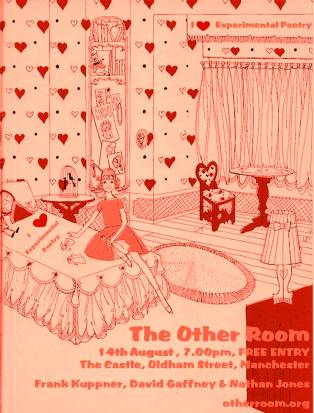
Nathan Jones – A Preview
Nathan Jones will perform at August 14th 2012 The Other Room alongside David Gaffney and Frank Kuppner. See the middle column of details of how to attend the event.
A lot of things Nathan Jones at A LITTLE NATHAN WEBSITE
David Gaffney – A Preview
David Gaffney will perform at August 14th 2012 The Other Room alongside Nathan Jones and Frank Kuppner. See the middle column of details of how to attend the event.
Below is an example of one of his flash fictions ALL MOD CONS.
Jake invented a prescription glass windscreen for his car so that he could drive without wearing his corrective lenses. He enjoyed the feeling of freedom – no plastic pads digging into his nose – and it had the added advantage that car thieves couldn’t drive the vehicle unless they happened to have the same degree of myopia.
Jennifer needed a lift. However, she soon began to complain. She couldn’t see, everything was blurred, and to stop herself being sick she had to stick her head out the window like a dog.
‘You idiot,’ she said to him when he dropped her off.
He wouldn’t ring her again. A permanent relationship would mean grinding the windscreen to suit two different people and he could imagine the arguments – it would be the self-cleaning bed-sheets saga all over again. He went to bed, turned up the shipping forecast and drifted to sleep.
Click HERE to visit his website
Tony Lopez at the Edinburgh International Book Festival
On Thursday 23 August, 8.30pm, Tony Lopez reads with Alan Gillis and Fiona Sampson at the Edinburgh International Book Festival, Peppers Theatre, Charlotte Square Gardens, Edinburgh. Tel: 0845-373-5888 www.edbookfest.co.uk
Admission £10 / £8 (concessions).
Crater Press – Jeff Hilson
Jeff Hilson, From ORGAN MUSIC: AN ANTI-MASQUE NOT FOR DANCING, a new and ongoing narrative and non-narrative sequence (not) about the English organ adding obfuscation to an already obfusced instrument. Available now at the Crater Press site.
James Harvey memorial reading – films
On the evening of July 19th 2012, a large group of friends, family and fellow poets met in the Keynes Library, in Birkbeck college, in London’s Bloomsbury to celebrate the life and work of the British innovative poet, James Harvey.
James Harvey (1966–2012) studied biology at UCL before becoming a full-time poet in the thriving experimental and innovative poetry community in London. His interest in science, especially biology, extended into his poetry. He was fascinated by the potential of ‘science in poetry to dismantle existing structures, and then put them back together again, build them up “mechanically” while at the same time each level of complexity is acted upon equally through “the forces of nature,” questioning the integrity of the structure.’
Jeff Hilson and Holly Pester above. Full list below:
- Carol Watts http://www.youtube.com/watch?v=OWzymLZEBLw
- Edward Carey http://www.youtube.com/watch?v=7xwHGtrq59U
- Elizabeth McCracken http://www.youtube.com/watch?v=lkW7BVb5_JA
- Will Rowe http://www.youtube.com/watch?v=j-SPcopjd3Y
- Jeff Hilson & Holly Pester http://www.youtube.com/watch?v=uhZcXbPPy1o
- Gavin Selerie http://www.youtube.com/watch?v=HgL0AWEBxfY
- James Wilkes http://www.youtube.com/watch?v=D8ie6_xTo9c
- matt martin http://www.youtube.com/watch?v=hVZosMmfRQ4
- Mendoza http://www.youtube.com/watch?v=0mamUo4UpfQ
- Antony John & David Miller & Juliet Troy & Keith Jebb http://www.youtube.com/watch?v=wqE-xJ2pKe8
- Stephen Mooney http://www.youtube.com/watch?v=COiU3fizr80
- David Miller http://www.youtube.com/watch?v=-wPxlll0Fpg
- John Gibbens http://www.youtube.com/watch?v=ES2nJWKkL7I
- Michael Zand http://www.youtube.com/watch?v=4PoP3_dGXjM
- Justin Katko http://www.youtube.com/watch?v=xFMU5S9Az9E
- Stephen Emmerson http://www.youtube.com/watch?v=5vZSIOK0yA0
- Peter Philpott http://www.youtube.com/watch?v=XWlvxCqP9c8
- SJ Fowler http://www.youtube.com/watch?v=KiYXEshmEQk
- Elizabeth Guthrie http://www.youtube.com/watch?v=Qq30tnvMcHo
Space Time
Intercapillary Places is…
Coded Histories: SPACE TIME (July 26th)
John Armstrong – On the Geometry of Space Time
John Seed – Poetry
Mathematician John Armstrong will speak on special relativity as a theory of the geometry of space time, and the historian and poet John Seed will read from his investigative poetry of labour, migration and the archive.#
Place: Parasol Unit, 14 Wharf Road, N1 7RW
Date: Thurs 26th July
Time: Arrive 6.30pm for drinks, event begins at 7pm
Tickets: £5/£5 conc – tickets can be booked through Parasol Unit by phone, email or online through Paypal – http://www.parasol-unit.org/index.php?id=22
SPACE TIME forms part of the ‘Islington Exhibits’ festival – http://www.islingtonexhibits.com/home
About the Speakers:
John Armstrong is a mathematician and software architect. He currently lectures at King’s College, London on financial mathematics, C ++ and Matlab, while researching differential geometry.
John Seed is an honorary research fellow at Roehampton. His book on ‘Dissenting Histories’ was published by Edinburgh University Press in 2008. His Collected Poems and also two volumes of archive poetry drawn from Henry Mayhew, That Barrikins, are published by Shearsman.
For more information: https://sites.google.com/site/intercapillary/
Intercapillary Places is organised by Edmund Hardy & Felicity Roberts
KFS book launches Bobby Parker, Meredith Andrea, and Rhys Trimble
Tuesday, July 17, 2012
7:00pm
Bobby Parker, Meredith Andrea, Rhys Trimble
The Kitchen Bar and Cafe
The Kitchen Bar and Cafe
More info on the KFS Facebook page
 otherroom.org