
Uncategorized
Koto y yo by Tim Atkins out now from Crater Press
new Atkins product from Crater Press!
Koto y yo documents a year in the lives of a father and daughter living in Poble Sec; a working class barrio in Barcelona. Told in luminous poetic prose, the interlinked stories – echoing the Platero y yo stories of Juan Ramon Jiminez – detail the couple’s adventures and encounters as they wander around the streets. The pages are inhabited by the plumbers, hairdressers, bakers, traveling knife grinders, mechanics, tobacconists, waiters, postmen, mangy cats, and itinerant musicians who populate the neighborhood.
£10 paperback, £15 hardback, both available at
or
http://www.lulu.com/spotlight/craterpress
As it’s Lulu the postage is about the same wherever you are in the world, and if you use this code FWD15 when you purchase you will get 15% off (this is working today, but I’m not sure how long for as Lulu changes the codes pretty often).
Proms Extra Lates: Chrissy Williams
LONDON SW7: Proms Extra Lates: Chrissy Williams
Date: Wednesday 7 September, 2016
Time: 10:00 PM
Price: Free, but book tickets in advance.
Venue address:
Elgar Room, Royal Albert Hall, London SW7 2AP
Publicity material for this event says:
BBC Proms Extra, in association with The Poetry Society, presents a series of late-night events at the Elgar Room in the Royal Albert Hall pairing musicians with poets. Hosted by Georgia Mann, and then broadcast on BBC Radio 3.
The poet featured at this event will be Chrissy Williams.
Tickets are free, but must be booked in advance from the Royal Albert Hall website.
Contact:
info@poetrysociety.org.uk
Geraldine Monk recording from The Other Room July 2016
Sarah Clare Conlon recording from The Other Room July 2016
Verbose

26 September at 19:30–22:30. Fallow Cafe, 2A Landcross Road, Manchester, M14 6NA.
This month’s headliners have all been published by literary periodical Bare Fiction Magazine, which promotes new creative writing across poetry, fiction and plays, and includes articles, reviews and interviews with practitioners. Michael Conley has published two pamphlets, Aquarium (Flarestack Poets) and More Weight (Eyewear). He runs a literature night The Other, in which poets swap words. Rosie Garland has five collections of poetry, with a sixth out this year on Flapjack Press, and two novels. Her third novel, The Night Brother, is due out next spring. Rachel Mann is resident poet at Manchester Cathedral. She is the author of three books, with The Great War, Memory & Symbol being published in spring 2017.
Fancy a go on the open mic? Sign up for a three-minute slot by emailing verbosemcr at gmail dot com.
Iain Morrison Video from July 2016
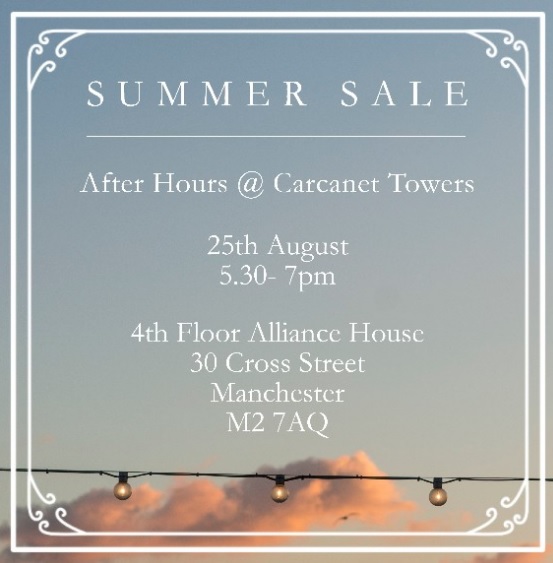
Carcanet book sale party in Manchester
Why not pop along to the Carcanet summer book sale tomorrow before coming along to our event which starts at 7pm. More details about that on our events page.
Kimberly Campanello Video from July 2016
Recording from July 2016, Other Room
Reading as Art
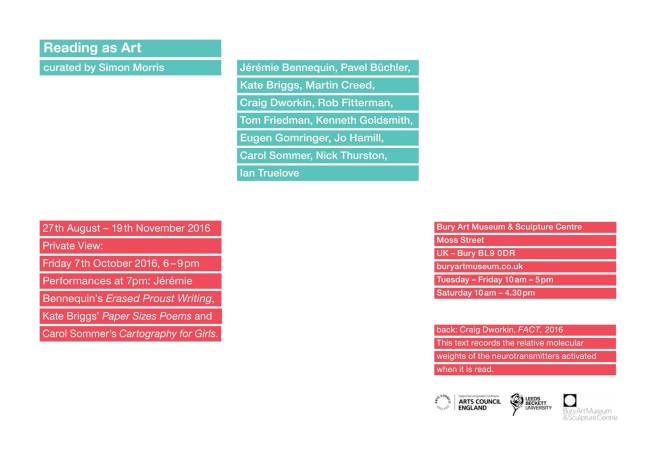
‘Reading as Art’ will be on public display from Saturday 27 August through to Saturday 19 November 2016. The works included in the exhibition find different means to foreground and to investigate the activity of reading: the forms it can take (silent reading, reading aloud, spontaneous reading, purposeful reading, and so on), the matter of reading (the book, the screen, the space of the page), the bodies that engage in it and the contexts in which it occurs. All of the works are concerned to make reading manifest in some way; in so doing, they each show – differently – how reading is its own form of making.
The image on the invitation is Fact by Craig Dworkin, 2016. The text records the relative molecular weights of the neurotransmitters activated when it is read.
Please save this date, Friday 7th October 2016 for the private view of the exhibition from 6-9pm with live performances from Jérémie Bennequin and Carol Sommer. Also, Kate Briggs’ Paper Size Poems will be performed…everyone is very welcome.
Sad Press Summer Bundle
** THE SAD PRESS SUMMER BUNDLE **
1. Karl M.V. Waugh, Obsessed by Proportions
2. Tom Jenks, An Anatomy of Melancholy
3. Anne-Laure Coxam, Toolbox Therapy
4. R.K., Killing the Cop in Your Head
5. Sally-Shakti Willow & Joe Evans, The Unfinished Dream
6. Eley Williams, Frit
2. Tom Jenks, An Anatomy of Melancholy
3. Anne-Laure Coxam, Toolbox Therapy
4. R.K., Killing the Cop in Your Head
5. Sally-Shakti Willow & Joe Evans, The Unfinished Dream
6. Eley Williams, Frit
Your friends are all telling you this is normal and fine and even a gesture of friendship but you’re not so sure. Anyway you may have them ALL for £30 (c.$1.07) including P&P at http://sadpress.wordpress.com, & they will be posted to you as they’re published between now and December.
PS: Review copies of individual titles available on request. Or we’ll do you the bundle for 0.07 BTC or 3 Echos (http://economyofhours.com/): get in touch & we’ll figure that out. We do also still have copies available of Jennifer Cooke’s Apocalypse Dreams (£5 incl. P&P, http://sadpress.wordpress.com), & back catalogue PDFs are available by donation (scroll down).
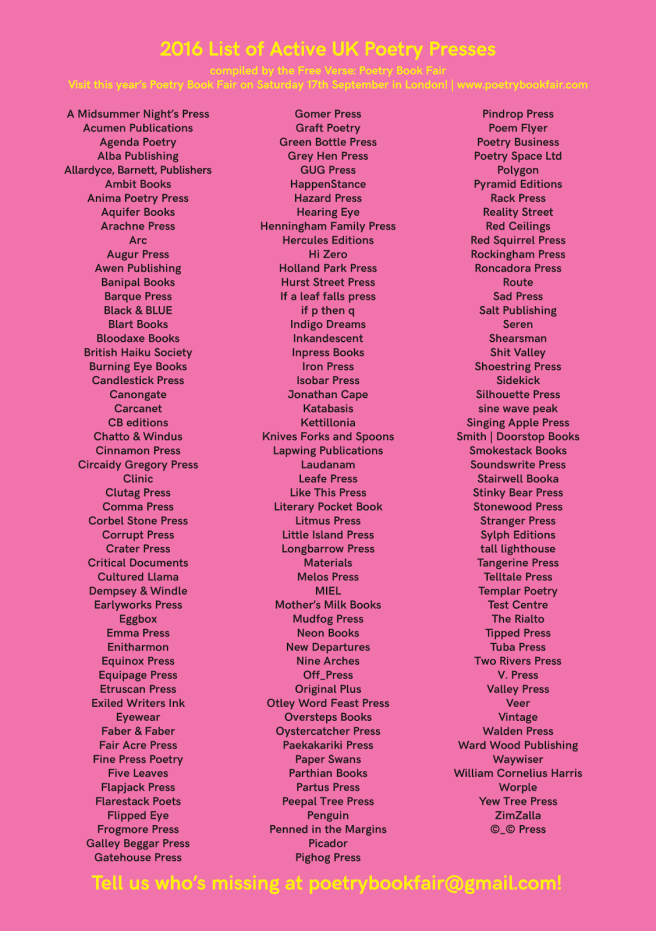
Free Verse list of active UK poetry presses
The Blue Bus – Keith Jebb, Phillip Rowland & Cathy Weedon
The Blue Bus is pleased to present a reading of poetry on Tuesday 16th August at 7.30 by Keith Jebb, Phillip Rowland and Cathy Weedon. PLEASE NOTE CHANGE OF VENUE the reading will still be in Lambs Conduit street but slightly further up at:
The Perseverance (pub)
63 Lamb’s Conduit St,
London
WC1N 3NB.
This is the 115th event in THE BLUE BUS series. Admissions: £5 / £3 (concessions). For future readings in the series, please scroll down to the end of this message.
Keith Jebb teaches Creative Writing at the University of Bedfordshire, he published ‘hide white space’ and ‘tonnes’, both from Kater Murr’s Press, and has been in numerous poetry magazines over the years, including Folded Sheets, Fire and Poetry Salzburg Review. He also co-edited New Poetry from Oxford, and is one of the organisers of The Blue Bus.
Born in south-west London in 1970, Philip Rowland is a long-time resident of Tokyo ‘Something Other Than Other’, (Isobar Press) is Philip Rowland’s most recent collection an excerpt can be found at: http://isobarpress.com/?page_id=1281.
Philip has published two previous collections and is the founding editor of NOON: journal of the short poem; he is also co-editor of the anthology Haiku in English: The First Hundred Years (Norton, 2013).
Cathy Weedon was born in Stoke-on-Trent and moved to Luton in the 1970s. She recently completed an MA in Creative Writing at the University of Bedfordshire. Previously she has created thematic visual poetry. Her recent book is ‘1-50’ (Blart Books 2015). She has read at the Blue Bus and in 2015 she contributed to SJ Fowler’s Mahu exhibition at the Hardy Tree Gallery. In February 2016 she read at the Institute of English Studies as part of a symposium for Race & Poetry & Poetics in the UK.
From the vaults – Paula Claire
April 2012
derek beaulieu: Ascender / Descender
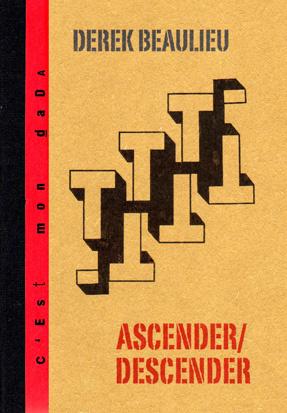
40 visual poems. A6 format (10.5×15 cm / 4 ” x 6″) – 44 pages hardcover, thread and quarter cloth binding laser printing on ivory paper.
Out now on Redfox Press. More information here.
Juliana Spahr and Sean Bonney in Liverpool
09 August 2016, 6.30pm. Tate Liverpool, Albert Dock, Liverpool, L3 4BB. Join radical poets Juliana Spahr and Sean Bonney, and new British poet Ruby Robinson for an evening of politically-charged poetry readings. Situated in the context of the contemporary avant-garde, Spahr and Bonney’s poetry undermines the political and cultural establishment, giving a fresh voice to the dispossessed. Also interested in dismantling and rebuilding, Robinson’s poetry engages with class issues, exploring the contemporary world in scrupulous detail, and offering up imaginative and emotionally-rich commentary on legacies of trauma. Free, booking required. More here.
Hugh II, The Istictiv by Clive Fencott, ebook
Other Room performer Clive Fencott has a new ebook available from Argotist
“Hugh II, The Istictiv” is an epic, multi-voice poem in the form of the libretto to a text-sound opera. It is set in a Britain that could exist as another in the multiverse: there are many resemblances as well as dissemblances to the one we variously know. This is the first publication of a work that was performed in parts in the multi-verse of the early 1980s but never …
Available as a free ebook here:
http://www.argotistonline.co.uk/HUGH%20II%20THE%20ISTICTIV.pdf
Full Argotist Ebooks catalogue here:
Bill Griffiths Collected Poems reviewed by Billy Mills
When the Collected Poems Volume 3 (1992-96), the third volume in Reality Street’s vital edition of Griffith’s poetry over three decades, arrived in the post, it became evident that it would make no sense to review it in isolation. And so, what follows is a review of all three volumes, or rather a survey of Bill’s poetic career up to 1996. Griffiths is, in my view, a major poet, one of the towering figures of late 20th and early 21st century British poetry.
Read more HERE
Amodern 6: Reading the Illegible guest edited by Nick Thurston
Announcing the launch of Amodern 6: Reading the Illegible
An issue guest-edited by Nick Thurston
Amodern 6: Reading the Illegible
Nick Thurston
“Anthology of the Illegible: Poésie de Mots Inconnus, 1949, Paris,
Edités par Le Degré 41”
Johanna Drucker
“Reading the Signs: Translations: Multilingualism, and the New Regimes
of Attention.”
Michael Cronin
“On Trying: André Hodeir and the Music Essay”
John Mowitt
“Dredging the Illegible: Photogram, Phoneme, Ph…ontology”
Garrett Stewart
“Style in Quotation Marks”
Diana Hamilton
“Story the Story in It”
Kate Briggs
“Glitched in Translation: Reading Text and Code as a Play of Spaces”
Matt Applegate
“Reading the Redacted”
Stephen Voyce
“Approaching the Contemporary: On (Post-)Conceptual Writing”
Luke Skrewbowski
Currents:
“Thinking with Zoe: An Interview with Rosi Braidotti”
Heather Davis and Rosi Braidotti
Philip Terry – Quennets
Other Room reader Philip Terry has a new book out now from Carcanet HERE
In Quennets Philip Terry develops a sonnet-like form invented by the Oulipian poet Raymond Queneau. Across three sequences, the ‘quennet’ is reworked and refigured in response to three perimiter landscapes. The first sequence, ‘Elementary Estuaries’, is inspired by a series of walks along the Essex estuary, the poems’ appearance on the page suggesting the landscape’s expansive esturine vistas, its pink sail lofts and windswept gorse, beach huts and distant steeples. In the second sequence, written after a series of walks around the Berlin Wall Trail, or Mauerweg, the form changes to reflect the physical, almost bodily tension of the wall as an architectural and social obstruction. The final sequence, ‘Waterlog’, retraces the steps of W. G. Sebald through Suffolk, and here the quennet’s newely elongated shape and ragged margin evoke the region’s eroding coastline, its deserted piers and power stations, electric fences and waterlogged fields. Terry’s project is bold in scope, his poems subtle in effect, a mix of sign and song, concerete and lyric, Oulipo and psychogeography. It is a work about boundaries, political, social, and natural, and about the walk as a critical apparatus through which these fields are shown to connect.
 otherroom.org