
“Conceptual writing is not easy to grasp, or to read. It is not about pleasure, or narrative. It brings together conceptual art and language. The excitement is intellectual rather than aesthetic, and it can be witty. It might be a transcription of a year of weather reports by Kenneth Goldsmith, or John Baldessari’s repetition of the sentence: “I will not make anymore boring art”.
Reviews
Adrian Clarke: Eurochants review by David Kennedy
Adrian Clarke’s most recent book with Shearsman gets a review from David Kennedy:
“The more you know about poetry, the more poetry becomes a matter of echoes and hauntings. Eliot dedicated ‘The Waste Land’ to Pound with the words il miglior fabbro, the same designation that Dante had given to the troubadour poet Arnaut Daniel. Larkin’s ‘postal districts packed like squares of wheat’ triggers a memory of Auden’s ‘The crowds upon the pavement / Were fields of harvest wheat’. George Herbert’s ‘Is there in truth no beauty?’ becomes a kind of backbeat at the end of Keats’s ‘Ode on a Grecian Urn’. This sort of poetic relationship is at the heart of Adrian Clarke’s new book which, in the words of the blurb, tests ‘some possibilities and limits of cultural and linguistic exchange’. Eurochants gathers translations of Max Jacob; improvisations on Chinese love poems, Persius, Tacitus and Villon; and other recent work in Clarke’s characteristic short-lined, phrasal style. Daniel and Dante are in there too.”
Galatea Resurrects #14
The important review magazine has 64 new poetry book reviews including Geof Huth’s ntst, Lucy Harvest Clarke’s Silveronda and June Other Room reader Nicole Mauro.
See HERE.
Matt Dalby reviews the Other Room 15
The second birthday of The Other Room reading series was marked by a packed venue, with more than forty people present to see performances from Ian Davidson, Zoe Skoulding and Matt Welton. Unusually in Matt and to a lesser extent in Zoe there were two poets performing that a reader who relies on the mainstream media for information about poetry might have heard of. This is not to the detriment of either reader, more to the detriment of mainstream media understanding of poetry.
Bob Grumman reviews ntst
Bob Grumann reviews ntst.
Extract and link below:
I was feeling too lousy to post anything here for two or three days, and wouldn’t today, either, although I feel a lot better. However, today I got a copy of Geof Huth’s NTST, the subtitle of which is the collected pwoermds of geof huth. It’s perfect for a blog entry because I can quote whole poems from it quickly, and because I found some pwoermds I can be quickly insightful about.
Ken Edwards reviews if p then q
“In Manchester, I see, the Other Room has been engaging new audiences too. Its co-curator, James Davies, is also editor of a magazine of “experimental poetry”, if p then q. The first two issues, which I haven’t got, were issued in envelopes. The third came in the form of a set of full-colour posters. The fourth, and current issue, is likely to cause apoplexy among some of the more austere adherents of post-avant poetry, but I love it.”
More.
The Other Room 13 – review
Sophie Robinson and Nick Thurston’s performance at The Other Room on 2nd December reviewed by Matt Dalby here.
Reading the Removal of Literature
Alan Halsey’s review of December Other Room reader Nick Thurston’s Reading the Removal of Literature can be read at Stride magazine. Here’s the start:
Reading the Remove of Literature is unlike any book I’ve looked at. I’ve read it too but the looking at it is the first essential. With all but a few books one reads without consciousness of seeing. Nick Thurston’s book demands that one look at it constantly and never detach the seeing from the reading – and yet it is only marginally what we generally describe as a ‘visual text’.
The first words of Craig Dworkin’s introduction set the scene: ‘The book you are holding is an edition of Maurice Blanchot’s L’Espace littéraire, although not a word of Blanchot’s text remains. Every page of this book has been assiduously erased by Nick Thurston.
click the LINK for more
The Other Room at Oxjam – review
Thanks to Richard Barrett for his review of our extra event at the Oxjam festival. Read Richard’s Review here.
Ray DiPalma – The Ancient Use of Stone
Nick Piombino reviews…
While contemporary poets and critics opine and debate about whether or not originality is still possible, contemporary poet Ray DiPalma has been quietly at work on a project for 10 years that demonstrates that not only is creativity and originality by poets alive and well, but Otis Books/Seismicity Editions has presented The Ancient Use of Stone, DiPalma’s superb new book, subtitled Journals and Daybooks 1998-2008, in a form that defies comparison with any other book of new writing for sheer visual and typographical beauty.
Matthew Welton book review
We needed coffee but we’d got ourselves convinced that the later we left it the better it would taste, and, as the country grew flatter and the roads became quiet and dusk began to colour the sky, you could guess from the way we returned the radio and unfolded the map or commented on the view that the tang of determination had overtaken our thoughts, and when, fidgety and untalkative but almost home, we drew up outside the all-night restaurant, it felt like we might just stay in the car, listening to the engine and the gentle sound of the wind.
I may at some point review this in more depth but I thought that if I didn’t get this down now it might never happen.
James
Surely one of the most important poets of his generation being expert craftsman, innovator and wordsmith it was with warm welcome that I picked up Matthew Welton’s second collection with the super long title We needed coffee but we’d got ourselves convinced that the later we left it the better it would taste, and, as the country grew flatter and the roads became quiet and dusk began to colour the sky, you could guess from the way we returned the radio and unfolded the map or commented on the view that the tang of determination had overtaken our thoughts, and when, fidgety and untalkative but almost home, we drew up outside the all-night restaurant, it felt like we might just stay in the car, listening to the engine and the gentle sound of the wind. The collection continues Welton’s pursuit for the ‘correct’ use of the word and its antithesis in finding countless ‘correct’ meanings. More regularly than in his first collection, the rich and poetic The Book of Matthew, he uses systems poetry as method and vehicle to discuss imagery and choice.
We needed coffee opens with the sequence Virtual Airport; a melancholy prose poem in 21 sections that highlights a connection in the emotions of the sterility of the airport experience with the essential, biological lonely truth of never being ‘connected’ in a relationship whether the relationship be bad or not. It’s a beautiful lullaby also; exploring the different lights and colours, both artificial and natural. But the sequence is in essence about various emotional states of numbness people find themselves in without knowing why. This isn’t to say depression. It’s like Satre says in Nausea: ‘Three o’clock is always too late or too early for anything you want to do. A peculiar moment in the afternoon. Today it is intolerable.’ Part of section 3 reads: ‘The light from the windows is like a kind of weariness’ and it continues ‘the blurry coloured signboards show nothing that makes much sense.’ This movement from simile to metaphor convinces us of the overall description. We can see the same method applied throughout the work of Wallace Stevens. And the similarities don’t stop there. Consider paragraph one in section 11: ‘The chairs are the colour of blue chocolate-papers. The departures boards is unreadable. The ceilings are low’. Metaphor moves into statement.
Ad Finitum reviewed by Matt Dalby
Be prepared for the possibility that I will get many things horribly, hilariously wrong. The motivation for this post and the others that will follow, although I’m not currently sure how many that will be, is that I’m simultaneously enjoying and finding it hard to come to an understanding of P.Inman’s work. Therefore I’ve decided to document my thoughts on reading Ad Finitum – which at present I have done in full twice, and will do several times more in the course of these posts.
A thorough review of Ad Finitum by Matt Dalby in three parts…so far!
The Other Room 9 – review
Thanks to Matt Dalby for this review of the Tina Darragh and P.Inman reading on 1st July.
The Poetry that they Don’t Teach You at School
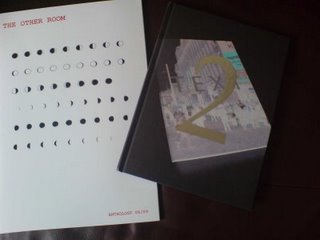
“Poetry readings are good value, for a few quid you get to see three or four poets, often interesting, sometimes excellent. The “sting” of course, is that there’s usually a table of books somewhere near. Whereas a reading by a “name” will see a man from Blackwells or Waterstones hovering with a pile of Fabers or similar – pleasant enough, but nothing you can’t buy from your local branch or the internet – a more obscure group of poets will come with a book table to die for.”
From Adrian Slatcher.
More Text Festival
TOR in MEN
“Literature should be seen as well as heard of course, and the relaunched website for The Other Room, Manchester’s only (as far as I know!) regular avant garde poetry night held at the Old Abbey Inn, has a great range of video content as well as the other stuff you’d expect, and is a really nice use of one of the more recent WordPress templates.”
By Adrian Slatcher. From The Mancunian Way, part of the Manchester Evening News site.
Link.
If you haven’t already done so, check out Adrian’s Art of Fiction pages via our links in the third column.
 otherroom.org