
Argotist interview with Pete Brown, poet and former lyricist for the1960s rock group, Cream. Part of the ongoing Argotist singer-songwriter interview series.
Resources
An interview with Craig Dworkin
Even when those texts look indistinguishable from the work that is included
Craig Dworkin talks about Against Expression, an anthology of conceptual writing in Jacket magazine.
Shared words: an interview with Alec Finlay

“the art work had to be us after we had left”
More at the nine dots site. Read about Alec’s many other projects at his own site.
Maintenant #78 – Damir Šodan
Though his work is utterly modern and could only be of the now, Damir Šodan, as a man, recalls a different age. Cosmopolitan, engaged, political, satirically adept and poetically versatile, he is a poet who defines and embodies one of Europe’s great, surging contemporary traditions, that is Croatia since the turn of the millennium. One of the most active and veracious translators and editors on the continent, he has won international awards for his plays and finds employment at the Hague, as a translator for the United Nations War Tribunal. This is beside his reputation as a poet, which is considerable and deservingly ever growing. His work is striking for its elasticity, its precision and its ability to retain power amidst a wit rarely found in modern letters. In a typically generous and eloquent interview, discussing everything from war crimes tribunals to the Croatian poetic tradition, we present a locus of modern European poetry, Damir Šodan.
http://www.3ammagazine.com/3am/maintenant-78-damir-sodan/
I’m very pleased to say we have published ten of Damir’s poems in English alongside the interview
Articulating Space: Short Essays on Poetry by Jessica Smith
Free ebook of essays from the Argotist by Jessica Smith.
Composed between 2000 and 2006, these short essays on poetry and poetics straddle the genres of traditional academic essay and manifesto. They include analyses of L=A=N=G=U=A=G=E poetics (Andrews, Bernstein, DuPlessis, Hejinian, Howe, McCaffery, and Silliman) and poetry by Modernists Eliot, Stein, and Zukofsky; 19th Century poets Browning, Rossetti and Shelley; and contemporary poets Cecilia Vicuña and Christian Bök. Spinning 200 years of poetry and philosophy, Smith weaves a theory of the concomitance of space and time in language.
MICHAEL9MURRAY
An eclectic and elegant arts and culture blog by Michael Murray with writing on a diverse range of poetry, including Lyn Hejinian and Inger Christensen.
Knives Fists and Spoons
Peter Hughes writes about the Knives, Forks and Spoons Press in general and imminent Other Room reader SJ Fowler’s The Red Museum in particular at the Poetry Book Society Poetry Portal:
“Earlier this year, Alec Newman’s Knives, Forks and Spoons Press was shortlisted for the Michael Marks Award for outstanding UK publisher of poetry in pamphlet form. It is easy to understand why. KF&S has been putting out an amazing range of innovative poetry at an extraordinary rate. There is a buzz and an urgency about the whole project which has made it a particularly welcome addition to the British poetry scene.”
Jonny Liron interview and reading
Jonny Liron taking The Other Room interview and reading in July 2011
UbuWeb: visual poetry
Edited by derek beaulieu, the UbuWeb visual poetry archive contains an array of interesting stuff, including Ian Hamilton Finlay’s seminal journal Poor. Old. Tired. Horse.
Jeffrey Side interviews Daniel Kane about the Second Gen NY School
New at the Argotist. Click it.
Post #1000
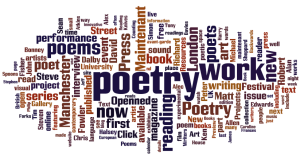
This is the thousandth post on The Other Room site. In case you missed any of the preceding nine-hundred and ninety-nine, here is how they look in word cloud form, with the names of the organisers removed.
David Berridge: The Moth Is Moth This Money Night Moth review
This review was originally published in Department Magazine, issue 1. A number of ammendments have been made from that version. David Berridge reads at The Other Room on August 24th.
This is better read as a PDF to see the layout of the poem.
The Moth Is Moth This Money Night Moth
By David Berridge
The Knives Forks and Spoons Press
Reviewed by James Davies
David Berridge’s The Moth Is Moth This Money Night Moth is a real delight. The work seems to me to mix minimalist and expressionist concerns. It is a work that chooses and places words which stand for themselves and also work pragmatically. Words also often seem to stand for the materiality of other words. This is achieved in misspellings, use of brackets and asterisks, thus extending the connotations within a single set of graphemes much in the same way that Geof Huth’s ntst does and some of Aram Saroyan’s seminal work from the 60s. So for example the second page reads:
gleen gnouth fnow
t (longue) l (lake)
night (night)
The words in the poem are easily readable as other words. So that gleen = ‘green’. gnouth = ‘mouth’. fnow = ‘snow’ and ‘for now’ as in ‘f’now’. t (longue) = a long tongue. l (lake) can be read as an example of stuttering, perhaps a reconfirmation that the word on the page, and that the image denoted, is indeed ‘lake’ – maybe a specific lake to Berridge but in leaving the lake unlabeled it is very much the reader’s lake, whether that is a named lake or the concept of ‘lake’.
The book reads as a sequence, not of fragments but as a whole; a sort of narrative. Yet the memories are not totally cohesive. The events are blurred or disguised in order to make the sensations stronger for the reader and make the experience far more democratic. It is the reader’s responsibility to choose whether they make the work confessional or not; confessional from Berridge’s point of view, or whether Moth triggers an event which the reader remembers. By this I mean that ‘lake’ in this poem seems to be a romantic symbol. By not being labeled it is so open that it can be substituted for any other romantic symbol of the reader’s making: beach, hill, bedroom, etc. With leanings towards romance (and also Buddhism) one is transported into one’s own memories – not Berridge’s. A minimalist poem has this power – we are the subject. DB gives something to me. A gift. However Berridge’s experience is clearly in there and thus Moth has expressionist tendencies too.
Moth is a world full of sense and cross-sense sensations, of feeling the inner light of the body or that of another’s body. On page 1 it is suggested that the body is integrated with/within the lake:
feet lake green lake mouth lake felt lake night night lake tongue lake
Reading left to right 13 words are strung across the page with every other one being ‘lake’ until the pattern is broken on the tenth word with ‘night’ replacing ‘lake’. This could be seen as the lake disappearing from eyesight as the night falls. ‘night’ is also the ninth word and this also promotes the idea that night falls. But ‘lake’ then reappears as the eleventh word. Perhaps this represents the coming of morning. Or perhaps a viewer focuses on ‘night’ and then switches his gaze to ‘lake’. The lake then reappears out of sequence and is taken over by the twelfth word ‘tongue’ and then consumes ‘tongue’ in the thirteenth word ‘lake’; surely an erotic image. Also ‘lake’ coming out of sequence is a glitch; again the reader chooses the implications of this glitch. It could be read as the haziness of memory or perhaps the way ‘perfect events’ have ‘wobbles’ in them.
Page 4 in part reads:
wnow outh
These work as heavy signs for ‘wow’, ‘snow’, ‘now’, ‘know’, ‘south’, ‘mouth’, ‘moth’ where again the reader chooses referents whilst being aware that what is actually on the page is actually a nonsense of no semantic value. As we move through Moth there are recurring motifs: ‘night’, ‘green’, ‘tongue’, ‘star’. But there are intrusions: ‘money’ and ‘fashion’ which appear often after page 4. A Money Moth by the way is a moth which is often associated with bad luck as it eats crops. This use of the word ‘money’ and its association with ‘the moth’ is a sudden negation, and imperfection, into what has been up until now idyllic landscape and mood; there is no such thing as perfection it suggests, all joy is transient.
However these intrusions never dominate in Moth. If we look at part of the middle pages:
t*o*n*
g*u*e
we see a visual play of snow falling on the tongue. And later on the same page:
snow = star
Snow is star and vice versa. The mass noun of ‘snow’ stops this image being personal as it is not fixed in a particular moment. It is about the idea of ‘snow’ and therefore we have to read star as the idea of ‘star’; perhaps their equivalence and perhaps combination. The reading of this short passage is made more difficult as it could be we are meant to assume an article is attached to ‘star’ and if it is we are not sure if ‘star’ is definite or indefinite. The same ambiguity applies to ‘snow’ as it could be ‘the snow’. This again shows that we can take the objects/words in Moth for what they are and also for what they could be.[1]
It is true that a sadness pervades here and there in the collection, Berridge’s landscape is not completely filled with joy – ‘money’ and ‘fashion’ interrupt ‘snow’, ‘stars’ and ‘lakes’ – but more regularly than not we move beyond colour , and experience happiness. That’s good. The Moth Is Moth This Money Night Moth is a really fine book. Go experience it.
[1] Similarities to other poems immediately occur. Yoko Ono’s poems/proposed performances in Grapefruit memorably use these two key elements of snow and star: yellow and white; the celestial. And Robert Grenier’s drawing poems are also connected. See http://www.parametermagazine.org/grenier.htm for my take.
The Innovative Sonnet Sequence
Robert Sheppard’s lecture on the Innovative Sonnet Sequence is now complete on his blogzine Pages.
SJ Fowler: new blog
SJ Fowler will be reading for The Other Room in October. In the meantime, you can get familiar with his work at his new blog, full of interesting stuff, including this reading at the recent launch of the Herbarium anthology.
Steve McCaffery – Carnival
Panel 3 of Steve McCaffery’s Carnival had its UK premiere at The Other Room in Leeds. Panels 1 and 2 can be downloaded in their entirety for free at Coach House Books.
I’ll Drown My Book – Conceptual Writing by Women Poets
About this project
I’ll Drown My Book will be the first collection of conceptual writing by women.
Conceptual writing is emerging as a vital 21st century literary movement and Les Figues Press wants to represent the contributions of women in this defining moment. By supporting this project, you will ensure that women claim their literary space. Edited by Caroline Bergvall, Laynie Browne, Teresa Carmody and Vanessa Place, the book includes work by 64 women from 10 countries. Contributors respond to the question: What is conceptual writing? I’ll Drown My Book offers feminist perspectives within this literary phenomenon.
CONTRIBUTORS:
Kathy Acker, Oana Avasilichioaei & Erin Moure, Lee Ann Brown, Angela Carr, Monica de la Torre, Danielle Dutton, Renee Gladman, Jen Hofer, Bernadette Mayer, Sharon Mesmer, Laura Mullen, Harryette Mullen, Deborah Richards, Juliana Spahr, Cecilia Vicuna, Wendy Walker, Jen Bervin, Inger Christiansen, Marcella Durand, Katie Degentesh, Nada Gordon, Jennifer Karmin, Mette Moestrup, Yedda Morrison, Anne Portugal, Joan Retallack, Cia Rinne, Giovanni Singleton, Anne Tardos, Hannah Weiner, Christine Wertheim, Norma Cole, Debra Di Blasi, Stacy Doris & Lisa Robertson, Sarah Dowling, Bhanu Kapil, Rachel Levitsky, Laura Moriarty, Redell Olsen, Chus Pato, Julie Patton, Kristin Prevallet, a.rawlings, Ryoko Seikiguchi, Susan M. Schultz, Rosmarie Waldrop, Renee Angle, Rachel Blau DuPlessis, Theresa Hak Kyung Cha, Tina Darragh, Judith Goldman, Susan Howe, Maryrose Larkin, Tracie Morris, Sawako Nakayasu, M. NourbeSe Philip, Jena Osman, kathryn l. pringle, Frances Richard, Kim Rosenfeld, Suzanne Stein, and Rachel Zolf.
EARLY REVIEW: Read an early response to the book by Janice Lee in Dear Navigator: http://blogs.saic.edu/dearnavigator/spring2011/janice-lee-the-ghosts-of-ill-drown-my-book/
ABOUT THE EDITORS:
Caroline Bergvall: http://www.carolinebergvall.com/
Laynie Browne: http://en.wikipedia.org/wiki/Laynie_Browne
Teresa Carmody: http://www.lesfigues.com/lfp/index.php?id=63
Vanessa Place: http://vanessaplace.artcodeinc.com/
FUNDING:
This funding will be used to offset actual printing costs. Most Les Figues titles are 96–160 pages; this book will be about 500 pages and three times more expensive to print. The book is already drawing international interest, as well as interest from outside the literary community, but we need to raise the funds to go to print!
Robert Sheppard – The Innovative Sonnet
Robert Shepard’s The Innovative Sonnet Sequence was delivered at the Hay Poetry
Jamboree 2011 at the Oriel Contemporary Art Gallery, Salem Chapel, Bell
Bank, Hay on Wye on June 4th 2011.
You can read it on Pages at www.robertsheppard.blogspot.com
It is in 14 parts, in deference to the sonnet. Posts will be one a day for the next fortnight. It therefore formally encodes the ambivalence towards the form found in the sonnet-like and sonnet-asperant
and sonnet-deviant productions of its most recent avant-garde practitioners and pasticheurs (many of them collected in The Reality Street Book of Sonnets, which appeared in 2008). Focussing on the sonnet sequences of Ted Berrigan, Tom Raworth, Jeff Hilson, Philip Terry, Geraldine Monk, Sophie Robinson, and Sheppard’s own sonnets
if p then q Top Trumps
There are now 21 if p then q Top Trump cards at the if p then q website. That’s enough to play with 3 players. There’ll be 32 in total which’ll come out as a limited edition set. This is the best thing since Snake.

Stirred
For women who write. A platform for female writers and performers of all genders to perform work of female origin. All welcome.
First Monday of every month, 7.30 PM start, £1 at Sandbar in Manchester.
Email: stirredwomen@gmail.com
YouTube: www.stirredsandbar/youtube
Painted Spoken at ten
Painted, spoken commiserate/celebrates its tenth year of publication with issue 21, comprising poetry by:
Amy Anderson
Tim Atkins
Isobel Dixon
Francesca Lisette
James McGonigal
Peter McCarey
Valerie Josephs
Peter Manson
Catherine Wagner
And in the Prose Supplement:
Joanne Tatham & Tom O’Sullivan [text-based works reflecting on / refracting their collaborative practice]
Kristen Krieder on / through / via PolyPly
Alistair Peebles on Ian Hamilton Finlay’s Orkney
Richard Price on film-maker & poet Margaret Tait
Peter McCarey on Ilôt 13 [Improvisation / Sound Art in Geneva]
Available almost free (send two A5 envelopes, each with two second class stamps on them) to: 24 Sirdar Rd, London, N22 6RG.
via Richard Price (ed.)
 otherroom.org