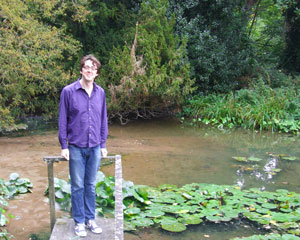
Philip Terry – a preview

Philip Terry will be reading at The Other Room on Wednesday 24th August. As a taster of his work, try Robert Sheppard’s discussion of his Shakespeare’s Sonnets at Pages or one of the sonnets themselves at Carcanet. Sections from his Dante’s Inferno, recently published by Oystercatcher Press, can be found at onedit and his recent reading at the launch of the Herbarium anthology is available on YouTube.

The other readers will be David Berridge and Rachel Lois Clapham.

Rachel Lois Clapham: a preview

Rachel Lois Clapham will be performing along with David Berridge and Philip Terry at the next Other Room on Wednesday 24th August. For a flavour of her work, try these three films of her diagrammatic readings: 0456461 to 0456464 2009; (W)reading The Crack-Up Fitzgerald, F. Scott  2010; Re- Rachel Lois Clapham and Emma Cocker 2010 – ongoing.

A preview of Philip Terry will appear shortly. Read this post for a preview of David Berridge.

David Berridge: The Moth Is Moth This Money Night Moth review

This review was originally published in Department Magazine, issue 1. A number of ammendments have been made from that version. David Berridge reads at The Other Room on August 24th.

This is better read as a PDF to see the layout of the poem.

The Moth Is Moth This Money Night Moth
By David Berridge
The Knives Forks and Spoons Press
Reviewed by James Davies

David Berridge’s The Moth Is Moth This Money Night Moth is a real delight. The work seems to me to mix minimalist and expressionist concerns.  It is a work that chooses and places words which stand for themselves and also work pragmatically. Words also often seem to stand for the materiality of other words. This is achieved in misspellings, use of brackets and asterisks, thus extending the connotations within a single set of graphemes much in the same way that Geof Huth’s ntst does and some of Aram Saroyan’s seminal work from the 60s. So for example the second page reads:

gleen gnouth fnow

t (longue)   l (lake)

night (night)

The words in the poem are easily readable as other words. So that gleen =  ‘green’. gnouth = ‘mouth’. fnow = ‘snow’ and ‘for now’ as in ‘f’now’. t (longue) = a long tongue. l (lake) can be read as an example of stuttering, perhaps a reconfirmation that the word on the page, and that the image denoted, is indeed ‘lake’ – maybe a specific lake to Berridge but in leaving the lake unlabeled it is very much the reader’s lake, whether that is a named lake or the concept of ‘lake’.

The book reads as a sequence, not of fragments but as a whole; a sort of narrative. Yet the memories are not totally cohesive. The events are blurred or disguised in order to make the sensations stronger for the reader and make the experience far more democratic. It is the reader’s responsibility to choose whether they make the work confessional or not; confessional from Berridge’s point of view, or whether Moth triggers an event which the reader remembers. By this I mean that ‘lake’ in this poem seems to be a romantic symbol. By not being labeled it is so open that it can be substituted for any other romantic symbol of the reader’s making: beach, hill, bedroom, etc.  With leanings towards romance (and also Buddhism) one is transported into one’s own memories – not Berridge’s. A minimalist poem has this power – we are the subject. DB gives something to me. A gift. However Berridge’s experience is clearly in there and thus Moth has expressionist tendencies too.

Moth is a world full of sense and cross-sense sensations, of feeling the inner light of the body or that of another’s body. On page 1 it is suggested that the body is integrated with/within the lake:


feet lake green lake mouth lake felt lake night night lake tongue lake


Reading left to right 13 words are strung across the page with every other one being ‘lake’ until the pattern is broken on the tenth word with ‘night’ replacing ‘lake’. This could be seen as the lake disappearing from eyesight as the night falls. ‘night’ is also the ninth word and this also promotes the idea that night falls. But ‘lake’ then reappears as the eleventh word. Perhaps this represents the coming of morning. Or perhaps a viewer focuses on ‘night’ and then switches his gaze to ‘lake’. The lake then reappears out of sequence and is taken over by the twelfth word ‘tongue’ and then consumes ‘tongue’ in the thirteenth word ‘lake’; surely an erotic image. Also ‘lake’ coming out of sequence is a glitch; again the reader chooses the implications of this glitch. It could be read as the haziness of memory or perhaps the way ‘perfect events’ have ‘wobbles’ in them.

Page 4 in part reads:

wnow        outh

These work as heavy signs for ‘wow’, ‘snow’, ‘now’, ‘know’, ‘south’, ‘mouth’, ‘moth’ where again the reader chooses referents whilst being aware that what is actually on the page is actually a nonsense of no semantic value. As we move through Moth there are recurring motifs: ‘night’, ‘green’, ‘tongue’, ‘star’. But there are intrusions: ‘money’ and ‘fashion’ which appear often after page 4. A Money Moth by the way is a moth which is often associated with bad luck as it eats crops. This use of the word ‘money’ and its association with ‘the moth’ is a sudden negation, and imperfection, into what has been up until now idyllic landscape and mood; there is no such thing as perfection it suggests, all joy is transient.

However these intrusions never dominate in Moth. If we look at part of the middle pages:


t*o*n*

g*u*e

we see a visual play of snow falling on the tongue. And later on the same page:


snow = star

Snow is star and vice versa. The mass noun of ‘snow’ stops this image being personal as it is not fixed in a particular moment. It is about the idea of ‘snow’ and therefore we have to read star as the idea of ‘star’; perhaps their equivalence and perhaps combination. The reading of this short passage is made more difficult as it could be we are meant to assume an article is attached to ‘star’ and if it is we are not sure if ‘star’ is definite or indefinite. The same ambiguity applies to ‘snow’ as it could be ‘the snow’. This again shows that we can take the objects/words in Moth for what they are and also for what they could be.[1] 

It is true that a sadness pervades here and there in the collection, Berridge’s landscape is not completely filled with joy – ‘money’ and ‘fashion’ interrupt ‘snow’, ‘stars’ and ‘lakes’ – but more regularly than not we move beyond colour , and experience happiness. That’s good. The Moth Is Moth This Money Night Moth is a really fine book. Go experience it.


[1]  Similarities to other poems immediately occur. Yoko Ono’s poems/proposed performances in Grapefruit memorably use these two key elements of snow and star: yellow and white; the celestial. And Robert Grenier’s drawing poems are also connected. See http://www.parametermagazine.org/grenier.htm for my take.

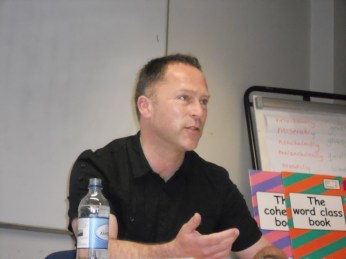
Alec Finlay – some activities

April 2011 reader Alec Finlay has many irons in many fires. For details of his current projects, see below.

* * *

Mountaineering in Counterpane

Alec will read ‘Mountaineering in Counterpane: a Report to the Armchair Mountaineering Club; other speakers include Misha Myers and Matthew Beaumont.

One-day symposium, presented by the University of Sunderland W.A.L.K. research initiative, seeking to interrogate the practice of walking in all its cultural, ethnographic, poetic, and geographical ramifications.

The Gymnasium, Gallery of Modern Art, Edinburgh
Thursday 28th July 2011, 12.30 – 17.00

For information contact Heather Yeung at: WALK@sunderland.ac.uk


____________________
the road north

St Weems http://the-road-north.blogspot.com/2011/06/33-st-weems_23.html

Killin and Acharn http://the-road-north.blogspot.com/2011/06/7-killin-acharn_27.html

Monreith http://the-road-north.blogspot.com/2011/06/9-monreith.html

the hidden gardens http://the-road-north.blogspot.com/2011/07/53-hidden-gardens_07.html

You can follow Ken and Alec’s steps on their blog http://the-road-north.blogspot.com/

Visit The Road North website, where you can read Basho’s Oku-no-Hosomichi, the work that inspired the project http://www.theroadnorth.co.uk/

__________________________
mapping the road north

This hand-drawn map documents all of the ‘stations’ visited by Alec and Ken on their year-long journey, with a mirror-map listing Basho’s Japanese place-names.

You can view or download the full-size map here http://dl.dropbox.com/u/1599958/TRN%20mirror-map%20%28final%29.jpg

For a free map, send an A4 SAE to Luke Allan, Studio Alec Finlay, 36 Lime Street, Newcastle Upon Tyne, NE1 2PQ.

___________________________
the road north ‘sampler’

As part of the programme for this year’s Edinburgh International Festival, Alec and Ken will present a ‘sampler’ of The Road North, displaying hokku-labels, tea-prints and whiskies that characterized their 53 visits. The sampler can be viewed at the Scottish Poetry Library, Edinburgh from 5 August, running till 3 September. Edinburgh http://www.spl.org.uk/about/find.html

On 28 August, 12:00pm, Alec and Ken will be reading from the project, accompanied by director of SPL Robyn Marsack: @ The Hub (Royal Mile, Edinburgh) http://www.edinburghfestivals.co.uk/venues/hub?page=1

_____________________________
T/H/E/C/I/T/Y/S/A/S/T/O/N/E/B/O/O/K

Alec has created a new civic grove for Victoria Gardens, Leeds. Three inter-related works on the theme of the city & pastoral have now been installed outside Leeds City Art Gallery. Among the formal screen of London Plane trees, 10 nest-boxes painted with QR codes offer e-links to field-recordings of birdsong by Chris Watson; in the Red Oak trees by the gallery entrance, S/I/N/G  W/I/L/D  K/I/N/D  W/O/O/D is an arrangement in 4×4 grids on next-boxes, echoing a phrase from John Berryman’s Dream Songs. T/H/E/C/I/T/Y/S/A/S/T/O/N/E/B/O/O/K is a stone-carved piece laid in the ground at the front of the Gallery, carved by Peter Coates. The digital print of this work will be available from Ingleby Gallery.

_________________
‘Moss on Stone’

Alec & Robin Gillanders have collaborated on a portrait of Stonypath, Little Sparta, for Boulderpavement, published by The Banff Centre, now online at http://boulderpavement.ca/issue004/moss-on-stone/

David Berridge: a preview

David Berridge will be performing at the next Other Room on Wednesday 24th August, along with Rachel Lois Clapham and Philip Terry. For a flavour of his work, try Game, Global, Green, Grown, Guys at Beard of Bees, Black Gardens at The Red Ceilings Press and  SPIT & PRAXIS: DOG MAN SPEAKS in Streetcake Magazine. Check out too his VerySmallKitchen project, which he describes as “inhabiting, defining and exploring spaces of connection between writing and art practice; text, book and exhibition; curating and authorship. ”

Previews of Rachel Lois Clapham and Philip Terry to follow soon.

Robert Sheppard – The Innovative Sonnet

Robert Shepard’s The Innovative Sonnet Sequence was delivered at the Hay Poetry
Jamboree 2011 at the Oriel Contemporary Art Gallery, Salem Chapel, Bell
Bank, Hay on Wye on June 4th 2011.

You can read it on Pages at www.robertsheppard.blogspot.com

It is in 14 parts, in deference to the sonnet. Posts will be one a day for the next fortnight. It therefore formally encodes the ambivalence towards the form found in the sonnet-like and sonnet-asperant
and sonnet-deviant productions of its most recent avant-garde practitioners and pasticheurs (many of them collected in The Reality Street Book of Sonnets, which appeared in 2008). Focussing on the sonnet sequences of Ted Berrigan, Tom Raworth, Jeff Hilson, Philip Terry, Geraldine Monk, Sophie Robinson, and Sheppard’s own sonnets

Tamarin Norwood: a preview

Tamarin will be performing at the next Other Room on 20th July. She describes herself and her work as follows:

“Tamarin Norwood is an artist and writer. Her work addresses the possibility of reciprocation between art and writing; practice and everyday life; production and circulation. Projects usually take the form of performance, objects or text. Tamarin holds first class bachelor’s degrees from Oxford University (2004) and Central Saint Martins (2007) in Italian & Linguistics and Fine Art respectively and gained her master’s degree in Art Writing at Goldsmiths (2010).”

For a wide range of samples from her work, visit Tamarin’s website. You can also watch her June 2011 Maintenant Slovakia reading at the Rich Mix in London’s Brick Lane, her “illustrated performative talk” What To Do at the Roehampton Institute and a performance of her Musica Practica at Tate Britain on YouTube.

Previews of Chris Goode and Jonny Liron to follow.

Frances Kruk – Down You Go

FRANCES KRUK | DOWN YOU GO, OR,NÉGATION de BRUIT (APRÈS DANIELLE COLLOBERT)

“The most pathetic poem is small people on fire”

Frontis piece constructed by gustave morin.

Two color silk screen on construction grade brown packing paper wrapped around black bristol cover. Interior printed on Mohawk Superfine. Set in Bodoni and Gill Sans. Hand stitched.

$5.00 US | $8.00 outside the US

http://damnthecaesars.org/punchpress.html

arthur+martha: BLOOM

Via Philip Davenport:

The current arthur+martha project in Four Acre, St Helens has been short-listed for the national Bloom Awards. The Bloom Awards are for excellence and innovation in improving the quality of life, dignity and well-being of older people receiving care and support. We would really value your support. To register and to cast your vote on the various projects in the awards please follow this link http://lemosandcrane.co.uk/home/index.php?id=213425 and look for St Helen’s Council- Arts Service: Art of the Unexpected. Voting closes 24th June (5pm)

Poems about succumbing to temptation iced onto cakes, childhood memories painted onto plates, or poverty stitched onto tablecloths, bunting that questions etiquette, fading memories written on doilies, ‘sugar’ graffiti that evokes long gone childhoods, hardship and friendship. We have been invited older people in the an economically-deprived area to make a mix of poetry and art, celebrating their lives and visions. We’re trying to reach those who might not normally join in with art activities, by taking our workshops to the local Bingo night, housebound people’s homes, the doctors surgery, Tescos, a day centre for people diagnosed with dementia, a local library…

To read the latest about the project visit http://arthur-and-martha.blogspot.com/search/label/Four%20Acre%20St%20Helens

More photos at http://www.flickr.com/photos/arthur-and-martha/