Maintenant #38 – Volya Hapeyeva

A figure of youthful prominence in Belarus, Volya Hapeyeva is at the very forefront of emergent poets reaching their notoriety in Eastern Europe. A lauded playwright, critic and linguistic philosopher, as well as a poet, her depth and zest have marked her out as one of the most agile stylists writing in Europe at large. Her work is marked by a sensitivity and care that many would find incongruous with her rigour and methodological pragmatism. She makes the conflagration of lyrical poetry & collaborations with Belarussian techno DJ’s seem effortless. We are happy once again to introduce another fantastic young poet as the 38th edition of the Maintenant series.

Accompanying the interview are seven of her poems. It is the first time her work has appeared in the English language.
We are indebted to Chris Michalski for his translations.

C’est mon dada


Red Fox’s cool series hits its 50th publication with Klaus Groh “Frutas y Terra”

Visaul poetry / Collages on Spanish fruit and vegetable packaging.
A6 format – 48 pages – laser printing.
Thread and quarter cloth binding
November 2010
price: 15 euro / 20 US $ / 13 UK Sterling

LINK

DEPT

DEPT #1 now available. Features new work from Simon Howard, Becky Cremin, Nat Raha, James Davies, Stephen Emmerson, Bill Drennan, Lucy Harvest Clarke, Tim Thornton, Alex Davies, Karen Sandhu and Gary Fisher. Costs 3 quid. Or exchanges very welcome. Send a message to barrett.richard1@googlemail.com if you want one. Please send submissions of poetry/essays/reviews/photographs for #2 to the same address.

New BlazeVOX now online

Featuring Alban Fischer, Amy Hard, Amanda Stephens, Amy Lawless, Amylia Grace, Andrea Dulanto, AE Baer, Anisa Rahim, Antony Hitchin, Brad Vogler, Barbara Duffey, Benjamin Dickerson, Bob Nimmo, Billy Cancel, Brian Edwards, Brian Anthony Hardie, Ashley Burgess, Carlos Ponce-Meléndez, Carol Smallwood, Caroline Klocksiem, Chad Scheel, Christine Herzer, Darren Caffrey, David Toms, Debrah Morkun, Diana Salier, Donna Danford, David Plumb, Ed Makowski, Elizabeth Brazeal, Eric Wayne Dickey, Erin J. Mullikin, Julie Finch, Flower Conroy, George McKim , Geoffrey Gatza, Sarah Sweeney, Geer Austin, Heather Cox, henry 7. reneau, jr, Howie Good, Ivan Jenson, Ian Miller, James Mc Laughlin, Jason Joyce, Jeff Arnett, Julia Anjard Maher, Joshua Young, Jennifer Thacker, Kate Lutzner, Kelci M. Kelci, Laura Straub, Martin Willitts Jr, Margot Block, Myl Schulz, Camille Roy, Megan Milligan, Michael Caylo-Baradi, Michael Crake, Michael Hartman, Nick Miriello, Nicole Peats, Orchid Tierney, Philip Sultz, SJ Fowler, Steven Taylor, Steve Potter, Stephan Delbos, Simon Perchik, Sean Neville, Sarah Sousa , Bob Whiteside, Ricardo Nazario y Colón, Santiago del Dardano Turann, John Raffetto, Bruce Bromley, Carl Dimitri, Gregory Dirkson, Jordan Martich, Natalie McNabb, Moura McGovern, Jennifer Houston, Robert Vaughan, Christi Mastley, pd mallamo and bruno neiva. Get it here.

blart 1

blart 1 is now online here
http://blartmagazine.jimdo.com/
featuring work by:

  • tom jenks
  • andy jordan
  • nicolas spicer
  • chris stephenson
  • james davies
  • ryan ormonde
  • jasmine rosenbloom
  • sean burn
  • gareth durasow
  • alison faulds
  • allen fisher
  • matthew martin
  • steven waling
  • michael zand
  • david marriott
  • colin herd
  • becky cremin
  • geof huth
  • posie rider
  • yolanda tudor-bloch
  • richard barrett
  • hazel mcadin
  • david clarke
  • tom oliver graham
  • michael dean
  • zachary chartkoff
  • ariel moon
  • nat raha
  • s j fowler

Maintenant catch up and Iceland reading

Maintenant 32

An interview with the Slovenian poet, Primož Čučnik, the 32nd subject of the 3am magazine interview series centred on contemporary European poets. The interview is also accompanied by two poems.

http://www.3ammagazine.com/3am/maintenant-32-primoz-cucnik/

http://www.3ammagazine.com/3am/two-poems-primoz-cucnik/


Maintenant 31

An interview with the Norwegian poet, Paal Bjelke Andersen, the 31st subject of the 3am magazine interview series centred on contemporary European poets and the fourth and final Norwegian poet featured as part of the series to celebrate the Maintenant: Ny Poesi readings held in London recently at the Poetry Cafe & the Rich mix arts centre. The interview is also accompanied by five pieces of poetry translated into English specifically for the readings & interview.

http://www.3ammagazine.com/3am/maintenant-31-paal-bjelke-andersen/

http://www.3ammagazine.com/3am/five-poems-paal-bjelke-andersen/


Maintenant 30

An interview with the Danish poet, Martin Glaz Serup, the 30th subject of the 3am magazine interview series centred on contemporary European poets. An extraordinary poet, children’s author and critic, included with the interview are seven excerpts from his remarkable work The Traffic Is Unreal translated by Thomas E. Kennedy.


http://www.3ammagazine.com/3am/maintenant-30-martin-glaz-serup/

http://www.3ammagazine.com/3am/seven-poems-martin-glaz-serup/


Maintenant 29

An interview with the Russian-born British poet, Annie Katchinska, the 29th subject of the 3am magazine interview series centred on contemporary European poets. An extraordinary talent, she is one of the very brightest stars emerging in the UK. Included with the interview are three of her poems.

http://www.3ammagazine.com/3am/maintenant-29-annie-katchinska/

http://www.3ammagazine.com/3am/three-poems-annie-katchinska/


Icelandic & British Poetry in collaboration

3am magazine’s Maintenant interview series presents Icelandic & British Poetry in collaboration at the Rich mix

(35 – 47 Bethnal Green Road, London. E1 6LA)

Saturday November 27th – 7pm – Entrance free

Iain Sinclair & Ragnhildur Jóhanns / Eirkur Örn Norðdahl & Stewart Home

Scott Thurston & Bryndís Björgvinsdóttir / Jón Örn Loðmfjörð & Tom Jenks


Currents in Electronic Literacy

Dear all,

Currents in Electronic Literacy (ISSN 1524-6493) solicits submissions
related to the theme below. Submissions are due on Monday, January 10,
2011.

Spring 2011 issue: Writing with Sound

Today we live in a society defined–in many senses, and by almost all
the connotations associated with the word as well–by the word
‘current’…. The old hierarchies of linear thought, sublime (and
sublimated!) engagements with art, poetry, music, science, and history
are no longer needed to do the ideological work now conducted again
along the lines of ‘current.’ (Miller 32)

This call for projects begins with a sample, with the echoing of a
familiar call to listen to a new kind of logic. The sample comes from
Rhythm Science by Paul Miller (a.k.a. DJ Spooky that Subliminal Kid),
who encourages us to go with the flow, to find a good mix, and to
listen for new ways of thinking and linking. In conjunction with
Miller’s appearance as part of the Digital Writing and Research Lab’s
annual Speaker Series, we are excited to announce that the Spring 2011
issue of Currents will focus on writing with sound.

The issue will open with a compelling radio piece by Avital Ronell in
which she–along with the flute accompanying her–insists that
Nietzsche was a DJ. Remixing, it seems, is everywhere. For some time
now, sampling and remixing has been a powerful metaphor for writing in
digital culture; indeed, the College Composition and Communication
Convention took remixing as its theme in 2010. The challenge now is to
literalize the metaphor, to allow audio technologies to enter into the
field’s descriptions of “the writing process(es),” which will change
not just the way we think about and teach writing, but our processes,
and so our “products,” as well. In order to encourage and embrace
these changes, Currents invites—along with traditional academic
submissions—audio essays, podcasts, oral histories, interviews, and
other audio recorded genres, as well as webpages, videos, animations,
slide presentations, etc., that address sound-related issues. Videos
may be uploaded to YouTube.com and shared with
currents@dwrl.utexas.edu. (Other video hosting sites may be used.
However, YouTube.com meets more accessibility standards than sites
like Vimeo.) Audio may be uploaded to SoundCloud.com and shared with
currents@dwrl.utexas.edu

. Both YouTube and SoundCloud allow for private sharing. During the
submission process, please make your audio and video materials
available to a limited audience. Audio/video/visual submissions should
also include a 500-word document explicating method and performance.

Some potentially interesting lines of inquiry include but are by no
means limited to the following:
• How does the mixing of audio recording and writing create new
genres? How do soundscapes and text work together?
• How do technical instrumentalities, such as, the materials used to
record sounds affect the message? Can sound ever be virtual?
• What have we not heard by focusing our attention on the printed
page? How can teaching with sound revitalize the rhetorical canons
(especially memory and delivery), as well as the issue of “voice”?
• What roles do silence and accessibility play in the discussion of
“voice”? What does “voice” mean for deaf and hard of hearing
individuals as students, professors and authors? How can new
technologies and pedagogies help educators meet the goal of
providing direct and uninhibited language communication access to
curriculum? How can we listen to the “oral” histories,
poems, songs, and stories that belong to the signing Deaf community
and Deaf culture?
• How does the practice of remixing change the way we think about
literacy?
• Multimedia encourages a shift in roles from writer to
producer–what are the implications of this shift?
• Alphabetic writing and audio recording both begin as inscriptions
on a surface, but in what ways does the waveform of audio
recording differ from alphabetic writing?
• How might workspaces in the world of audio recording change the
way we write?
• Many theorists, rhetoricians, and philosophers have argued in
favor of an “ethics of listening.” What further rhetorical and
pedagogical implications might such an ethics entail?
• Through phonography, audio recording, and writing share a history,
what parts of this history do recorders and writers need to bring
to light, retell, and reimagine?
• Through dictation, writers have written with sound for a variety
of reasons in a multiplicity of social and technological
configurations, not all of which have been mutually beneficial. How
might we imagine a productive dictating relationship that ethically
distributes power?
• From recording for the blind and dyslexic to screen readers, sound
reproduction has often been used to extend our (sense)abilities.
What kinds of dictation, transcription, reading, and writing tools
are on the horizon of assistive technology?
• As the tools and techniques for capturing and storing literacy
narratives and oral histories proliferate, we increase our ability
to build and study archives of audio material from many different
cultures. What literal and virtual spaces are shared by fields such
as sound studies, ethnomusicology, rhetoric and literature? What
are the risks and benefits of building and studying archives? Who
might be the secret beneficiaries?
• In a classroom setting, how might the use of sound recordings
introduce students to the affective and emotional textures of
historical experience? In other words, how might sound influence
students’ understanding of historical context?
• In terms of both pedagogy and research, how might we use sound to
convey intangibles such as Barthes’ “grain of the voice”? What
other kinds of intangible, ephemeral, or otherwise ghostly affects
and ideas are better captured through sound rather than the written
word?

All submissions should adhere to MLA style guidelines for citations
and documentation. Submissions should state any technical requirements
or limitations. Currents in Electronic Literacy reserves all
copyrights to published articles and requires that all of its articles
be housed on its Web server. It is the policy of Currents that all
accepted contributions must meet Section 508 accessibility standards
(e.g., captioning for video and transcripts for audio). While all
Currents articles are accessible, readers are advised that these same
articles may contain links to other Web sites that do not meet
accessibility guidelines.

Please direct all submissions and questions to: currents@dwrl.utexas.edu

http://currents.dwrl.utexas.edu/call-for-papers

Via Graham Clarke

Directions by by Robert Fitterman and Steve Giasson

Via Derek Beaulieu:

For Les Figues Press’ fundraising auction, Fitterman offered something called “Not A Thing;” an offer to collaborate on a conceptual text.

Giasson won the bid and together they came up with a text titled Directions where they chart out the various ways to get from Fitterman’s apartment to Giasson’s … car, ship, plan, bicycle and more.

Published in an edition of 60 handbound copies (30 of which are for sale), each copy has handcut BFKRives covers.

Directions is available for $8 (shipping included).

To order, please email derek@housepress.ca

Shad Thames, Broken Wharf

From Chris McCabe:

“My play for voices has just been published by Penned in the Margins, it’s called Shad Thames, Broken Wharf and was performed at the London Word Festival in March this year. It’s a beautifully made mini-book of 48 pages that comes in a limited edition box (200 made) with a free-gift of an item from the Thames (fitting the theme of the play), including Victorian claypipes, pottery, a McDonalds toy, a champagne cork and what looks to me like a horse’s tooth. The play will be performed again at the Bluecoat in Liverpool on the 4th of December. More info and to buy on Penned site here: http://www.pennedinthemargins.co.uk/?p=954

And there’s background text to the whole project here: http://chris-mccabe.blogspot.com.

Maintenant #27 – Zvonko Karanović

Via Steven Fowler:
An interview with the Serbian poet, Zvonko Karanović, the 27th subject of the 3am magazine interview series centred on contemporary European poets.

In an extraordinary interview, Karanovic speaks of his influences, the context of the Balkan wars and his experience of how Serbia, and Serbian poetry, has altered in the countries tempestuous recent history.
Included with the interview is ten of his poems spanning five collections.

Our next Maintenant reading:
Ny Poesi: 3am magazine’s Maintenant interview series presents New Norwegian Poetry at the Rich mix
(35 – 47 Bethnal Green Road, London. E1 6LA)
Saturday September 25th – 7pm – Entrance free
Jenny Hval / Endre Ruset / Paal Bjelke Andersen / Audun Mortensen

A free evening of International poetry and performance from four of the most vibrant and resounding young poetic talents in a grand Scandinavian tradition. Hval, Ruset, Mortensen and Andersen belong to a generation of poets that measure the sophistication of literary poetry with the groundbreaking developments of the avant-garde poetic practise and performance. This reading will feature poets who have already gained prominence for their originality and power, and seemlessly engage the boundaries of what poetry can and should become as we reconfigure poetry as song, as lyric, as art and text.
The event will also see the release of a one off special publication from Knives Forks and Spoons press featuring poetic collaborations between the visiting Norwegian poets and Jeff Hilson, Sean Bonney, Agnes Lehoczky and Sam Riviere.

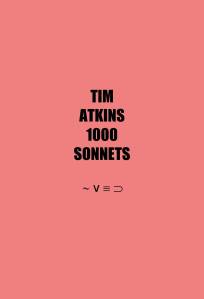
Tim Atkins’ 1000 Sonnets published by if p then q


The long awaited full set of Tim Atkins’ minimalist sonnets is finally here. First published by The Figures back in 2000 this if p then q collection contains over 100 extra sonnets to comprise 127. The title alludes to Kenneth Koch’s hilarious sequence of short plays/skits 1000 Avant Garde Plays and as ever Tim Atkins’ magic is in the spirit of that playfulness. You will have clocked some of these delights in The Reality Street Book of Sonnets.

What Ron Silliman had to say about Sonnet 91:

“Certainly a sonnet is possible in which these words fall in these places. Yet is not clear if anything, in fact, is missing. As such, the text stands mute, ironic, self-amused all at once.”

LINK to purchase from if p then q