GLOSS TO CARRIERS By Ian Heames

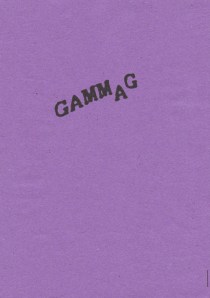
New from Critical Documents. £5/$11. 20 pages, 200 copies. Printed colour end-papers. 26 copies printed on a larger format.

Luke Roberts:
Gloss To Carriers is propelled by an internal logic of visor and helmet, tracking mutations on the horizon, ‘a picture of speed on the liquid corn’. The interface we see is heavily sedated warfare, her joysticks wild détourning, spinning through a set of invasive procedures, secret pingbacks between the Gloss and its Carriers. Every reader is also a bystander, totemic radar guilt lining our pockets: ‘goodbye immunity’. Can also be read as an operating-manual for the malfunctioning software of Recent British Poetry. Undetected viruses, get this and sleep in a new position.

Louis Jagger:
A vibrantly sexualised, obliquely emotionalised language of technology demonstrates the oppressions, disconnections, yearnings or compromises of an intelligent species mediated to by laser-wielding overlords and expected to swallow the dumbness of it whole. The poems are fragmented communications, garbled flight-logs of the things delivering death on imperial command, each marrying (or photon-fusing) an assortment of technical details into a concise and curiously unadorned vision of the organic and the intellectual reconstituted as mechanical will to power…This is a poem of protest and of sharp observation…Gloss To Carriers is a pulverising, all-consuming linguistic gun-battle from which nothing escapes.

I’ll Drown My Book – Conceptual Writing by Women Poets

About this project

I’ll Drown My Book will be the first collection of conceptual writing by women. 

Conceptual writing is emerging as a vital 21st century literary movement and Les Figues Press wants to represent the contributions of women in this defining moment. By supporting this project, you will ensure that women claim their literary space. Edited by Caroline Bergvall, Laynie Browne, Teresa Carmody and Vanessa Place, the book includes work by 64 women from 10 countries. Contributors respond to the question: What is conceptual writing? I’ll Drown My Book offers feminist perspectives within this literary phenomenon.

CONTRIBUTORS: 

Kathy Acker, Oana Avasilichioaei & Erin Moure, Lee Ann Brown, Angela Carr, Monica de la Torre, Danielle Dutton, Renee Gladman, Jen Hofer, Bernadette Mayer, Sharon Mesmer, Laura Mullen, Harryette Mullen, Deborah Richards, Juliana Spahr, Cecilia Vicuna, Wendy Walker, Jen Bervin, Inger Christiansen, Marcella Durand, Katie Degentesh, Nada Gordon, Jennifer Karmin, Mette Moestrup, Yedda Morrison, Anne Portugal, Joan Retallack, Cia Rinne, Giovanni Singleton, Anne Tardos, Hannah Weiner, Christine Wertheim, Norma Cole, Debra Di Blasi, Stacy Doris & Lisa Robertson, Sarah Dowling, Bhanu Kapil, Rachel Levitsky, Laura Moriarty, Redell Olsen, Chus Pato, Julie Patton, Kristin Prevallet, a.rawlings, Ryoko Seikiguchi, Susan M. Schultz, Rosmarie Waldrop, Renee Angle, Rachel Blau DuPlessis, Theresa Hak Kyung Cha, Tina Darragh, Judith Goldman, Susan Howe, Maryrose Larkin, Tracie Morris, Sawako Nakayasu, M. NourbeSe Philip, Jena Osman, kathryn l. pringle, Frances Richard, Kim Rosenfeld, Suzanne Stein, and Rachel Zolf.

EARLY REVIEW: Read an early response to the book by Janice Lee in Dear Navigator: http://blogs.saic.edu/dearnavigator/spring2011/janice-lee-the-ghosts-of-ill-drown-my-book/ 

ABOUT THE EDITORS: 

Caroline Bergvall: http://www.carolinebergvall.com/
Laynie
Browne: http://en.wikipedia.org/wiki/Laynie_Browne
Teresa
Carmody: http://www.lesfigues.com/lfp/index.php?id=63
Vanessa
Place: http://vanessaplace.artcodeinc.com/

FUNDING:

This funding will be used to offset actual printing costs. Most Les Figues titles are 96–160 pages; this book will be about 500 pages and three times more expensive to print. The book is already drawing international interest, as well as interest from outside the literary community, but we need to raise the funds to go to print!

LINK

» Maintenant #68: Ulf Stolterfoht

Concepts that may link poets from one nation are as fraught as the idea of nationhood itself. The poet who truly understands the nature of his own beginnings, most often by acquiescing to a conceived misunderstanding, perhaps offers the finest representation of his language and his country. Often only in the trace, the fragments, the shadows and the bunkered leftovers of language and expression can the truly analytical, intellectual and philosophically rigorous poet find safe ground. Thus we come to Ulf Stolterfoht , simply one of the most sophisticated and brilliant poetic minds of our generation, conceivably of any generation. Utterly unique, wise, witty and thoroughly considered, Stolterfoht’s work has been a beacon in European poetry for some time, and his standing has been a lightning rod for many poets he might call his peers. In one of the finest interviews given for the series, we present one of the finest German poets of his generation.

http://www.3ammagazine.com/3am/maintenant-68-ulf-stolterfoht/

Accompanying the interview are four of Ulf’s poems.

Infinite Editions e-poetry postcards

Editor Andrew Spragg has been amassing an impressive list of poets for his e-postcard series, so far including Tom Raworth and Emily Critchley and more. You can even print them as postcards and send to your loved ones. After opening the file in Google reader choose ‘file’ to open as a pdf. From there select ‘print’. In print choose ‘multiple pages’ where it reads page scaling and tick ‘page borders’

LINK

zimZalla object 010: # – Richard Barrett

#: Richard Barrett

# is a treatment of selected text output from the @_M_I_A_ Twitter feed. Using instinctive interventions, the original text has been transformed to create a new artefact. Echoes, repetitions and ghost-motifs occur and re-occur throughout #, laying trails true and false, with the # symbol doubling as medical shorthand for “fracture”. For distribution, the complete work has been split into fifty micro-texts of which only a single version exists, each presented in a labelled vial and accompanied by a bespoke extraction tool. # can be owned individually only in part and totally only in common. Each micro-text object is available in exchange for a gift, which can be in a physical, digital, verbal, gestural, symbolic or any other form. Use and exchange value are entirely irrelevant. As gifts are received, they will be listed on the Twitter feed #zimzalla. This list will be collated for presentation as a future object. Contact mail@zimzalla.co.uk or encounter a relevant individual in logical space. Visit the zimZalla site for more #.

@tweetfromengels Manchester, UK

Snapshots in text of homeless lives. Engels wrote about the harshness of 19 Century Manchester; people today who live a comparable existence are the homeless.

This project with homeless people in Manchester, UK is run by arthur+martha arts organisation in partnership with the Text Festival. Other partners were The Big Issue in the North, The Red Door (Bury Housing Concern),
Brighter Futures, The Booth Centre, The Lowry, LOVE Creative, the BBC. Poets and writers who’ve been involved include Steve Giasson, Geof Huth, copland smith, Anna MacGowan. Editors Philip Davenport and Rebecca Guest. The resulting long poem will be tweeted over the coming weeks.

Follow here.

Robert Sheppard – The Innovative Sonnet

Robert Shepard’s The Innovative Sonnet Sequence was delivered at the Hay Poetry
Jamboree 2011 at the Oriel Contemporary Art Gallery, Salem Chapel, Bell
Bank, Hay on Wye on June 4th 2011.

You can read it on Pages at www.robertsheppard.blogspot.com

It is in 14 parts, in deference to the sonnet. Posts will be one a day for the next fortnight. It therefore formally encodes the ambivalence towards the form found in the sonnet-like and sonnet-asperant
and sonnet-deviant productions of its most recent avant-garde practitioners and pasticheurs (many of them collected in The Reality Street Book of Sonnets, which appeared in 2008). Focussing on the sonnet sequences of Ted Berrigan, Tom Raworth, Jeff Hilson, Philip Terry, Geraldine Monk, Sophie Robinson, and Sheppard’s own sonnets

New Halfcircle site

Halfcircle is a poetry journal dedicated to innovative and experimental work. The latest issue features original poetry by Richard Barrett, John Wilkinson, James Cummins, Rosa van Hensbergen, Laura Kilbride, Tom Graham, Amy De’Ath, Andy Spragg, Tomas Weber, Emily Critchley, Lisa Jeschke, Charles Bernstein, Jonty Tiplady and Keston Sutherland, as well as a poetry postcard by Emily Critchley, Tom Graham, Gerry Loose or Tom Raworth, courtesy of Andy Spragg’s ‘infinite editions’.  See the new website for more details.

Call for Submissions: Handmade/Homemade

Drunken Boat, the online journal of arts and literature, seeks work for a Handmade/Homemade Folio. This folio will include handmade, homemade and letterpress chapbooks, one-of-a-kind editions and broadsides. We envision a marriage of the visual and textual, as a complement to Drunken Boat’s mission of reinventing the printed page. Work might include collage work, film, photography, scans of text objects and applicable forms of visual poetry. The folio is slated for Issue 16 (Winter 2012) and will likely be linked with the annual Handmade/Homemade exhibit at Pace University, Westchester Country (March, 2012). More at the Drunken Boat site.

Recreating Baghdad’s Lost Literary Street

Named for a tenth-century poet and revolutionary who lived in what is now Iraq, Al-Mutanabbi Street in Baghdad was the center of the city’s intellectual and literary life. It was home to booksellers, stationery stores, antiquarian bookstores, and cafes as famous for the ideas that flowed freely as for their pungent coffee.

In 2007, a car bomb exploded on Al-Mutanabbi Street, killing 30 and injuring another 100. Residents of Baghdad felt it as not just another attack but a strike against the richness of Iraqi literary history and against the free exchange of ideas and openness of thought. Books and papers lay scattered and charred beside the corpses on Al-Mutanabbi Street that day in March.

Beau Beausoleil, an American poet and bookseller based in San Francisco, was inspired to act. He created the Al-Mutanabbi Street Starts Here project because “I felt this connection between Al-Mutanabbi Street and here, and myself, on a visceral level. If I were an Iraqi, a bookseller, a poet, I would be on that street. I felt we needed some sort of response [to the bombing] from our own arts community.”

More about this project including work by Other Room reader Tina Darragh, can be found at the Foreign Policy in Focus site.