
gorse is a twice-yearly print journal edited by Susan Tomaselli and David Gavan, featuring longform narrative essays, original fiction and interviews. Issue 1 is online now, with contributors including Other Room readers SJ Fowler and Colin Herd.
gorse is a twice-yearly print journal edited by Susan Tomaselli and David Gavan, featuring longform narrative essays, original fiction and interviews. Issue 1 is online now, with contributors including Other Room readers SJ Fowler and Colin Herd.
Until January 31st, to editors@theclaudiusapp.com. Claudius App V here.
An internationalist online magazine of visual poetry. Issue 2 online now.

averbaldraftsone&otherstories
Bruno Neiva
The Knives Forks and Spoons Press (2013)
This sumptuous, sensuous, colour drenched book is, before content is addressed or even thought of, a delight to look at: rich red, mustard yellow and scorched orange abound, like looking at the world through technicolour goggles. As always with Knives Forks and Spoons, the production values are high. Neiva describes the work as illustrating his shift away from asemic practice, which can be described, albeit somewhat imperfectly, as writing without semantic content, and towards averbal practice, which we can assume means writing without words. This is not strictly true, as words do appear in averbaldraftsone&otherstrories, but they do not function as signs or signifiers. Rather they are simply part of the palate. This is language as material, forcing us to abandon our habitual linguistic norms and approach language as we would an image. Each page is as vibrant and vivid as the panel of a fresco.
The book raises interesting questions of context and the effect of context upon perception. At the end of the book is a list of where many of these pieces were exhibited in galleries. What difference would it make to see them hung on a wall, rather than presented on a page, to encounter them as visual art rather than poetry? The experience cannot but be different, for here we are studying the representation of the thing rather than the thing itself. We could think of this book as simply a catalogue, like a series of photographs of oil paintings or marble sculptures that might be sold as a memento of an exhibition, but this would be to miss the point. By presenting the work on a poetry imprint without any of the conventional surrounding text commonly found in an exhibition catalogue, this is a book that demands to be experienced as a book, a demand furthered by the presence of the word stories in the title. When we pick up a book we are primed to expect text, but here there is, for the most part, no text. The reader is straight away thrown off centre by the realisation that they are not really a reader at all. To engage with this book, the reader cannot simply passively receive, but must instead actively engage. These pieces do not offer obvious meaning and so the reader must make their own meaning, if indeed it is meaning that they want. To read the work, we must also read the frame around the work.
Although the pieces presented here could be described as visual poetry, they cannot be located in the canonical lineage of the form – Gombringer, the de Campos brothers, Noigandres etc. – all of whom were largely typographical and worked, in the main, directly on paper. Neiva’s work, although no less visually striking, does not have the same basis. Many of the pieces here are constructed using found material, particularly the sequence &otherstories that comprises the second part of the book and was made using materials found in the vicinity of a packaging warehouse. The most obvious reference point is Kurt Schwitters, particularly the smaller collages he made shortly after coming to Britain in the 1940s, constructed from bus tickets, scraps of newspaper and other ephemera. As with Schwitters, the apparent disorder and randomness is deceptive. This is no magpie’s nest. The material here is crisp and cleanly presented on the page according to its own internal geometry. Neiva speaks elsewhere of working according to constraints, and in averbaldraftsone&otherstrories we can see that in action in two ways. Firstly, there is no clutter. Neiva has used his materials economically and with precision. Each image is sparely arranged, like an abstract painting. Secondly, each piece seems to have built according to the limits of what was to hand, Neiva restricting himself to assembly and arrangement. Here, the environment itself has become a constraint. Like a woodsman taking only the timber he can find on the forest floor to build with, so Neiva constructs the poems in the &otherstories sequence from what the world presents him with. His is a heuristic poetics. In a time of superabundance of content and previously undreamt of freedom in the manipulation of material, Neiva’s disciplined, almost ascetic approach is an interesting counterpoint, a subtle refusal of capitalism and consumerism.
The pieces in the first part of the book, whilst consistent with Neiva’s rigorous methodology, are slightly different in character. Here, we see more authorial intervention. Text is more prevalent. Materials are marked and indented and carry the trace of human activity. Still, however, we see the same attention to the character of materials, the same radical sensitivity. Constraint based work often contains one non-constrained element, what Magne and others associated with Oulipo called the clinamen. Here, Neiva breaks the spell of averbaldraftsone&otherstrories only once by placing an uncaptioned monochrome photograph of a group of men in suits, some carrying straw boater hats, in the middle of the first section of the book. The image is annotated with gnomic glyphs that may have been added by Neiva, or may have already been on the image. The presence of this spectral image has the effect of bringing the reader up short: a break in transmission, a subliminal frame. Neiva does not explain it, as he does not explain anything. No authorial guidance is offered by him throughout the book. Each of these images stands alone, allowing us to make of them what we will and to make our own connections.
averbaldraftsone&otherstrories is an example, if examples are needed, of the importance of publishers such as Knives Forks and Spoons who make it their business to get behind experimental work and give it the attention it deserves. A mainstream publisher would simply not touch a book as cryptic and tangential as this. This enigmatic, angular, elegant, paradoxical work, so Spartan in its aesthetic, yet so luxuriant in its realisation refines our ideas of what visual poetry can be.
96pp, 18.9×24.61cm, paperback. Front and back cover images by Stathis
Tsemberlidis, from his book “Transmutation: Of Human Bodies and Flora”
(2013); see more at decadencecomics.com.
6.50 GBP | 8.00 EURO | 16.50 USBUKS
For a limited time, Jones’ Perdika Press pamphlet AKHMATOVA is available
with MEALY BLOOM for the discounted price of:
8.50 GBP | 10.50 EURO | 20.00 USBUKS
All prices inc. P&P
MEALY BLOOM brings together more than ten years of work by the poet Tom
Jones. It collects the pamphlet Transactions Grotesques, and presents the
new sequence “The Punk Star Tuba”, along with sixteen other poems, including
versions of Mandelshtam and Tsvetayeva. In a prefatory “Advertisement”, the
author set outs the poetics governing this collection: “the sense that
training of the conscience is possible, and could be done through this kind
of text.”
Tom Jones teaches English literature at the University of St. Andrews. He is the author of “Pope and Berkeley: The Language of Poetry and Philosophy” (Palgrave, 2005) and “Poetic Language: Theory and Practice from the Renaissance to the Present” (Edinburgh University Press, 2012). Essays can be found in “Jacket” and “Complicities” (Litteraria Pragensia, 2007). His books of poetry and translation include “Transactions Grotesques” (Barque Press, 2002) and “Akhmatova” (Perdika Press, 2007). His poems have appeared in “Quid”, “Boxon”,
“Blackbox Manifold”, “Cambridge Poetry Summit: Some Evidence”, and “Prague Literary Review”. He can be heard reading his poems at The Archive of the Now.
See the website for an extract from the book: http://mountain-press.co.uk/mealybloom.html
Critical Documents is pleased to announce its latest publication: Ryan Dobran’s Remote Carbon. Swaddled in gorge-destabilising cover images by Emir Šehanovic, this large-format 32-page collection brings together ten fugitive poems from 2008 to 2012, and includes the brand-new clutch of complicated instrumentation, ‘Ode to Dragon Bond’. It is available for the agreeable price of £4, $10, or €7 (shipping included).
Ludicrous Aesthete was written for the Reel Iraq festival at London’s Rich Mix in March 2013: “obstinate dogmatic cunning capable// lion asks: is it written anywhere that/it had to be found in the darkness.” Out now on Blart.
NUMBER 2: Reviews of Goat Far DT & Papa Boop Ndiop, Luke Roberts, Anne Gorick, Judah Rubin, Alison Gibb, Justin Katko, SNOW #1, Tom Leonard, Richard Owens, Carol Watts, John Wilkinson, Rosa Van Hensbergen & Emily Critchley. November 2013. eds. Lindsay + Luna, design, setting and production by Robbie Dawson

“Sea Witch” consists of 21 poems, loosely based on each scene of the film Jaws. The shark is now female. The writing combines attention to verbal texture with use of space on the page to present a verbal-visual whole. Out now from Leafe Press.
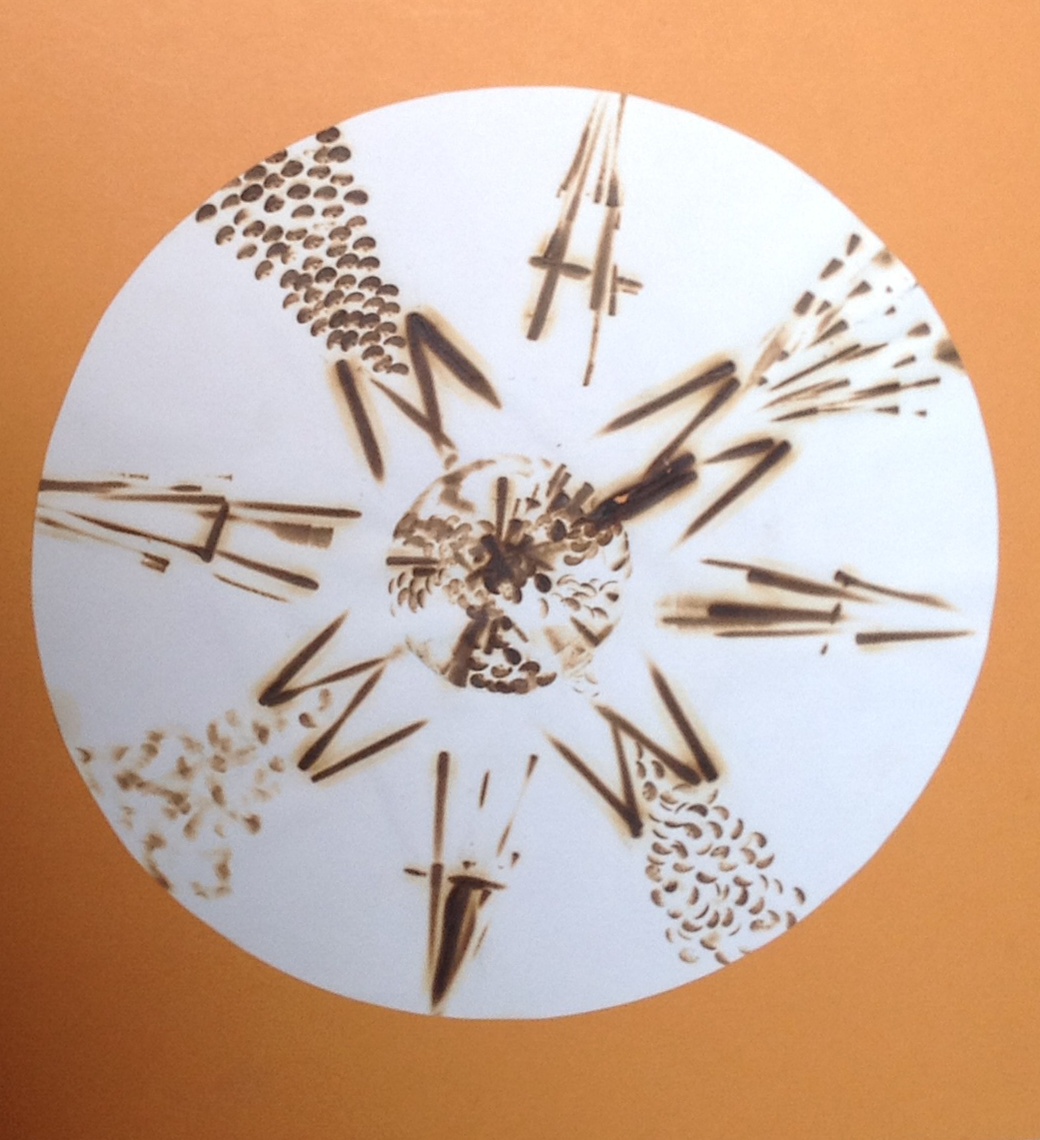
MAGMA poetry magazine Issue 57 is dedicated to Visual Poetry and is edited by Ian McEwen and Hannah Lowe. It will be launched with readings by contributors at The Troubadour, 263 Old Brompton Road LONDON SW5 9JA on Monday 18 November at 8.00pm. The issues features The Shaped Poem, an article by Paula Claire, with illustrations by Mirella Bentivoglio, Karl Kempton, Fernando Aguiar and Shoji Yoshizawa. Paula Claire’s own work is represented by her scorch mark poem MAGMA (1973), shown above, published by Writers Forum in 1978.

Out now from Penned in the Margins, featuring Tim Atkins, David Berridge, Cristine Brache, Patrick Coyle, Emily Critchley, Lone Eriksen, Frédéric Forte, Tom Jenks, Samantha Johnson, Alexander Kell, David Kelly, Sarah Kelly, Anatol Knotek, Ilenia Madelaire, Chris McCabe, nick-e melville, Eiríkur Örn Norðdahl, Matteo X Patocchi, Claire Potter, Monika Rinck, Sam Riviere, Hannah Silva, Marcus Slease, Ross Sutherland, Ryan Van Winkle, Philip Venables, and Sian Williams.
Phew…
NEW to the archive: Three Little Books by Aram Saroyan: THE BEATLES, I AM ROSE, and MY MUMMY’S DEAD.
NEW from Editions Eclipse: C o n t i n u u m, the latest installment of Stephen Ratcliff’s thousand-page projects triangulating an eco-conceptual poetics through daily devotional practice, rigorous form, and lyrical attention.
What joy. HERE at the Eclipse site
New bulging issue…
The new issue of VLAK: Contemporary Poetics & the Arts will be available during the ‘Camarade‘ collaborate poetics event, hosted by Steven J. Fowler, 2-10pm, Rich Mix, 35-47 Bethnal Green Road, London, 26 October — or can be got direct at www.vlakmagazine.com …
INSIDE THE LATEST ISSUE….
‘ESSAYS’ Jeroen Nieuwland on ‘Printing Out the Internet’ Vanessa Place on Conceptualism David Vichnar on Mark Danielewski Darren Tofts on Peter Milne Ian Haig on the Horror of the Toilet Pam Brown on the UBU Films Collective Alice Notley on the Post-Olsonian Epic Dustin Breitling on the White Cube Bev Braune on ‘Harder They Fall’ Jim Ruland on ‘Django Unchained’ Niall Lucy on That Deadman Dance Ann Hamilton on Ian Hays Javant Biarujia on Environment and Language Karel Piorecký on Czech Concrete Poetry Benjamin Tallis on the Prague housing projects Olga Peková on Intermedia & The Posthuman
‘PHOTOMONTAGE’ Peter Milne, Ian Hays, Robert Herbert, Maldo Nolimerg, Vincent Dachy
‘PHOTOGRAPHY’ Adam Trachtman, Glendyn Ivin, Vadim Erent, Vadim Erent, Katherine Oktober Matthews
‘COLLABORATIONS’ David Kelly & Daniele Pintano Hal Porter & Mark Melnicove Fernando Corona & Chris Kraus Zuzana Husárová & Amalia Roxana Filip Louis Armand & John Kinsella Iris Fraser-Gudrunas & Mat Laporte Mark Atkins & Rod Mengham The Camarade Project curated by Steven J. Fowler: Sean Bonney & Jeff Hilson Marcus Slease & Tim Atkins Philip Terry & Jeff Hilson Allen Fisher & Philip Terry Emily Critchley & Tamarin Norwood Jeff Hilson & Robert Shepherd Tim Atkins & Harry Gilonis
‘FICTION’ Philippe Sollers, Louis Armand, Fakie Wilde & Brentley Frazer, Sean Carswell, Thor Garcia, Lou Rowan, Scott O’Connor, Phil Shoenfelt, Holly Tavel, Morgan Childs, Damien Ober, Andrew Robert Hodgson, Prudence Trinca
‘NON-FICTION’ Stephanie Gray on Super 8 Film Stills Kent MacCarter on Pork Town Sean Bonney on Hunger & Ritual
‘POETRY’ Sam Langer, Vanessa Place, Frédéric Forte, Anselm Berrigan, Micah Ballard, Christodoulos Makris, Bev Braune, Corey Wakeling, Jill Jones, Stephanie Strickland, Steve Dalachinsky, DglsN.Rthsjchld, Stu Hatton, Jessica Wilkinson, Ondřej Buddeus, Marjorie Welish, Vincent Katz, Robert Kiely, John Wilkinson, Michael Farrell, Cecilia White, Shane Anderson, Andrew P. McLeod, Jennifer K. Dick, Peter Šulej, Jane Lewty, Nat Raha, Fiona Hile, Pam Brown, Brett Price, Nathan Thompson, J.T. Welsch
‘ART’ Tray Drumhann, Amy Evans-Bauer, Hara Miko, Jan Pícha
‘INTERVIEW’ Alice Notley with Olga Peková
VLAK editorial collective: Louis Armand, David Vichnar, Edmund Berrigan, Ali Alizadeh, Steven J. Fowlers, Jane Lewty, Stephen Mooney, Olga Pekova, Jeroen Nieuwland, Ewelina Chiu. ISSN 1804-512X. 425pp. Publication date: October 2013 Published by Litteraria Pragensia: Prague, London, New York, Melbourne, Berlin, Paris, Amsterdam
— VLAK MAGAZINE www.vlakmagazine.com
In November of 2008, derek beaulieu approached a number of poets and conceptual writers, asking them to fulfill a series of simple instructions: “On a single sheet of paper in letters approximately one half inch tall write the alphabet from A to Z”.
“26 Alphabets (for Sol LeWitt)” documents the results of that request, and includes work from Gareth Jenkins, Lorenzo Menoud, Oana Avasilichioaei, Helen Hajnoczky, Robert Fitterman, Donato Mancini, Gregory Betts, Jonathan Ball, Nico Vassilakis, Mark Laliberte, Eiríkur Örn Norðdahl, Christian Bök, Harold Abramowitz, Johanna Drucker, Giles Goodland, Ross Priddle, Gitte Broeng, John Bennett, Crag Hill, Peter Ganick, Jeff Hilson, Peter Jaeger, Nick Thurston, Stephen McLaughlin, Kjetil Røed and kevin mcpherson eckhoff.
Online now, featuring work from Chris Stephenson, Peter Barlow, Scott Thurston, Tom Jenks, Andrew Spragg, sl mendoza, James Davies and Sarah Kelly.
Issue 1 out now, featuring Tim Atkins, Áine Belton, Caroline Bergvall, Natalie Bradbeer, Bonny Cassidy, Stephen Collis, Kelvin Corcoran, Amy Evans, Ollie Evans, Allen Fisher, Nancy Gaffield, David Herd, Ben Hickman, Jeff Hilson, John James, Doug Jones, Dorothy Lehane, Tony Lopez, Aodán Mccardle, Anthony Mellors, Stephen Paul Miller, Richard Parker, Denise Riley, Will Rowe, Simon Smith, Sam Solomon, Juha Virtanen, Steve Willey, and Heidi Williamson.
Out now. More HERE,
Networks have structured our social – and media – development long before the emergence of the “network society.” From the letter-writing networks of the proto-Italian aristocracy to the electrical networks that facilitated industrialization; from the spread of woodcuts, pamphlets, and ballads that supported the Protestant Reformation to the twentieth century emergence of broadcast radio and television networks, media have always been situated in the matrices of networks of circulation and distribution, facilitating historically specific modes of connection. These histories often remain disconnected from research on digital networks, the latest to re-shape our socio-technical environment into a mesh of interconnecting nodes. An archaeological approach, one that routes between contemporary and historical networks, Alan Liu argues, has the potential to regenerate a sense of history that would temper the presentism of digital culture, all too often experienced as instantaneous and simultaneous.
This special issue of Amodern features original research, initially presented in 2012 at the “Network Archaeology” conference at Miami University of Ohio, on the histories of networks, the discrete connections that they articulate, and the circulatory forms of data, information, and socio-cultural resources that they enable. Drawing from the field of media archaeology, we conceptualize network archaeology as a call to investigate networks past and present – using current networks to catalyze new directions for historical inquiry and drawing upon historical cases to inform our understanding of today’s networked culture. In this introduction, we elaborate how network archaeology opens up promising areas for critical investigation, new objects of study, and prospective sites for collaboration within the productively discordant approach of media archaeology.


 otherroom.org