

Red Fox’s cool series hits its 50th publication with Klaus Groh “Frutas y Terra”
Visaul poetry / Collages on Spanish fruit and vegetable packaging.
A6 format – 48 pages – laser printing.
Thread and quarter cloth binding
November 2010
price: 15 euro / 20 US $ / 13 UK Sterling
Projects
Review: A Perverse Library
“Conceptual writing is not easy to grasp, or to read. It is not about pleasure, or narrative. It brings together conceptual art and language. The excitement is intellectual rather than aesthetic, and it can be witty. It might be a transcription of a year of weather reports by Kenneth Goldsmith, or John Baldessari’s repetition of the sentence: “I will not make anymore boring art”.
Acronyms: Statement
David Berridge has posted a version of James Davies’ Acronyms on Very Small Kitchen with a statement.
Currents in Electronic Literacy
Dear all,
Currents in Electronic Literacy (ISSN 1524-6493) solicits submissions
related to the theme below. Submissions are due on Monday, January 10,
2011.
Spring 2011 issue: Writing with Sound
Today we live in a society defined–in many senses, and by almost all
the connotations associated with the word as well–by the word
‘current’…. The old hierarchies of linear thought, sublime (and
sublimated!) engagements with art, poetry, music, science, and history
are no longer needed to do the ideological work now conducted again
along the lines of ‘current.’ (Miller 32)
This call for projects begins with a sample, with the echoing of a
familiar call to listen to a new kind of logic. The sample comes from
Rhythm Science by Paul Miller (a.k.a. DJ Spooky that Subliminal Kid),
who encourages us to go with the flow, to find a good mix, and to
listen for new ways of thinking and linking. In conjunction with
Miller’s appearance as part of the Digital Writing and Research Lab’s
annual Speaker Series, we are excited to announce that the Spring 2011
issue of Currents will focus on writing with sound.
The issue will open with a compelling radio piece by Avital Ronell in
which she–along with the flute accompanying her–insists that
Nietzsche was a DJ. Remixing, it seems, is everywhere. For some time
now, sampling and remixing has been a powerful metaphor for writing in
digital culture; indeed, the College Composition and Communication
Convention took remixing as its theme in 2010. The challenge now is to
literalize the metaphor, to allow audio technologies to enter into the
field’s descriptions of “the writing process(es),” which will change
not just the way we think about and teach writing, but our processes,
and so our “products,” as well. In order to encourage and embrace
these changes, Currents invites—along with traditional academic
submissions—audio essays, podcasts, oral histories, interviews, and
other audio recorded genres, as well as webpages, videos, animations,
slide presentations, etc., that address sound-related issues. Videos
may be uploaded to YouTube.com and shared with
currents@dwrl.utexas.edu. (Other video hosting sites may be used.
However, YouTube.com meets more accessibility standards than sites
like Vimeo.) Audio may be uploaded to SoundCloud.com and shared with
currents@dwrl.utexas.edu
. Both YouTube and SoundCloud allow for private sharing. During the
submission process, please make your audio and video materials
available to a limited audience. Audio/video/visual submissions should
also include a 500-word document explicating method and performance.
Some potentially interesting lines of inquiry include but are by no
means limited to the following:
• How does the mixing of audio recording and writing create new
genres? How do soundscapes and text work together?
• How do technical instrumentalities, such as, the materials used to
record sounds affect the message? Can sound ever be virtual?
• What have we not heard by focusing our attention on the printed
page? How can teaching with sound revitalize the rhetorical canons
(especially memory and delivery), as well as the issue of “voice”?
• What roles do silence and accessibility play in the discussion of
“voice”? What does “voice” mean for deaf and hard of hearing
individuals as students, professors and authors? How can new
technologies and pedagogies help educators meet the goal of
providing direct and uninhibited language communication access to
curriculum? How can we listen to the “oral” histories,
poems, songs, and stories that belong to the signing Deaf community
and Deaf culture?
• How does the practice of remixing change the way we think about
literacy?
• Multimedia encourages a shift in roles from writer to
producer–what are the implications of this shift?
• Alphabetic writing and audio recording both begin as inscriptions
on a surface, but in what ways does the waveform of audio
recording differ from alphabetic writing?
• How might workspaces in the world of audio recording change the
way we write?
• Many theorists, rhetoricians, and philosophers have argued in
favor of an “ethics of listening.” What further rhetorical and
pedagogical implications might such an ethics entail?
• Through phonography, audio recording, and writing share a history,
what parts of this history do recorders and writers need to bring
to light, retell, and reimagine?
• Through dictation, writers have written with sound for a variety
of reasons in a multiplicity of social and technological
configurations, not all of which have been mutually beneficial. How
might we imagine a productive dictating relationship that ethically
distributes power?
• From recording for the blind and dyslexic to screen readers, sound
reproduction has often been used to extend our (sense)abilities.
What kinds of dictation, transcription, reading, and writing tools
are on the horizon of assistive technology?
• As the tools and techniques for capturing and storing literacy
narratives and oral histories proliferate, we increase our ability
to build and study archives of audio material from many different
cultures. What literal and virtual spaces are shared by fields such
as sound studies, ethnomusicology, rhetoric and literature? What
are the risks and benefits of building and studying archives? Who
might be the secret beneficiaries?
• In a classroom setting, how might the use of sound recordings
introduce students to the affective and emotional textures of
historical experience? In other words, how might sound influence
students’ understanding of historical context?
• In terms of both pedagogy and research, how might we use sound to
convey intangibles such as Barthes’ “grain of the voice”? What
other kinds of intangible, ephemeral, or otherwise ghostly affects
and ideas are better captured through sound rather than the written
word?
All submissions should adhere to MLA style guidelines for citations
and documentation. Submissions should state any technical requirements
or limitations. Currents in Electronic Literacy reserves all
copyrights to published articles and requires that all of its articles
be housed on its Web server. It is the policy of Currents that all
accepted contributions must meet Section 508 accessibility standards
(e.g., captioning for video and transcripts for audio). While all
Currents articles are accessible, readers are advised that these same
articles may contain links to other Web sites that do not meet
accessibility guidelines.
Please direct all submissions and questions to: currents@dwrl.utexas.edu
http://currents.dwrl.utexas.edu/call-for-papers
Via Graham Clarke
Poet hijacks Atlanta streets with haiku advertising campaign
Mimicking the usual advertisements for weight loss and health insurance, Morse’s poems began appearing throughout the city last month. From an exhortation to “Lose ugly weight fast!!/ Feel Happier! Healthier!/ Dump your bigotry” to “Meet local singles!!/ Easy: stand near others/ Hang up your cell phone” and “Free debt counselling/ Take the important first step/ Beware signs like these”, the artist has written 10 different haikus, printed 50 copies of each and placed them at 500 locations across Atlanta.
Linus Slug Other Room Interview
Two Calls for Participation
From Tony Trehy:
1
Call for submissions for inclusion in a CD of language/text-based responses to the great contemporary composer Luigi Nono. The works will also be featured in a sound art exhibition in October-November as part of the Huddersfield Contemporary Music Festival.
If you would like to be part of this project get in touch with me.
Deadline: 15 September
For more details contact tony.trehy@tiscali.co.uk
2
The Text Festival partnership with the Live Art Development Agency call for participants:
http://www.thisisliveart.co.uk/prof_dev/diy/diy7_2010_participants.html
A found-live-language speaking choir, based on a 3 1/2-day intensive collaborative workshop to explore techniques of gathering, creating forms with and improvising live with found language.
Who can apply?
DIY is a scheme for artists working in Live Art. However, many of the DIY projects are relevant to artists who are interested in Live Art/performance but may not have an extensive track-record of Live Art practice.
Deadline and notification
The DIY projects have an application deadline of Friday 16 July, 2010. If you would like to take part in this DIY project (or one of the others featured on the LADA website) you need to contact the DIY project leader and submit your application to them.
Each project has slightly different selection methods – most often you will be asked to submit a cv or biography and a short statement. You should check each project description carefully to work out what is required for your submission. If in doubt, email the lead artist as early as possible with a question to clarify what is required.
The lead artist will respond to your submission and let you know if you have been accepted to participate. They will usually do this within a week of the deadline. Sometimes they will request further information to help them work out if the project is right for you.
The deadline for submission is 16 July. We encourage you however to make your submission at any time leading up to the deadline.
How much does DIY cost?
Generally DIY projects are free to take part in; however, for some projects you will be asked to contribute to the cost of food and other direct expenses. Mostly you will also be asked to cover your own travel costs to and from the place where the project is taking place. Some projects provide participants for specified costs such as travel.
The artist:
Fiona Templeton is a poet, director, performance/installation artist and teacher. She is director of the performance group, The Relationship, based in New York and London, which specialises in site-specific work, innovative language and exploring relations to the audience. Books and performances include The Medead (a performance epic), L’Ile (a citywide performance commissioned for Lille 2004), You-The City (an intimate Manhattanwide play for an audience of one), Cells of Release (an installation in an abandoned penitentiary), Delirium of Interpretations (on Camille Claudel), and Mum in Airdrie (poetry). Her current work involves Bluebeard and ventriloquism.
www.fionatempleton.org / www.therelationship.org
information as material
From Nick Thurston:
“Firstly, (and in another sense, finally!) we’ve readied a new information as material website. You’ll soon notice that it’s WordPress powered, for the sake of compatibility and manageability, and that there’s still plenty of historical information which needs to be posted. However, it’s current, it’s functioning, and we’ll be much more diligent about keeping it so than before. Have a look if you get a chance: www.informationasmaterial.com.
Secondly, attached is the general press release for an information as material-curated exhibition at Shandy Hall (The Laurence Sterne Museum), Coxwold (UK). It runs from September to late October and as you’ll read in the PDF there’s a lot on show and lots of new releases to celebrate. We’ll post full listings on the website nearer the time, but do contact the persons listed in the PR if you’d like to be kept posted by any other means.”
Press release here.
Nojagtig Pamplemousse
Nojagtig Pamplemousse was shown at the recent if p then q book launches. It is part of the book Absolute Elsewhere by Joy as Tiresome Vandalism published by The Knives Forks and Spoons Press. The video below is to be played on a loop. It’ll be archived at if p then q in the next few days.
LINK to Knives Forks and Spoons Press
LINK to video
Sudo Poetry
From Michael Egan:
Dear Poets,
I am inviting you all to take part in a poetic experiment. If you don’t like experiments then stop reading now. I am putting together a blog called Sudo Poetry. This is a new poetic form and I hope to use the blog to present ‘sudo’ (as in judo) poems – purely the poems, no social commentary or critical chit chat.
The first rule of Sudo poetry is that poets use pseudonyms. Obviously when poems are submitted a note will be made and stored of the poet’s true name alongside the ‘sudo’ name but only the ‘sudo’ name will be displayed on the blog.
You may at this point say, ‘nah, what’s the point’ and wander away. That’s fine, I am merely inviting submissions and may get zero submissions whereby there will be no blog (maybe the few sudo poems I have written) and no ‘sudo’ poetry.
And so ‘sudo’ poetry requires rules for me to call it a poetic form. Here are those rules which I hope you may be moved to try out:
Sudo poems are 7 lines long.
Lines 1, 2 and 3 consist of the following syllable count: 7/10/7.
The last syllables of line 1 and 2 rhyme.
That rhyme is loosely carried over into the first syllable of line 3.
These first 3 lines are called the ‘su’ and must have some reference to either an animal or a bodily function or a wildflower.
The second section of 4 lines is called the ‘do’ and each line has six syllables. There is no rhyming structure here but you can always impose one if you like.
The first syllable of the first 3 lines should begin with the same vowel. So line 4,5 and 6 might each begin with an ‘a’ say or maybe an ‘e’.
The last syllable of lines 4, 5 and 6 should also end with the same consonant. Each might stop with a t. Or even a v.
And for line 7. The last line of the ‘do’. This should be nothing to do with anything you’ve written about in the rest of the poem. If the poem is about the world cup then make the last line about Harald Hardrada. The vowel and consonant rules do not apply here.
And by following these rules you should have written a sudo.
I will use the blog as a tool to express only Sudo poetry and as I said, I would like poets to write under pseudonyms…sudonyms…sudo-nyms. Hammer that point in.
This is a purely poetic experiment but may become an academic one. I would also ask if anyone is bored enough to write a sudo poem and submit one, might they then pass the email on to other poets they know. It would be good to do this for say a year and see how many sudo poems I can get on the blog.
Here is an example of a sudo poem I have written.
daschund of our separation
when last I saw that daschund
our night was paid for by the christmas fund
round after round of schnapps downed
it slept right through our songs
ignorant of our sins
inebriated bliss
how quickly maize crops fail.
Yours sincerely
Michael Egan….I will be presenting poems on the blog as Ian McMichael.
Also can all submissions be sent to sudopoetry@yahoo.co.uk
Voiceworks
The culmination of work from our Voiceworks project, a six-month collaboration between poets via Birkbeck Poetics Centre and composers and singers from Guildhall School of Music & Drama, is taking place at 6pm at Wigmore Hall on Thursday 20 May, free to attend and also live streamed for the first time on the internet. Full details of this and the upcoming new website voiceworks.org.uk which is launched at the same time is at: LINK
Voiceworks 2010 participants are:
Francisco Coll Garcia, Albert Pellicer, Iria Perestrelo
Antonia Barnett-McIntosh, Emma Bennett, Adam Crockatt
David Moore, Ben Gwalchmai, Luke Tracey
Raymond Yiu, Kim Patrick, Luis Gomes, Clément Dionet
Patrick Brennan, James Wilkes, Robert Elibay-Hartog
Nick Scott, Frances Kruk, Lucy Hall
Matthew Mendez, Holly Pester, Victor Sicard
Come along in person or virtually. It lasts 45 minutes.
Via Carol Watts
Counting Backwards
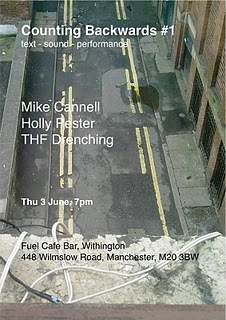 At last I can let you know about a new series of events in Manchester.
For a few weeks now Richard Barrett, Gary Fisher and myself have been working on a new series of text-sound-performance events called Counting Backwards.
Beginning Thursday 3 June 2010, Counting Backwards will take as its starting point contemporary text-sound practices that question semantics and received traditions, and emphasise performability.
Counting Backwards takes place at Fuel Cafe Bar in Withington on the first Thursday of alternate months. Entry is free. The flyer for our launch event is below.
Via Matt Dalby
Cleaves 2
Now online. Globalising and gloacalizing:
Robert Grenier poem-talks WCW
Today we are releasing PoemTalk episode #30, which features Robert Grenier, Bob Perelman, and Charles Bernstein discussing two poems by William Carlos Williams selected by Grenier.
– Al Filreis
The Sound Of Writers Forum
The documentary features eleven poets that have been published by Writers forum over a period of 50 years. The film had no budget and was made over the course of one week and was first screened at the Off The Shelf event held at the Slade/UCl on the 22nd March 2010.
A documentary made by Openned’s Steve Willey. See the video at this LINK
Absolute Elsewhere
The collaborative text and image project between James Davies and Simon Taylor – collectively Joy As Tiresome Vandalism – concludes with a poem by James. An edited version of Absolute Elsewhere will come out in free pdf format and possibly some other form later in the summer on if p then q. See the complete project here.
Sarah Sanders – The act of writing LIVE NOW
Sarah Sanders live writing piece for Ekleksographia is going on now at the LINK until sunrise Tuesday. Go there now.
The Small Press catalogue
Harry Godwin launches the Small Press Catalogue; a portal which provides easy access to experimental small presses. Nice one.
More Absolute Elsewhere
Absolute Elsewhere is a collaborative text and image project by James Davies and Simon Taylor – collectively known as Joy As Tiresome Vandalism. The latest instalment is online now. Click here to view the whole project.
Simon Taylor’s responses to Scott Thurston’s Internal Rhyme

In 2007, in the space of two weeks, Simon Taylor responded to Scott Thurston’s Matchbox N0. 9, Internal Rhyme, shooting around 12 films. These were then edited down to 150 negatives which became 150 unique gifts in Matchbox No. 9. Matchbox No.9 was just a sample of the collection Internal Rhyme which will be available in 2011 from Shearsman. Other parts of the poem have been published over the last couple of years in various magazines. The links below are to:
Matchbox No.9, Scott Thurston’s Internal Rhyme poems (Poetry Library digital archive)
 otherroom.org