Andrew Motion channels Kenneth Goldsmith

Interesting points on the nature of ownership here, from an area of writing where we might not expect to find them. Interesting too to picture the former Poet Laureate as a “shameless burglar”, although whenever I’ve seen him he looks a bit embarrassed. Read the article in full here. If you want to read a true master of uncreative writing, check out the Kenneth Goldsmith archive at Eclipse.

So what if I copied work says Sir Andrew Motion, Shakespeare did all the time

Sir Andrew Motion has been accused of “shameless burglary” by a military historian whose research he lifted and put into a poem about shell-shock for Remembrance Sunday.

The former Poet Laureate yesterday insisted that his use of quotations that he discovered in a history book belonged to a noble tradition of “found poetry” dating back to Shakespeare.

But Ben Shephard, an expert who produced The World at War for television, complained that the poet had been “extracting sexy soundbites” from his painstaking work on military psychiatry.

Motion’s poem, published as a tribute to war veterans in The Guardian on Saturday, uses quotations from soldiers and psychiatrists whose accounts Shephard spent ten years compiling. “He has no right to claim any sort of legal or moral ownership of the material,” Shephard said. “There is nothing original in this at all.”
We’re not really here

Whilst this article in The Guardian has some good points, it is a cursory glance at the Manchester ‘scene’ from a restricted view seat. The utilisation of the same handful of well-worn reference points is to be expected but remains disappointing. Partial pictures such as this are fine if acknowledged as such, but when presented in a way which suggests completness give a distorted perspective. It’s like talking about Manchester when you’ve never left the Arndale Centre.

Google to reincarnate digital books as paperbacks

Millions more titles could be added to On Demand’s virtual inventory if Google gets federal court approval of a class-action settlement that would grant it the right to sell copyrighted books no longer being published. Google estimates it already has made digital copies of about 6 million out-of-print books.

The settlement terms includes a provision that could authorize republishing the books with a machine like the Espresso. Some of Google rivals and a long list of other critics are hoping to block the settlement, mainly because they believe it will give Google a monopoly on the digital rights to out-of-print books and make it too easy to track people’s reading preferences.

Read more HERE in the independent

Poetry and practice

“There’s no creativity, there’s just decisions.” — Kenneth Goldsmith

“Poetry is not a turning loose of emotion, but an escape from emotion; it is not the expression of personality, but an escape from personality.” — T.S. Eliot

“All good poetry is the spontaneous overflow of powerful feelings.” — Wordsworth

“Nor till the poets among us … can present … ‘imaginary gardens with real toads in them,’ / shall we have / it.” — Marianne Moore

“Poetry is concerned with using with abusing, with losing with wanting with denying with avoiding with adoring with replacing the noun.” — Gertrude Stein

You can vote for one of these, should you be so inclined, at readwritepoem.

Link

Poetic speciation and diversification

“Or, Why I am Alarmed at the Role the Academic Environment is Playing in Contemporary British Innovative Poetry

I like using an analogy made by Andrew Duncan to explain the disparate heterogeneity of contemporary British poetry: the SciFi topos of centuries-long space-missions, venturing out from the home planet to reach different stars, and establishing their own separate lineages and cultures. These increasingly diverge from each other and become unable to intercommunicate.”

An interesting perspective from Peter Philpott.

Link

The Logoclasody Manifesto

“Ours is an age of anxiety, of dissociation of sensibility, of pessimism, cynicism, incredulousness. Our state, our condition, is a constant “fight or flight.” We are a matter of excretions. Our wets. Our arts. Our poetry. Excretions, anxieties, this enormity, this Behemoth.

Ours is the age of canned laughter. (There is an analogue for this in poetry.) This has been imposed on us. We — we poets! — must struggle to be free of this.”

Link

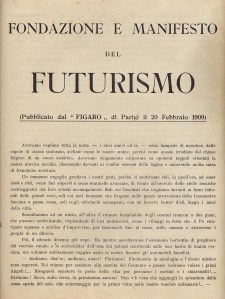
Futurists, Vorticists, Imagists: where are the manifesto writers today?

manifesto

“Whatever happened to manifestos? There was a time, 100 years ago, when you couldn’t open a paper without seeing a litany of avant-garde statements, or a crazily idealistic declaration of political attitudes, or a sternly numbered list of arty Dos and Donts, as portentous as the Ten Commandments. Writers, poets, sculptors, artists and freelance visionaries would meet at the Eiffel Tower restaurant or stay up all night in bordellos, thrashing out their stroppy jeremiads like kidnappers writing ransom notes. They may have been a few elephants short of the full zoo, but by God they were passionate.”

Link