Matchbox Poetry in India

If poetry is all about firing your imagination, this one literally comes in a matchbox.

An avid poetry lover in Jorhat, India, is emptying matchboxes, filling them with rolls of poems and selling them for a mere Rupees 5 to help popularise Assamese poetry among the uninitiated.

The man behind the innovative idea, Bipul Regon, insists that the formula works.

“Innovative ideas always sell and believe me my messages in the matchboxes are selling big,” said Regon, a novelist himself.

Read more in The Calcutta Telegraph

Poet hijacks Atlanta streets with haiku advertising campaign

Mimicking the usual advertisements for weight loss and health insurance, Morse’s poems began appearing throughout the city last month. From an exhortation to “Lose ugly weight fast!!/ Feel Happier! Healthier!/ Dump your bigotry” to “Meet local singles!!/ Easy: stand near others/ Hang up your cell phone” and “Free debt counselling/ Take the important first step/ Beware signs like these”, the artist has written 10 different haikus, printed 50 copies of each and placed them at 500 locations across Atlanta.

Read more

Notes on the Value of Recuperating Language Poetry

or

How to Save the Avant-Garde from Being Merely Therapeutic

In my last post, I discussed a way of viewing Language Poetry that would reclaim its textual practices as aspects of a plausible social critique. Such a project is generally referred to as “recuperation,” and basically consists of the effort to save the valuable portion of a set of ideas and practices. As I remarked, Language Poetry suffers from two major theoretical problems: 1) an implausible, or esoteric, relation to Marxism, and 2) the general implausibility of Marxism as a theory for maximizing the public good. Either of these problems could be sufficient to cause the neglect of Language Poetry. Therefore I offered an account of Language Poetry that avoids both problems, as well as providing a plausible account of the value of Language Poetry for its inheritors (i.e. Flarf Poetry and Conceptual Writing). See below for more about this.

MORE discussion from Stan Apps

Sony: ebooks to overtake print within five years

Sony believes that the ebook market has now passed the point of no return. Haber said: “I have multiple meetings with publishers and tell them paradigm shifts happen. You can say fortunately or unfortunately you haven’t had a paradigm shift in, what, hundreds of years.”

He added: “We in the consumer electronics area have a paradigm shift every year or two.”

More HERE

Notes on Peter Burger’s Theory of the Avant Garde

Three months ago I did a similar post on Poggioli’s early study which can be found HERE.

These notes again are mostly based on Burger’s notions but occasionally I pass comment and/or look for further examples to put in his model. There are two tables in this set of notes which are readable if you click on them.

Notes from Peter Burger, Theory of the Avant Garde

Genres are illusory although there is the study of what is called poetry/art

The audience is never passive but prejudiced

The interpreter applies his prejudice to the situation

It is inevitable that we interpret the past in terms of our own epoch

Social function of religion: religion alleviates misery but on the other hand it stops happiness

When man realised religion was illusory he redefined it as philosophy and not faith

Adorno – avant-garde art is functionless (Burger admits it has a function of leisure or to trigger discussion)

Avant-garde works only help to stabilise whatever is in place – the conditions against which it protests

“Art allows at least an imagined satisfaction of individual needs that are repressed in daily praxis.”

Individual movements should not be easily stitched together. If they are stitched together they change their function

Dada has no style, it has an ethos – is the true owner of the term historical avant-garde, attempts in this way to be outside the institution

Benjamin –reproduction in the mechanical age changes the reception of the work of art

When art takes the place of religion art generates ritual rather than existing for the ritual

WB of Dada – ‘Their poems are a ‘word salad’ containing obscenities and every imaginable waste product of language’

Art nowadays is made with profit in mind. How does poetry, the anomaly fit in?

The written word does not have a moment like painting does with photography because literature can never take a snapshot – although people have tried like say the imagists but even this is a version. Of course realist photography is a version too

Art differs from everyday life; it is magical. Therefore all arts a jumbled together as a whole. Like the vile notion poets must stick together

When art loses its functional value it gains educational value (the furtherance). But it is often light education disguised as furtherance

Model (Function, production, reception):

Thick line = major break
Thin line = minor break

In courtly art the artist becomes aware of his uniqueness

“The citizen who, in everyday life has been reduced to a partial function (means-ends activity) can be discovered in art as ‘human being’”

The institution has defined art as things which are in the institution – this happens because of a sociological rather than an aesthetic reason. Similar ideas in Return of the Real, Foster.

For Burger the true avant-garde artist wants to break with the system. This is often difficult for a modern day artist after Duchamp, as when he broke the system the art then became the system – think also L.H.O.O.Q. key-rings at The Tate.

The culture industry has brought about the false elimination of the distance between art and life

Any argument that a readymade negates the notion of the art work being produced by the individual is unfounded as it is his idea and ideas are now what art is

Tzara and Breton give instructions on how to make art. This is an attack on the notion of an individual making art – i.e. the artist is simply a worker when making a cut up poem from an arbitrary newspaper

“Today the only works which really count are those which are no longer works at all.” – Adorno

But lots of the bourgeoisie favour Jack Vettriano, photo of a dog with a speech bubble going woof, etc. How is this art given back to us from the institution?

The Flarfists treat their action as the first time in poetry rather than as the umpteenth hackneyed time in art. The problem of splitting disciplines in art: in terms of intention and manufacture

Much conceptual art (including poetry) does not give enough attention to form

The famous Flarf story that Sullivan tells of a vanity publisher accepting his Google mumbo-jumbo.

This is a peculiar notion. The vanity press, the same as the institution, does not take experimental unless there is to be money to be made in it.

Anti-tradition became tradition. So did it not win then? It did not as Fountain is now treated as part of our leisure and separate from our life praxis

The argument that arts and crafts, and cookery and gardening is art, as it is the people’s truly

“The neo avant-garde institutionalizes the avant-garde as art and thus negates genuinely avant-garde intentions.”

To remain in silence?

Things always become new but what is meant by new by the avant-garde is total newness – a radical shift.

Adorno belives that the artist’s drive to be new is analogous to the consumption of new goods by buyers in capitalist governments

Warhol and the abstract expressionists accept this and is not therefore avant garde

Just as consumption has need of fads so too does art need them. There are perhaps today many more movements and they become replaced as king movement at a quicker rate of transition – think of the coming and going of minimalism but did it really go? Was it exhausted aesthetically?

Are there ‘more’ movements because of globalisation and media coverage?

The results of some Dada works is that they are free of ideology. Say for example chance pieces but the alleatory action is not free of ideology; in fact it is heavily conceptual

For Burger Cubism isn’t anti-tradition (therefore is not the avant-garde) as it does not represent a true shift. i.e. we can all read the painting (a collective, sociable experience; see model)

In non-avant-garde works the whole needs its parts and the parts needs its whole. This is not the case in avant-garde works – think about the Jason Rhoades large detritus sculptures/installations

For the avant-garde, process and outcome are more important than content

“This refusal to provide meaning is experienced as shock by the recipient.”

Avant-garde hopes that the:

Refusal to give meaning = recipient is shocked = recipient reconsiders their life praxis / realises life praxis is separate from art

BUT

The shock is generally non-specifically directed and therefore the recipients respond with blind fury, do not know how to read the work and therefore do not change their life praxis or even consider it as separate from life

Is a solution to direct the shock? Not to tell the audience the meaning but to tell them it is OK to have an individual reading and that one can be part of a collective within individual readings – think presentation of The Other Room, if p then q

I remember reading somewhere about someone getting a Salt catalogue through their door and disliking the way it was marketed, saying it was pointless to package Alan Halsey in a glitzy way. The reason being that since Halsey’s current audience are above such marketing techniques and there is therefore no need to market the book in a glitzy way. The answer is simple they are trying to create an audience and not shock people so much so that the audience doesn’t consider the prospect of approaching the work. We must remember the Salt list is very strange now with their publications over the last two years

Burger’s book essentially ignores Futurism – both Russian and Italian. Is this because Futurism never became institutionalised as did Dada and surrealism; it simply died

The institution is happy to play Duchamp’s games as he signals that all is to be consumed and sold and therefore the institution can sell what it wants – everything

The avant-garde destroyed the notion of aesthetic hierarchy. This can often be misread as the need to consider everything

Brecht attempted to change the institution from within

Is this what innovative poetry attempted but instead weakly became part of a sub-culture of tradition in the universities and then shut shop in terms of its responsibility to tell people about the distinction of life art praxis; letting slam and story-telling (prose written in stanzas) to remain the institution in terms of festivals and media coverage?

The Other Room attempts to change the system from within, slow as that may be and with the little power it has

Is the internet an institution of sorts?

Key Differences between Poggioli and Burger’s Theory of the Avant-Garde:
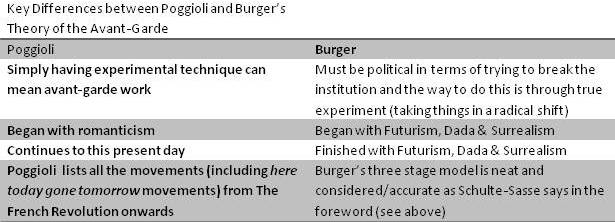
Comments:

Both reach a theory of types of significant change and characteristics of a certain type of grouping. They could be labelled with different terms than avant-garde perhaps

Burger lays claim to being correct with the proof coming as his is a hermeneutical study whereas Poggioli’s theory is based on general knowledge and vague definitions

Alberto Manguel

“I don’t think the book of paper and ink will disappear, as long as we allow for technologies to coexist. The notion that one must replace the other is simply the urge of the new to exist alone on the planet, but it doesn’t happen – it didn’t happen with photography and painting, it didn’t happen with film and theatre, it didn’t happen with video and film, and it hasn’t happened with electronic technology and the printed page. I was delighted when Bill Gates, a number of years ago, wrote his book about the end of paper and then printed it on paper; I think that says a lot.”

More here.

The Theory of the Avant-Garde and Practice

“The Theory of the Avant-Garde and Practice” by Libbie Rifkin at The Argotist Online, here. Excerpt:

“Enzensberger traces the military roots of the term “avant-garde,” breaking it down into its component parts and pushing each to its aporetic limit. The first aporia emerges when the avant-garde moves from the synchrony of the battle field to the diachrony of historical progress. Confronting the enemy up ahead, the “en avant of the avant-garde would, as it were, realize the future in the present, anticipate the course of history”. In spite of tremendous advances in prognostication by the “consciousness industry,” this is, of course, impossible. And yet the whole system depends on this impossibility; the avant-garde is the engine of advancement for the main body of artistic works, but the scene of its reception is, by definition, always just out of reach.  The avant-garde’s value, in fact its very identity, can only be determined by the future generations for whom it is already passé.”

Via Jeffrey Side

Poem Talk on Robert Grenier’s Sentences

Five hundred cards in a box: on each is typewritten a few words or phrases of poetic writing. This is Robert Grenier’s Sentences. Al gathered Joseph Yearous-Algozin, Jena Osman, and Bob Perelman to talk about this complex work. As Jena notes several times, there’s something odd about producing an audio discussion about a oral reading or performance by Grenier from a work that was and is so closely associated with a material text-object. A text-object that indeed has become famously central to people’s response to the writing in it. So one question immediately is on that count: by performing the work (and by doing so with such comic pleasure, and even, at times, with such schtickiness), is Grenier signalling to us that our focus on the object is misleading–that Sentences is meant to be always somewhat and variously unmoored from the codex book and the normally printed-on-page poem? All the PoemTalkers, led by Bob, want to discuss in some way how and why Robert Grenier always forces us to think about the most fundamental qualities and definitions of poetry. And surely this is good in itself.

LINK

Schematic Differences between Modernism and Postmodernism

Modernism Postmodernism
romanticism/symbolism paraphysics/Dadaism
purpose play
design chance
hierarchy anarchy
matery, logos exhaustion, silence
art object, finished word process, performance
distance participation
creation, totalization deconstruction
synthesis antithesis
presence absence
centering dispersal
genre, boundary text, intertext
semantics rhetoric
paradigm syntagm
hypotaxis parataxis
metaphor metonymy
selection combination
depth surface
interpretation against interpretation
reading misreading
signified signifier
lisible (readerly) scriptible
narrative anti-narrative
grande histoire petite histoire
master code idiolect
symptom desire
type mutant
genital, phallic polymorphous
paranoia schizophrenia
origin, cause difference-difference
God the Father The Holy Ghost
Metaphysics irony
determinacy indeterminacy
transcendence immanence

Hassan “The Culture of Postmodernism” Theory, Culture, and Society, V 2 1985, 123-4.

The Theory of the Avant-Garde

Notes from The Theory of the Avant Garde (1962) by Renato Poggioli. Mostly summaries of his ideas:

Avant-garde could simply mean new art

100% Marxists are anti the avant-garde

Marxists use term ‘bourgeois art’ rather than avant-garde to attack/negate the work

Term is ignored in English-American culture – no aggressive world wars

Term is Parisian and ingrained in French culture

The divorce of the two avant-gardes – political and aesthetic around 1880

Avant-garde is a new phenomenon

Avant garde movements spring out of enthusiasm

Avant-garde more interested in gestures than acts

Isn’t it traditional to want the new?

The avant-garde artist wants to be an individual in society but paradoxically wants society to change and take him in

The avant-garde acts and speaks like a child

The avant-garde is unpopular

Unpopularity thru non distribution

1) Package the avant-garde for a more populist audience
2) In pop culture the author is often ‘unknown’ to the public – see adverts/Youtube

Romanticism was more popular than avant-garde or classical art – cite fall of the aristocracy/rise of the working and middle classes

Voluntary and involuntary unpopularity

Romanticism direct link to avant-garde

Is there an avant-garde any more?

Romanticism was easily understood by the people as is Tate

N.B. romantic + avant-garde art are aristocratic movements existing in democratic times

Do nihilistic tendencies work deliberately against social relations?

The rush to become future movements

Fashion

There are two types of followers (audience) of the avant-garde
1) Those who accept it all
2) And those with an exclusive passion

The extreme left wants content and therefore denies the avant-garde

The followers of the avant-garde sees the joining of isolated individuals who come from different backgrounds – think Long Tail Theory

In a feeling of uselessness or estrangement here comes Americanisation. Term globalisation is misleading

The romantic artist resorts to self-mockery, hysteria & caricature

The artist wants material success in the age of capitalism. When he was in the court he was satisfied with creation.

The avant-garde is constantly conscious of writing its historical place

The avant-garde artist is always protesting socially tho not necessarily politically

Poggioli – “experimentalism aiming solely at novelty can end up sterile and false”

The avant-garde uses secret communication which even some of its followers don’t get.

Some of the pleasure is in not getting

I don’t get it
1) Sincere confession
2) Versus lament

Ignored not necessarily disliked

Avant-garde junk comes out the same as normal junk just with different labels and intentions

The labels and intentions are important – concrete versus abstract

Realism is a useless competition with no winners

Ours is an age of stylistic pluralism – watering down

The avant-garde’s analogies aren’t inverted

We now demand extreme liberty and extreme intensity of feeling

Matt Dalby Reviews The Other Room 14

Interesting discussion of February’s readers and notions of performance in poetry and performance in general. Snippet below:

Despite snow there were around thirty people at The Old Abbey Inn for the latest Other Room reading on Wednesday. The readers were Steven Waling, Holly Pester and Rob Holloway. To be honest I found my attention wandering a lot throughout the evening so my account will be pretty unreliable. That wasn’t the poets’ fault, it’s just been a hazy kind of a week, but it may have contributed to some of the misgivings I had that will become apparent.

READ MORE

Armchair Emblems, Prosthetic Mottos & Walking Definitions: Fact Sheet

Fact sheet below.

See more emblems at onedit – LINK

Armchair Emblems, Prosthetic Mottos & Walking Definitions:

Fact Sheet

“I am on the hunt for constructions. I come into a room and find them whitely merging in a corner.” –Franz Kafka, Diaries

“In my life the furniture eats me.” –William Carlos Williams, Spring & All

EMBLEM

Invented in 1531 by a Florentine legal scholar named Andrea Alciato, the emblem is a tripartite structure composed of a motto or epigram (generally moral in theme), an icon (often referred to as the emblem’s ‘body’) and a commentary on the two in prose or poem form. Many emblems made variations on this formula.

ARMCHAIR EMBLEM

The upholstered emblem or armchair emblem incorporates only the epigram/motto and image tension of the Renaissance emblem but retains its conceptual gist and glyphic structure.

PROSTHETIC MOTTO

An aspirational embodiment or transcorporation for the body-image. “Building the muscles of mind’s legs.” Enhanced mobility via an ingested foreign body.

TRANSCORPORATION

A translation from one body to another. An ingestion or introjection.

WALKING DEFINITION

An indoor walking stick that defines constituents of the built interior as allegories of mind. A measure. A ‘getting underway’ instrument, frequently ‘left around.’

BUILT INTERIOR

An indoor pedestrian structure comprised of mobile furniture for the solicitation of thinking. An allegory of mind.

SOLICITATION

The directed rousal of thinking through upholstered didactic prompts or forms (an intelligent furniture).

FORMS

Ornaments of thought. Including: the glyphic (static—the emblem); the mnemonic (transcorporable—the prosthetic); the definitive (the Walking Definition).

FURNITURE

What is lived with. “The relation of with.” Any instrument or form housing information intended to be absorbed by accompaniment.

–THOMAS EVANS

Herman van Rompuy vs. Basho

The new President of the European Union is not only a consumate political operator, but also a haiku master. For instance:

Hair blows in the wind
After years there is still wind
Sadly no more hair

and

Puddles wait
for warmth to evaporate.
Water becomes a cloud

We’d have him at The Other Room, but we couldn’t afford his expenses. Anyway, he might decide to turn it in after his work was described as having “an awful conservative, picturesque prettiness” by Andrew Motion here. That’s got to hurt.

Missing: 6 years of Poetry Review – reward for finder

A counterblast to Blake Morrison from Matt Dalby:

“Not only are we not really here, it seems we were never here. I would have posted this sooner if I’d got round to reading the weekend Guardian before now. In a review on Saturday Blake Morrison reviewed Fiona Sampson’s A Century of Poetry Review.

Now given that things were fairly eventful round there in the 70’s you’d think there might be plenty of opportunity to mention the British Poetry Revival, Bob Cobbing and so on. Apparently not. The closest he comes are the following:

Controversy also surrounded Eric Mottram in the 1970s, with his radical Anglo-American poetics. Which comes as an aside in a discussion of Muriel Spark’s editorship, and

Several editors of the Poetry Review, including Mottram and later Peter Forbes, strenuously avoided little-Englandism, and there’s a reasonable showing of Americans and Europeans here, including Brodsky, Ginsberg, Ashbery and Primo Levi.

And that’s your lot. Maybe this is reflective of the contents of the book, I can’t find a list of contents and don’t propose buying a copy to find out.”

More Matt Dalby here.

Working methods – speed vs. slowness

“I have always known that I work quickly. My work whether text, visual or sound poems, essays, or whatever else emerges in brief intense bursts. I simply assumed that this was a flaw, that high quality work could only be reached through laborious and extended processes. Education and other aspects of the culture tended to support this belief…But it’s only in the last week that I’ve begun to think that this might not be a fault, it might just be the condition of my mind, the way that I work best. I think part of the reason is there’s a kind of moral supposition that the more carefully thought-out something is the better it is. We distrust pleasure, are suspicious of fun and things that seem effortless.”

Matt Dalby, here.

“Recollection in tranquillity, not derangement of the senses, is the sine qua non of good writing…the digital age has simply compounded a problem caused by the increasing hegemony of one school of writing (the Ionic) over another (the Platonic).”

Andrew Gallix, here.