
Online now, featuring work by Louis Armand, Dan Beachy-Quick, Andrew Cox, Jen Degregorio, Mark Dow, Valerie Duff, Giles Goodland, Anne Gorrick, Ben Hickman, Linda Kemp, Burgess Needle, John Regan, Denise Riley, Robert Sheppard, Gary Sloboda, Simon Smith, Jeffrey Thomson, Philip Wilson, with an essay by John Wilkinson on D.S. Marriott, and Adam Piette reviewing Alan Halsey; CUSP, ed. Geraldine Monk; Helen Mort; John Birtwhistle; David Kennedy & Christine Kennedy’s Women’s Experimental Poetry.
Month: December 2013
Tom Watts: The Fruit Journal

Happy Christmas
Emerging Language Practices #2
Includes CLOSE READINGS: Florence, Flores, Huber, Kozak, Upton; REPORTS on E-Poetry’s TEN YEAR ANNIVERSARY, E-Poetry 2011 plus Digital Poetry & Dance, 2012, featuring works by numerous distinguished members of our list. Many great gems here, reflections, high-quality videos, documentation of the “Language to Cover A Wall: Digital Poetry Component” exhibition, a major exhibition for digital poetry held in Buffalo last year and more.
Online here.
Laurence Lane at The Other Room
Peter Riley in Canterbury
Rescheduled from 5th December, now 30th January at 8 PM, Veg Box Café, 1-2 Jewry Lane, Canterbury.
The Blue Bus January – Paul Buck, Paul Holman and Jaime Robles
The Blue Bus is pleased to present an event featuring poetry by Paul Buck, Paul Holman and Jaime Robles, on Tuesday 7th January, from 7.30 at The Lamb (in the upstairs room), 94 Lamb’s Conduit Street, London WC1. This is the eighty-fourth event in THE BLUE BUS series. Admissions: £5 / £3 (concessions). For future events in the series, please scroll down to the end of this message.
Paul Buck’s first book was Pimot (1968), and whilst he holds a fondness for all his books he might note re/qui/re(qui)re (1975), Lust (1976), Violations (1979), No title (1991), Walking into Myself (1995), Lisbon (2002), Spread Wide (2006)… along with his editing of Curtains through the 1970s and various off-shoots here and abroad… and his divertissements in film, theatre and music (albums with 48 Cameras, Marc Almond, Melinda Miel…). And not to forget countless books co-translated with his wife, Catherine Petit. Recent publishing includes A Public Intimacy (BookWorks), a text that strip-searches scrapbooks to expose autobiography and more, and Performance (Omnibus), a full-length biography of the Cammell/Roeg film, itself destined to be filmed. Currently working on what purports to be a fiction written through film criticism, and editing Disappearing Curtains, a sudden final issue of his magazine, using the exhibition at Focal Point Gallery as the core of the volume. Never wishing to escape presenting others, he is editing, with Catherine Petit, a series of books, under the banner Vauxhall&Company, to appear from Cabinet Gallery, that will publish translations by Pierre Klossowski, Colette Thomas, Bernard Noël, Georges Bataille, Pierre Guyotat and others, alongside works by himself, Stephen Barber & others that inflame and ravage on the boundaries of poetry, prose and theatre.
Paul Holman is the author of The Memory of the Drift. Books I-IV are available from Shearsman. A fifth book, Tara Morgana, is currently in preparation from Scarlet Imprint (http://www.scarletimprint.com/), who have also published his writing in their anthologies Datura and Mandragora. Work in progress can be found at http://paulholman.drupalgardens.com/. Material relating to Invisible Books, which he operates with Bridget Penney, is online at http://www.invisiblebooks.co.uk/.
Jaime Robles, a poet and book artist as well as reviewer, published her most recent book of poetry, Hoard, with Shearsman Books in January 2013. She has produced many of her texts as artist books, and her bookworks are in collections at the Bancroft Library, University of California, Berkeley; The Beinecke Library, Yale University; and the Oulipo Archive in Paris, among others. Her poetry and reviews have been published in numerous magazines, among them Agenda, Conjunctions, New American Writing, Shadowtrain and Stride. She has written texts for several art song cycles and librettos for two one-act operas: Inferno (music by Peter Josheff), staged in 2009 by San Francisco Cabaret Opera, and Vladimir in Butterfly Country (music by Anne Callaway), which was staged in 2012. She is a member of the poetry installation collective ExEgesis, located in Exeter, UK.
Forthcoming events will include Sharon Morris, Burt Kimmelman and Jeremy Hilton (5th February), Elaine Randell, Robert Hampson and Joanne Ashcroft (18th March), Holly Pester, Doug Jones and Keith Jebb (15th April), Alan Halsey, Frances Presley and Ken White/David Miller (13th May), and Helen Calcutt, James Davies, Lawrence Upton, Stephen Emmerson, Sarah Kelly, Juliet Troy, Robert Vas Dias and others.
An Anthology Of Concrete Poetry (in braille)

An Anthology of Concrete Poetry was first edited and published by Emmett Williams and Something Else Press in 1967. In 2013, artist Rachel Simkover chose a selection of poems from the anthology to have transcribed into braille. Available from Motto Books.
NAPE: Nathan Walker
Commissioned by Performance Space as part of ‘In Conversation’, a 6 month digital residency and performance event. The digital residency blog documented processes and methodologies leading to the presentation of NAPE:
“Following a score of pre-recorded spoken text, the work superimposes the private performance of reading into the public performance of writing. I developed a system of writing as a score structure for the performance that installs materials as performance actions and tasks. Alongside this work I also developed a digital writing programme that infinitely generates performance texts in relation to the performance.”
Nathan Walker will perform at The Other Room in April 2014. More about NAPE here.
Gorse
gorse is a twice-yearly print journal edited by Susan Tomaselli and David Gavan, featuring longform narrative essays, original fiction and interviews. Issue 1 is online now, with contributors including Other Room readers SJ Fowler and Colin Herd.
Enemies: Slovakian poetry
Videos from the recent Slovakian poetry event at the Rich Mix arts centre are now online:
Peter Milcak https://www.youtube.com/watch?v=MfSQAdxKts0
Martin Solotruk https://www.youtube.com/watch?v=p3Isb4wuVyM
Francesca Lisette https://www.youtube.com/watch?v=F1mehE70l74
Pascal O’Loughlin https://www.youtube.com/watch?v=ag8nquGjjZY
Doug Jones https://www.youtube.com/watch?v=Ypi1L1ExqAA
Chrys Salt https://www.youtube.com/watch?v=yLpamPFLhAc
Saradha Soobrayen https://www.youtube.com/watch?v=0GYhH3HvJ_s
David Vichnar https://www.youtube.com/watch?v=teNnKrO2lAA
Louis Armand https://www.youtube.com/watch?v=hTSkm31JzSI
Sarah Hesketh (&Cristina Viti) https://www.youtube.com/watch?v=gpLyGuU2kic
Mark Waldron & Martin Solotruk https://www.youtube.com/watch?v=84klLN9kNXc
Peter Milcak & Stephen Watts https://www.youtube.com/watch?v=ZhCVTxaNEPo
Wildermenn collective

Wildermenn combines visual art, poetry, sonic art and sculpture into one wholly collaborative art collective about urban transhumance.
David Buuck at Birkbeck
Reading and conversation with David Buuck

David will read work that comes directly out of thinking about Occupy Oakland & its more militant actions/offshoots/confrontations, put into context with broader questions about poetics and how Bay Area (& other North American) poet-activists are beginning to (re)think-through the always tangled questions of poetry/politics/etc.
7-9 pm
Wednesday 18th December
Room G 16
Birkbeck College, Main Building, Torrington Square
David Buuck is a writer who lives in Oakland, CA. He is the founder of BARGE, the Bay Area Research Group in Enviro-aesthetics, and co-founder and editor of Tripwire, a journal of poetics. An Army of Lovers, co-written with Juliana Spahr, is forthcoming from City Lights this fall, and SITE CITE CITY will be out from Futurepoem in 2014. Some publications, writing & performance samples, etc. available via davidbuuck.com
The Claudius App VI – open for submissions
Until January 31st, to editors@theclaudiusapp.com. Claudius App V here.
Ffooom
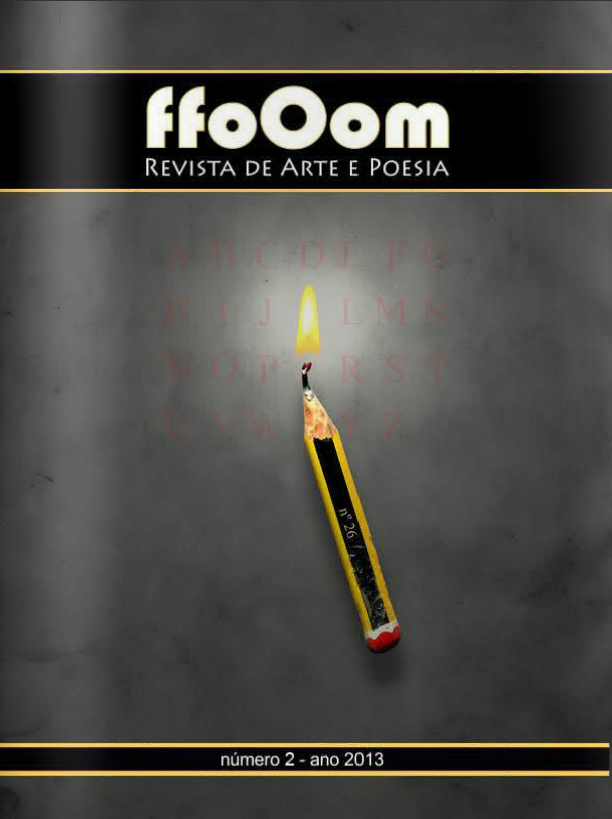
An internationalist online magazine of visual poetry. Issue 2 online now.
Book review: averbaldraftsone&otherstories by Bruno Neiva

averbaldraftsone&otherstories
Bruno Neiva
The Knives Forks and Spoons Press (2013)
This sumptuous, sensuous, colour drenched book is, before content is addressed or even thought of, a delight to look at: rich red, mustard yellow and scorched orange abound, like looking at the world through technicolour goggles. As always with Knives Forks and Spoons, the production values are high. Neiva describes the work as illustrating his shift away from asemic practice, which can be described, albeit somewhat imperfectly, as writing without semantic content, and towards averbal practice, which we can assume means writing without words. This is not strictly true, as words do appear in averbaldraftsone&otherstrories, but they do not function as signs or signifiers. Rather they are simply part of the palate. This is language as material, forcing us to abandon our habitual linguistic norms and approach language as we would an image. Each page is as vibrant and vivid as the panel of a fresco.
The book raises interesting questions of context and the effect of context upon perception. At the end of the book is a list of where many of these pieces were exhibited in galleries. What difference would it make to see them hung on a wall, rather than presented on a page, to encounter them as visual art rather than poetry? The experience cannot but be different, for here we are studying the representation of the thing rather than the thing itself. We could think of this book as simply a catalogue, like a series of photographs of oil paintings or marble sculptures that might be sold as a memento of an exhibition, but this would be to miss the point. By presenting the work on a poetry imprint without any of the conventional surrounding text commonly found in an exhibition catalogue, this is a book that demands to be experienced as a book, a demand furthered by the presence of the word stories in the title. When we pick up a book we are primed to expect text, but here there is, for the most part, no text. The reader is straight away thrown off centre by the realisation that they are not really a reader at all. To engage with this book, the reader cannot simply passively receive, but must instead actively engage. These pieces do not offer obvious meaning and so the reader must make their own meaning, if indeed it is meaning that they want. To read the work, we must also read the frame around the work.
Although the pieces presented here could be described as visual poetry, they cannot be located in the canonical lineage of the form – Gombringer, the de Campos brothers, Noigandres etc. – all of whom were largely typographical and worked, in the main, directly on paper. Neiva’s work, although no less visually striking, does not have the same basis. Many of the pieces here are constructed using found material, particularly the sequence &otherstories that comprises the second part of the book and was made using materials found in the vicinity of a packaging warehouse. The most obvious reference point is Kurt Schwitters, particularly the smaller collages he made shortly after coming to Britain in the 1940s, constructed from bus tickets, scraps of newspaper and other ephemera. As with Schwitters, the apparent disorder and randomness is deceptive. This is no magpie’s nest. The material here is crisp and cleanly presented on the page according to its own internal geometry. Neiva speaks elsewhere of working according to constraints, and in averbaldraftsone&otherstrories we can see that in action in two ways. Firstly, there is no clutter. Neiva has used his materials economically and with precision. Each image is sparely arranged, like an abstract painting. Secondly, each piece seems to have built according to the limits of what was to hand, Neiva restricting himself to assembly and arrangement. Here, the environment itself has become a constraint. Like a woodsman taking only the timber he can find on the forest floor to build with, so Neiva constructs the poems in the &otherstories sequence from what the world presents him with. His is a heuristic poetics. In a time of superabundance of content and previously undreamt of freedom in the manipulation of material, Neiva’s disciplined, almost ascetic approach is an interesting counterpoint, a subtle refusal of capitalism and consumerism.
The pieces in the first part of the book, whilst consistent with Neiva’s rigorous methodology, are slightly different in character. Here, we see more authorial intervention. Text is more prevalent. Materials are marked and indented and carry the trace of human activity. Still, however, we see the same attention to the character of materials, the same radical sensitivity. Constraint based work often contains one non-constrained element, what Magne and others associated with Oulipo called the clinamen. Here, Neiva breaks the spell of averbaldraftsone&otherstrories only once by placing an uncaptioned monochrome photograph of a group of men in suits, some carrying straw boater hats, in the middle of the first section of the book. The image is annotated with gnomic glyphs that may have been added by Neiva, or may have already been on the image. The presence of this spectral image has the effect of bringing the reader up short: a break in transmission, a subliminal frame. Neiva does not explain it, as he does not explain anything. No authorial guidance is offered by him throughout the book. Each of these images stands alone, allowing us to make of them what we will and to make our own connections.
averbaldraftsone&otherstrories is an example, if examples are needed, of the importance of publishers such as Knives Forks and Spoons who make it their business to get behind experimental work and give it the attention it deserves. A mainstream publisher would simply not touch a book as cryptic and tangential as this. This enigmatic, angular, elegant, paradoxical work, so Spartan in its aesthetic, yet so luxuriant in its realisation refines our ideas of what visual poetry can be.
POLYply > 27
POLYply presents Writers Forum Workshop (New Series)
- Tom Bamford
- Geraldine Bhoyroo
- Johan de Wit
- Paul Ingram
- Doug Jones
- Antony John
- Robert Kiely
- matt martin
- Peter Philpot
- Philip Terry
Thursday 12 December The Centre for Creative Collaboration 16 Acton Street, London WC1X 9NG Free entry, 7pm Royal Holloway Poetics Research Centre and MA Poetic Practice, Royal Holloway.
TOM JONES | MEALY BLOOM
96pp, 18.9×24.61cm, paperback. Front and back cover images by Stathis
Tsemberlidis, from his book “Transmutation: Of Human Bodies and Flora”
(2013); see more at decadencecomics.com.
6.50 GBP | 8.00 EURO | 16.50 USBUKS
For a limited time, Jones’ Perdika Press pamphlet AKHMATOVA is available
with MEALY BLOOM for the discounted price of:
8.50 GBP | 10.50 EURO | 20.00 USBUKS
All prices inc. P&P
MEALY BLOOM brings together more than ten years of work by the poet Tom
Jones. It collects the pamphlet Transactions Grotesques, and presents the
new sequence “The Punk Star Tuba”, along with sixteen other poems, including
versions of Mandelshtam and Tsvetayeva. In a prefatory “Advertisement”, the
author set outs the poetics governing this collection: “the sense that
training of the conscience is possible, and could be done through this kind
of text.”
Tom Jones teaches English literature at the University of St. Andrews. He is the author of “Pope and Berkeley: The Language of Poetry and Philosophy” (Palgrave, 2005) and “Poetic Language: Theory and Practice from the Renaissance to the Present” (Edinburgh University Press, 2012). Essays can be found in “Jacket” and “Complicities” (Litteraria Pragensia, 2007). His books of poetry and translation include “Transactions Grotesques” (Barque Press, 2002) and “Akhmatova” (Perdika Press, 2007). His poems have appeared in “Quid”, “Boxon”,
“Blackbox Manifold”, “Cambridge Poetry Summit: Some Evidence”, and “Prague Literary Review”. He can be heard reading his poems at The Archive of the Now.
See the website for an extract from the book: http://mountain-press.co.uk/mealybloom.html
Peter Jaeger PENN Sound Page
Other Room reader Peter Jaeger now has a PENN Sound page – HERE
Tonight

 otherroom.org