
A new issue of the online magazine featuring Tim Allen, Sarah Hayden and many others.
Uncategorized
Expanded Translation Conference
Wowzers! Bangor 4-6th April. More HERE
About us
This conference is the third and final event of the AHRC Network Poetry in Expanded Translation.
Conference Organisers
The conference organisers are Dr Zoë Skouding, Bangor University z.skoulding@bangor.ac.uk and Dr Jeff Hilson, Roehampton University, j.hilson@roehampton.ac.uk
Confirmed Speakers
Confirmed speakers include:
- Jennifer K. Dick (Université de Haute Alsace),
- Chris McCabe (National Poetry Library),
- Vahni Capildeo (Douglas Caster Cultural Fellow, Leeds University),
- Vincent Broqua (Université Paris 8),
- Lily Robert-Foley (Université Paul-Valéry, Montpellier),
- Carole Birkan-Berz (Université Sorbonne Nouvelle, Paris 3),
- Alys Conran (Bangor University),
- Nia Davies (Poetry Wales),
- Philip Terry (University of Essex),
- Simon Smith (University of Kent),
- Nisha Ramayya
- Rhys Trimble.
Keynote Speakers
Caroline Bergvall, artist, writer and performer
Lawrence Venuti, translation theorist, Professor at Temple University
Keynote Performance
Andrew Lewis, composer, Professor at Bangor University
Coming soon…
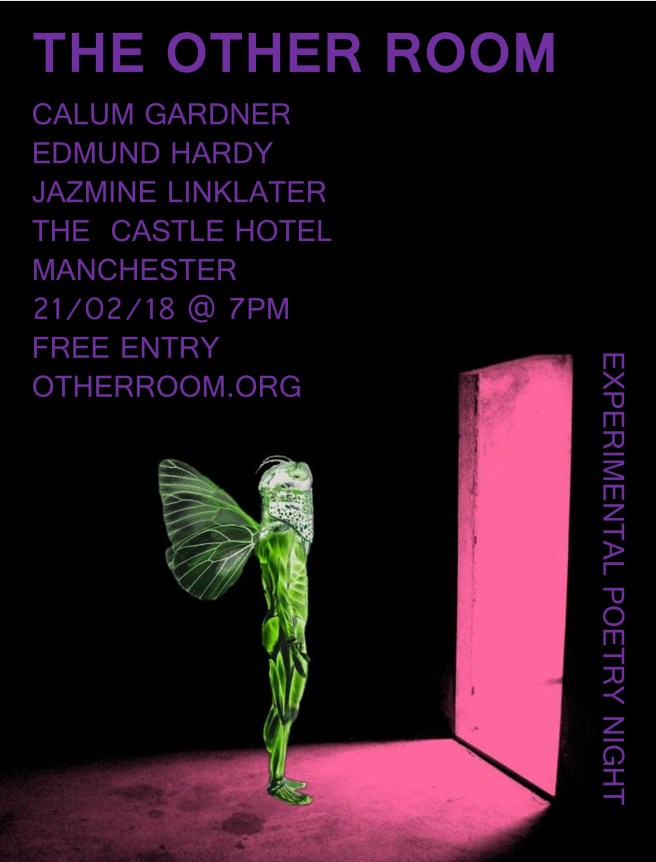
Poster by Joy as Tiresome Vandalism
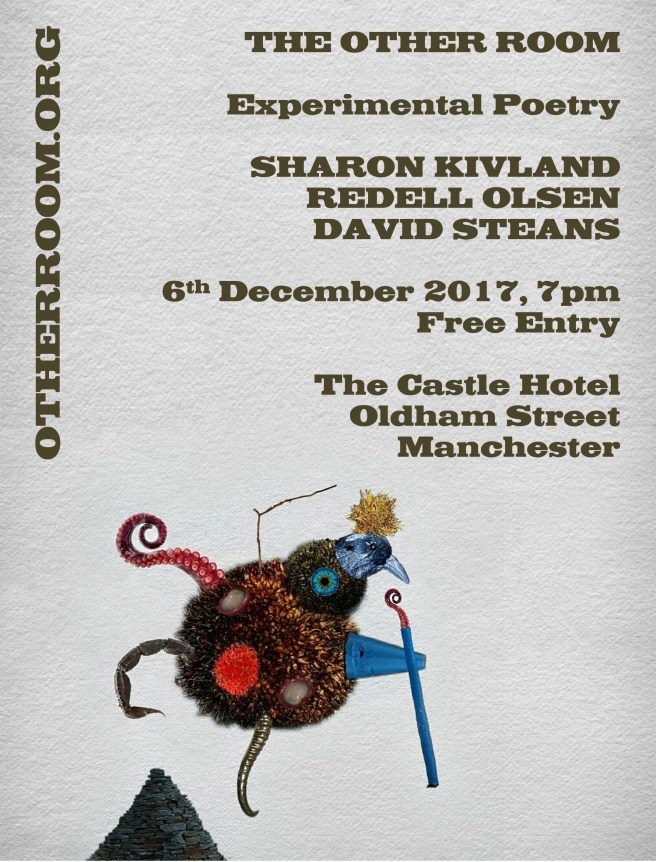
The Other Room (Kivland, Olsen, Steans) – Tonight
Lots of new additions at Archive of the Now
David Steans – A Preview
Our next event takes place on December 6th at The Castle Hotel, 7pm and is free as ever – hope to see you there. It features Sharon Kivland, Redell Olsen and David Steans. Here’s a little preview of David Steans:
More HERE
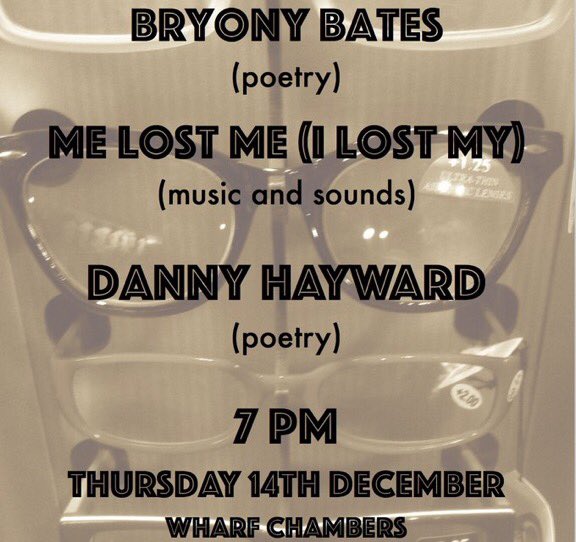
Zarf reading in Leeds – Bryony Bates, Danny Hayward, Me Lost Me (I Lost My)
Boiler House Press readings in London
Come and celebrate the London launch of 5 brand new titles from Boiler House Press. A post-launch DJ set is rumoured!
Atkins, Critchley, Herd, Hilson, Morris
Thursday, December 14 at 7 PM
Iklectic, Old Paradise Yard’ 20 Carlisle Lane, SE1 7LG London
More via Facebook – https://www.facebook.com/events/1965787766993372/
Stephen Emmerson reading at Poem Brut
Well worth a watch. How terrific!
Redell Olsen – A Preview
Our next event takes place on December 6th at The Castle Hotel, 7pm and is free as ever – hope to see you there. It features Sharon Kivland, Redell Olsen and David Steans. Here’s a little preview of Redell Olsen:
say I and you London land marks
say I and you in London mark land
say London land is marked by you and I
say I and you make marks in London’s land
say I and you mark lands in London
say I and you marked by land
say London land marks
say long done land marks
say long done marks in land
say land in long marks in language
from Film Poems. See more HERE
Sharon Kivland – A Preview
Our next event takes place on December 6th at The Castle Hotel, 7pm and is free as ever – hope to see you there. It features Sharon Kivland, Redell Olsen and David Steans. Here’s a little preview of Sharon Kivland:
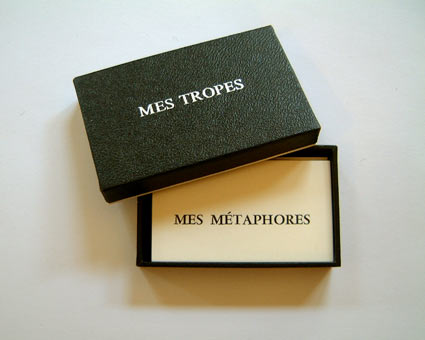
Find out more about Sharon HERE
Elizabeth-Jane Burnett interviewed in The Guardian
Other Room reader Elizabeth-Jane Burnett is interviewed in The Guardian. Terrfic to see!
Swims is a work of poetry that follows its author into open waters around the UK, where she finds both simple pleasure and more complicated political hope
Read more HERE
Tom Crosher’s photos from The Other Room – Davies, Mooney, Thurston
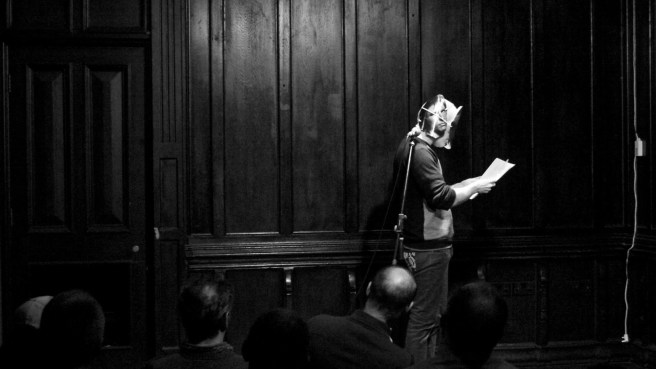
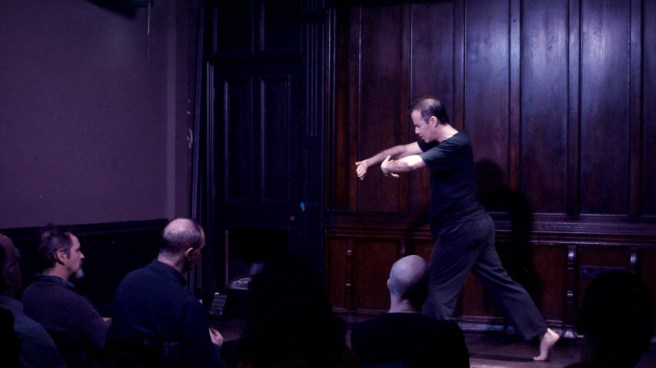
Tom Crosher took a number of photos of our night in October. Super thanks. There are more photos via the link under these photos.

https://photos.app.goo.gl/RMBMb2hxWiZ6MOYQ2
Adjacent Pineapple Two
Issue Two of Colin Herd’s lively new online magazine available at this LINK and featuring:
Verity Spott’s Kate’s Dream Diamond Anti-Fatigue Matting Surface out from Crater Press
Verity Spott’s Kate’s Dream Diamond Anti-Fatigue Matting Surface! 4pp., four colours, letterpressed, with a lino-cut by Verity. It’s £6 + p&p from www.craterpress.co.uk
A Theory of Minimalism by Marc Botha
Marc Botha’s stunning book is out now.

The explosion of minimalism into the worlds of visual arts, music and literature in the mid-to-late twentieth century presents one of the most radical and decisive revolutions in aesthetic history. Detested by some, embraced by others, minimalism’s influence was immediate, pervasive and lasting, significantly changing the way we hear music, see art and read literature.
In The Theory of Minimalism, Marc Botha offers the first general theory of minimalism, equally applicable to literature, the visual arts and music. He argues that minimalism establishes an aesthetic paradigm for rethinking realism in genuinely radical terms. In dialogue with thinkers from both the analytic and continental traditions – including Kant, Danto, Agamben, Badiou and Meillassoux – Botha develops a constellation of concepts which together encapsulate the transhistorcial and transdisciplinary reach of minimalism.
House of Bedlam Concert in Manchester
The book of Matthew
Music and film by Larry Goves/Text by Matthew Welton
The wind around the orange-tree
brings on the smell
of nutskins mixed with whisky
mixed with lemons or rain…
From The book of Matthew; Matthew Welton, Carcanet, 2003
A piece for instruments and projected text using extracts Matthew Welton’s The book of Matthew; a collection of thirty-nine hauntingly beautiful poem variations arranged according to Roget’s Thesaurus.
Tithonus, Drunk
Music by Laurie Tompkins/Text by Sam Quill
Tithonus, drunk is a short soap about life on the sauce for four instrumentalists, electronics, and projected drinker.
House of Bedlam:
Kathryn Williams flutes
Harry Fausing-Smith & Carl Raven saxophones
Tom McKinney guitars
Steph Tress cello
Laurie Tompkins projected drinker
Larry Goves director
Free admission, no ticket required
Judith Wilson, Sandeep Parmar & James Davies reading in Hebden Bridge

The Crater/Sharon Borthwick Advent Calendar 2018
Via Richard Parker…
This year Sharon Borthwick’s done our advent calendar! The Borthwick Riot Calendar contains all sorts of incendiary material, 25 poems, a colour collage and lots of Xmas cheer – it’s also definitely NSFW. £5 and P&P, it’s on the website now: www.craterpress.co.uk Copies will be sent out about the middle of November – orders from outside of the UK may not receive their copies before December/advent.
Also, there’ll be an Cratery Xmas party on the 1st of December at The Field, 385 New Cross Road, London, where we’ll celebrate Sharon’s advent intervention and yuletide cheer. Sharon will read, there’ll be an Xmas performance from the Ninnies and there’ll be a bunch of other stuff too.
Merry advent one and all!
Sophie Collins & CA Conrad in Glasgow

 otherroom.org