
Emily Critchley interviewed by The Other Room, October 6th 2010.
Month: October 2010
Xing the Line – November 2010
Xing the Line: Eleni Sikelianos & Laird Hunt
Wednesday, November 10 at 7:30pm
Location: William IV pub, 7 Shepherdess Walk, London, United Kingdom, N1 7QE
Steve Willey
Interview and film from Steve’s 6th October reading at The Other Room.
Interview
Reading
Adrian Clarke
Interview and film from Adrian Clarke’s 6th October reading.
Interview
Reading
RENEGADE – an on-line journal of visual poetry
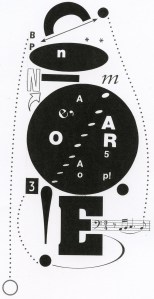
The second installment of RENEGADE is now on-line here. The third installment is slated for january, followed by a print edition of RENEGADE.
Maintenant catch up and Iceland reading
Maintenant 32
An interview with the Slovenian poet, Primož Čučnik, the 32nd subject of the 3am magazine interview series centred on contemporary European poets. The interview is also accompanied by two poems.
http://www.3ammagazine.com/3am/maintenant-32-primoz-cucnik/
http://www.3ammagazine.com/3am/two-poems-primoz-cucnik/
Maintenant 31
An interview with the Norwegian poet, Paal Bjelke Andersen, the 31st subject of the 3am magazine interview series centred on contemporary European poets and the fourth and final Norwegian poet featured as part of the series to celebrate the Maintenant: Ny Poesi readings held in London recently at the Poetry Cafe & the Rich mix arts centre. The interview is also accompanied by five pieces of poetry translated into English specifically for the readings & interview.
http://www.3ammagazine.com/3am/maintenant-31-paal-bjelke-andersen/
http://www.3ammagazine.com/3am/five-poems-paal-bjelke-andersen/
Maintenant 30
An interview with the Danish poet, Martin Glaz Serup, the 30th subject of the 3am magazine interview series centred on contemporary European poets. An extraordinary poet, children’s author and critic, included with the interview are seven excerpts from his remarkable work The Traffic Is Unreal translated by Thomas E. Kennedy.
http://www.3ammagazine.com/3am/maintenant-30-martin-glaz-serup/
http://www.3ammagazine.com/3am/seven-poems-martin-glaz-serup/
Maintenant 29
An interview with the Russian-born British poet, Annie Katchinska, the 29th subject of the 3am magazine interview series centred on contemporary European poets. An extraordinary talent, she is one of the very brightest stars emerging in the UK. Included with the interview are three of her poems.
http://www.3ammagazine.com/3am/maintenant-29-annie-katchinska/
http://www.3ammagazine.com/3am/three-poems-annie-katchinska/
Icelandic & British Poetry in collaboration
3am magazine’s Maintenant interview series presents Icelandic & British Poetry in collaboration at the Rich mix
(35 – 47 Bethnal Green Road, London. E1 6LA)
Saturday November 27th – 7pm – Entrance free
Iain Sinclair & Ragnhildur Jóhanns / Eirkur Örn Norðdahl & Stewart Home
Scott Thurston & Bryndís Björgvinsdóttir / Jón Örn Loðmfjörð & Tom Jenks
Kenny G’s Hour of Pain
Kenneth Goldmith’s aural smörgåsbord, here. This is an archive of his weekly show for WFMU, a New Jersey freeform station.
Openned is near
Wednesday 27th October, 7.30pm.
Corsica Studios
Tube: Elephant & Castle
Admission Free
Readings from
* Tim Atkins
* Allen Fisher
* Sarah Kelly
* Jonny Liron
* Nat Raha
A simultaneous reading from
* Prudence Chamberlain*
* Jennifer Cooke
* Joanna Humphreys*
* Anna Lawrence*
* Jow Lindsay
* Peter Philpott
* Rachel Porcheret*
* Posie Rider
* Carol Watts
* Tessa Whitehouse
More here.
Knives, Forks and Spoons launches
Of these good folks:
Chris Gutkind, Peter Philpott, Harry Ross
Thursday, November 4 at 7:30pm
Location: upstairs at The Camden Eye
Review of The Other Room 20
The readings from the anthology were eye-opening – a wonderfully funny extract from Clare’s letters about city folk thinking every bird they hear at night must be a nightingale, some of the extracts from late Holderlin, some Issa haiku that seemed to largely involve pissing and frogs…
Openned Eyes
Openned Eyes is a visual poetry project curated by David-Baptiste Chirot, assembled from 2009 – 2010. Click here to see it.
Unoriginality
“The irony is that The Guardian reading chattering classes – the left-liberals whose tender sensibilities determine the mainstream poetry scene – would rather die than be seen as insular or parochial. But any claims to be “progressive” are certainly laughable when assessed through their literature.”
The Other Room 20 Tonight
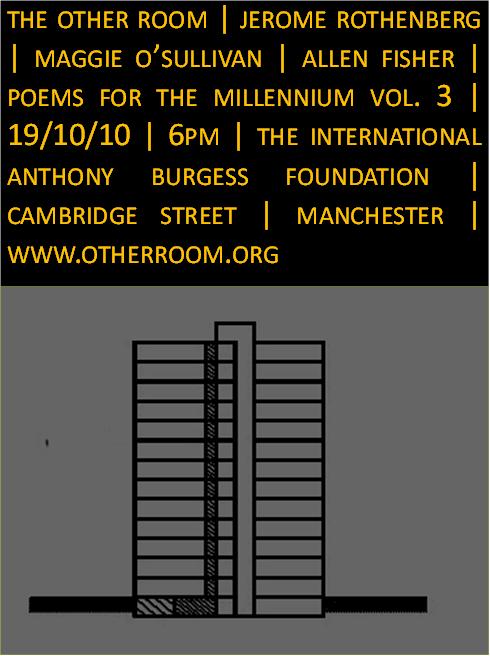
Jerome Rothenberg, Maggie O’Sullivan, Allen Fisher & Poems for the Millennium 3: Preview of 19th October event
Some tasters for our three readers. In addition there will be readings by all three poets, Jeffrey Robinson and The Other Room of a selection of poem from Poems for Millennium Volume 3. Videos of O’Sullivan and Fisher can be found in the middle left column. Please note that this event starts at 6pm and is at THE INTERNATIONAL ANTHONY BURGESS FOUNDATION
Jerome Rothenberg
Jerome Rothenberg is the author of over seventy books of poetry including Poems for the Game of Silence, Poland/1931, A Seneca Journal, Vienna Blood, That Dada Strain, New Selected Poems 1970-1985, Khurbn, and most recently, A Paradise of Poets and A Book of Witness (all from New Directions). Describing his poetry career as “an ongoing attempt to reinterpret the poetic past from the point of view of the present,” he has also edited seven major assemblages of traditional and contemporary poetry.
LINK TO Buffalo Page with links to poems and publications
Maggie O’Sullivan
O’Sullivan’s work is influenced by Kurt Schwitters, Joseph Beuys, Jerome Rothenberg, Bob Cobbing and Basil Bunting. Her books include An Incomplete Natural History (1984), In the House of the Shaman (1993), Red Shift (2000) and Palace of Reptiles (2003). She edited out of everywhere: An anthology of contemporary linguistically innovative poetry by women in North America & the UK (1996).
Allen Fisher
Allen Fisher has been involved in performance writing since 1962. A poet, painter, publisher, editor and art historian, he has produced one hundred and forty chapbooks and books of poetry, graphics and art documentation. He was co-editor and publisher of Aloes Books and he currently edits and publishes Spanner. He lives in Hereford and is Head of Contemporary Arts at Manchester Metropolitan University in Crewe. His books and chapbooks include: The Apocalyptic Sonnets (1978), Poetry for Schools (1980), Brixton Fractals (1985, republished 1999), Dispossession & Cure (1994), Civic Crime (1994), Now’s the time (1995), Fish Jet (1997), Place(collected set 2005) Gravity(2004), Entanglement(2004), Singularity Stereo(2006), Leans(2007), Birds (2009).
LINK to Allen Fisher at BEPC
Review: A Perverse Library
“Conceptual writing is not easy to grasp, or to read. It is not about pleasure, or narrative. It brings together conceptual art and language. The excitement is intellectual rather than aesthetic, and it can be witty. It might be a transcription of a year of weather reports by Kenneth Goldsmith, or John Baldessari’s repetition of the sentence: “I will not make anymore boring art”.
Cleaves 3
The wonderful, regional & international online journal Cleaves takes its third outing.
Revolutions in Form #3
Caroline Bergvall / Ross Sutherland / Laura Dockril / Hannah Silva
The third in Mercy’s occasional series of language-in-performance events returns to its roots with four of the top practitioners of innovative poetry in performance – seeing out the Bluecoat’s Chapter and Verse Literature Festival.
REVOLUTION IN FORM #3
at the Bluecoat
Sunday 17th October, 9.30 – 11.00
Acronyms: Statement
David Berridge has posted a version of James Davies’ Acronyms on Very Small Kitchen with a statement.
Currents in Electronic Literacy
Dear all,
Currents in Electronic Literacy (ISSN 1524-6493) solicits submissions
related to the theme below. Submissions are due on Monday, January 10,
2011.
Spring 2011 issue: Writing with Sound
Today we live in a society defined–in many senses, and by almost all
the connotations associated with the word as well–by the word
‘current’…. The old hierarchies of linear thought, sublime (and
sublimated!) engagements with art, poetry, music, science, and history
are no longer needed to do the ideological work now conducted again
along the lines of ‘current.’ (Miller 32)
This call for projects begins with a sample, with the echoing of a
familiar call to listen to a new kind of logic. The sample comes from
Rhythm Science by Paul Miller (a.k.a. DJ Spooky that Subliminal Kid),
who encourages us to go with the flow, to find a good mix, and to
listen for new ways of thinking and linking. In conjunction with
Miller’s appearance as part of the Digital Writing and Research Lab’s
annual Speaker Series, we are excited to announce that the Spring 2011
issue of Currents will focus on writing with sound.
The issue will open with a compelling radio piece by Avital Ronell in
which she–along with the flute accompanying her–insists that
Nietzsche was a DJ. Remixing, it seems, is everywhere. For some time
now, sampling and remixing has been a powerful metaphor for writing in
digital culture; indeed, the College Composition and Communication
Convention took remixing as its theme in 2010. The challenge now is to
literalize the metaphor, to allow audio technologies to enter into the
field’s descriptions of “the writing process(es),” which will change
not just the way we think about and teach writing, but our processes,
and so our “products,” as well. In order to encourage and embrace
these changes, Currents invites—along with traditional academic
submissions—audio essays, podcasts, oral histories, interviews, and
other audio recorded genres, as well as webpages, videos, animations,
slide presentations, etc., that address sound-related issues. Videos
may be uploaded to YouTube.com and shared with
currents@dwrl.utexas.edu. (Other video hosting sites may be used.
However, YouTube.com meets more accessibility standards than sites
like Vimeo.) Audio may be uploaded to SoundCloud.com and shared with
currents@dwrl.utexas.edu
. Both YouTube and SoundCloud allow for private sharing. During the
submission process, please make your audio and video materials
available to a limited audience. Audio/video/visual submissions should
also include a 500-word document explicating method and performance.
Some potentially interesting lines of inquiry include but are by no
means limited to the following:
• How does the mixing of audio recording and writing create new
genres? How do soundscapes and text work together?
• How do technical instrumentalities, such as, the materials used to
record sounds affect the message? Can sound ever be virtual?
• What have we not heard by focusing our attention on the printed
page? How can teaching with sound revitalize the rhetorical canons
(especially memory and delivery), as well as the issue of “voice”?
• What roles do silence and accessibility play in the discussion of
“voice”? What does “voice” mean for deaf and hard of hearing
individuals as students, professors and authors? How can new
technologies and pedagogies help educators meet the goal of
providing direct and uninhibited language communication access to
curriculum? How can we listen to the “oral” histories,
poems, songs, and stories that belong to the signing Deaf community
and Deaf culture?
• How does the practice of remixing change the way we think about
literacy?
• Multimedia encourages a shift in roles from writer to
producer–what are the implications of this shift?
• Alphabetic writing and audio recording both begin as inscriptions
on a surface, but in what ways does the waveform of audio
recording differ from alphabetic writing?
• How might workspaces in the world of audio recording change the
way we write?
• Many theorists, rhetoricians, and philosophers have argued in
favor of an “ethics of listening.” What further rhetorical and
pedagogical implications might such an ethics entail?
• Through phonography, audio recording, and writing share a history,
what parts of this history do recorders and writers need to bring
to light, retell, and reimagine?
• Through dictation, writers have written with sound for a variety
of reasons in a multiplicity of social and technological
configurations, not all of which have been mutually beneficial. How
might we imagine a productive dictating relationship that ethically
distributes power?
• From recording for the blind and dyslexic to screen readers, sound
reproduction has often been used to extend our (sense)abilities.
What kinds of dictation, transcription, reading, and writing tools
are on the horizon of assistive technology?
• As the tools and techniques for capturing and storing literacy
narratives and oral histories proliferate, we increase our ability
to build and study archives of audio material from many different
cultures. What literal and virtual spaces are shared by fields such
as sound studies, ethnomusicology, rhetoric and literature? What
are the risks and benefits of building and studying archives? Who
might be the secret beneficiaries?
• In a classroom setting, how might the use of sound recordings
introduce students to the affective and emotional textures of
historical experience? In other words, how might sound influence
students’ understanding of historical context?
• In terms of both pedagogy and research, how might we use sound to
convey intangibles such as Barthes’ “grain of the voice”? What
other kinds of intangible, ephemeral, or otherwise ghostly affects
and ideas are better captured through sound rather than the written
word?
All submissions should adhere to MLA style guidelines for citations
and documentation. Submissions should state any technical requirements
or limitations. Currents in Electronic Literacy reserves all
copyrights to published articles and requires that all of its articles
be housed on its Web server. It is the policy of Currents that all
accepted contributions must meet Section 508 accessibility standards
(e.g., captioning for video and transcripts for audio). While all
Currents articles are accessible, readers are advised that these same
articles may contain links to other Web sites that do not meet
accessibility guidelines.
Please direct all submissions and questions to: currents@dwrl.utexas.edu
http://currents.dwrl.utexas.edu/call-for-papers
Via Graham Clarke
Counting Backwards 3 Tonight
 otherroom.org