
Other Room favourite Matt Dalby’s project to produce a CD of sound poetry a month rolls on, with August’s instalment now available. It features four tracks, Tread, Decay, Shiver and Gnaw and is available from Matt’s own website.
Month: August 2009
Icon – Call for Contributions
“We are currently soliciting contributions for the next edition of the next issue of Stimulus Respond, called Icon.
Contributions might be literally or abstractly related to Icon, and we encourage, as always, creative and experimental approaches to the theme. In congruence with Stimulus Respond’s undisciplined approach, we welcome submissions from new and established contributors from within, between, and beyond such fields as cultural studies, anthropology, literary criticism, fashion, creative writing, politics, visual cultures, architecture, theatre, film and screen studies, sociology, media and communications and philosophy.
Fashion editorials and photography should be sent as low resolution jpegs including credits where necessary. The deadline for expressions of interest is 4 September, with the final deadline being 25 September.
This issue we are working with guest editors Phil Sawdon and Marsha Meskimmon. Potential contributors to the Literature section are to send an abstract of 200-300 words and an indication of the anticipated word length of the final article (within the parameters of 1000-4000 words) by 4 September. Authors of successful abstract submissions will be required to submit the final piece by 18 September and to be available to make any minor corrections by Friday 25 September.”
Spell/ing ( ) Bound
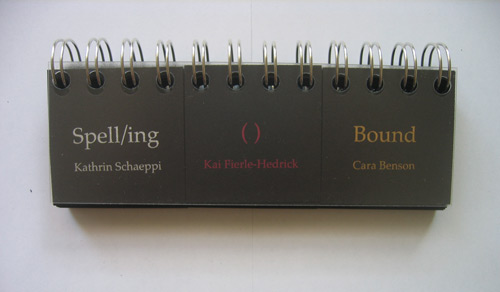
Jessica Smith reviews this wonderful looking object. get your pennies out of your pockets.
The amazing thing about Spell/ing () Bound is how fully conceived it is. There’s not a false step, but there are many surprises. I’m not sure how closely the collaborators worked together or what their parameters were when writing their three individual parts, or whether the magic came together in the editorial process, but it seems like each combination brings off a new meaning and metacommentary.
Charles Olson – The Kingfishers
A feast for the ears via Penn Sound and Ron Silliman.
Joy as Tiresome Vandalism
The latest instalment of James Davies and Simon Taylor’s collaborative text/visual project is online now.
Wopk by James Davies
Thought people might be interested in seeing this. Made it about 2/3 years ago. Wanted the feel of those late night Czech animations.
Poem Talk
Poem Talk podcasts available for dedicated close readings, the latest being no 21 where
“We talk about a poem by Charles Bernstein written in 2002, published in World on Fire and eventually collected in Girly Man: “In a Restless World Like This Is.”
Gotta beat Late Night Review.
Ray DiPalma – The Ancient Use of Stone
Nick Piombino reviews…
While contemporary poets and critics opine and debate about whether or not originality is still possible, contemporary poet Ray DiPalma has been quietly at work on a project for 10 years that demonstrates that not only is creativity and originality by poets alive and well, but Otis Books/Seismicity Editions has presented The Ancient Use of Stone, DiPalma’s superb new book, subtitled Journals and Daybooks 1998-2008, in a form that defies comparison with any other book of new writing for sheer visual and typographical beauty.
Strretcake 7 open for submissions
From Nikki and Trini at Streetcake:
We are also still looking for contributions to our COMBO COMPOSITION! It’s going to be fun, as long as people get involved. Show us your inventiveness and we can celebrate it! (No one will know who you are!)
In the vein of strange combination words like ‘streetcake’, we have decided to open up to suggestions from our witty fans.
This is what you have to do:
1) Reply to this email OR
2) be a fan on either Facebook or follow us on Twitter
3) Add your strange combo ideas to either OR email them back
4) We will collate all of them and make a strange tribute page to our fans in the next issue!!
One to inspire you: stingsilence
We look forward to your input!
Matthew Welton book review
We needed coffee but we’d got ourselves convinced that the later we left it the better it would taste, and, as the country grew flatter and the roads became quiet and dusk began to colour the sky, you could guess from the way we returned the radio and unfolded the map or commented on the view that the tang of determination had overtaken our thoughts, and when, fidgety and untalkative but almost home, we drew up outside the all-night restaurant, it felt like we might just stay in the car, listening to the engine and the gentle sound of the wind.
I may at some point review this in more depth but I thought that if I didn’t get this down now it might never happen.
James
Surely one of the most important poets of his generation being expert craftsman, innovator and wordsmith it was with warm welcome that I picked up Matthew Welton’s second collection with the super long title We needed coffee but we’d got ourselves convinced that the later we left it the better it would taste, and, as the country grew flatter and the roads became quiet and dusk began to colour the sky, you could guess from the way we returned the radio and unfolded the map or commented on the view that the tang of determination had overtaken our thoughts, and when, fidgety and untalkative but almost home, we drew up outside the all-night restaurant, it felt like we might just stay in the car, listening to the engine and the gentle sound of the wind. The collection continues Welton’s pursuit for the ‘correct’ use of the word and its antithesis in finding countless ‘correct’ meanings. More regularly than in his first collection, the rich and poetic The Book of Matthew, he uses systems poetry as method and vehicle to discuss imagery and choice.
We needed coffee opens with the sequence Virtual Airport; a melancholy prose poem in 21 sections that highlights a connection in the emotions of the sterility of the airport experience with the essential, biological lonely truth of never being ‘connected’ in a relationship whether the relationship be bad or not. It’s a beautiful lullaby also; exploring the different lights and colours, both artificial and natural. But the sequence is in essence about various emotional states of numbness people find themselves in without knowing why. This isn’t to say depression. It’s like Satre says in Nausea: ‘Three o’clock is always too late or too early for anything you want to do. A peculiar moment in the afternoon. Today it is intolerable.’ Part of section 3 reads: ‘The light from the windows is like a kind of weariness’ and it continues ‘the blurry coloured signboards show nothing that makes much sense.’ This movement from simile to metaphor convinces us of the overall description. We can see the same method applied throughout the work of Wallace Stevens. And the similarities don’t stop there. Consider paragraph one in section 11: ‘The chairs are the colour of blue chocolate-papers. The departures boards is unreadable. The ceilings are low’. Metaphor moves into statement.
Matchbox Digital Archive at The Poetry Library

For me the whole thing was about how to get good poetry read by people who don’t usually read good poetry, create excitement, be cheap to produce and sell; and yet not be some folded A4 paper. There were about 150 or so of each issue – all sold out now. The limited number of copies made was due completely down to the fact that I was getting sores on my fingers from cutting and folding not due to exclusivity so it’s wonderful that Dean Farrow, Chris McCabe et al have archived the editions for anyone who’s not read the poems or seen what the boxes looked like. So far the first 6 are up with the final six to come.
Language Moment
In the ancient Olympics poetry was a key part of the celebration of athletic achievement. The 21st Century Olympiad has become a symbol of developing global friendship and so needs again to celebrate the importance of languages in world dialogue. The idea of “The Language Moment” is to create an international gathering of the world’s most innovative artists who use language – from web artists to poets, sound artists to sculptors. The event will include performances, exhibitions, films, readings, sound and media installations, internet projects, broadcasts, public art commissions, publications, schools and community events. It aims to create a moment in which language itself becomes the vehicle for celebration.
I have 7 weeks to map out what this will involve. This event is the opportunity for poets and artists who work with language to carry forward the ideas of the Text Festival to a new level of global profile. I will be inviting many many people to participate and I am particularly open to proposals for projects you would like to see in the event – but you have to be quick.
Via Tony Trehy
cris cheek’s part: short life housing
Published by The Gig, 2009, 259pp. The most substantial collection to date of cris cheek’s ‘poems performing thematic extraction’: mud (and fluff), fogs, squat, broom sleigh, plain speaking yet, canning town chronicles, short life housing: texts begun in the 1980s & ’90s and worked through into the 2000s.
£17 + £2.24 UK postage. Payment by cheque or PayPal.
Orders to a.halsey@westhousebooks.co.uk
or West House Books, 40 Crescent Road, Nether Edge, Sheffield S7 1HN
‘is your tongue a glom / weapon that stains?’ cris cheek is the Kepler of Chisenhale Dance Space. After a century of developments in poetic form best understood as a series of metaphors for transcribed speech, cheek’s poetry often is transcribed speech, throwing shapes on the page that pay homage to (and lay the ghosts of) all the dead metaphors. As in Alvin Lucier’s I Am Sitting in a Room, the speech in cheek’s work functions as something like echolocation: its reflections (on him and in us) mapping out an ever more complex and multifocal shape for the public sphere, ‘where others fear to / t / read’. Peter Manson
‘For all its thickness, unanticipated moves, visual beauty, and playful language acrobatics, the poetry of part: short life housing consistently retains the edge of serious critique. There are few poets as attuned to the sounds and ambient fogs of everyday life as cris cheek, yet his record is tuned and sharply turned toward the reimagining of social knowledge. This volume is a generous move towards the full representation of cheek’s crucial project.’ Carla Harryman
‘Finally a good and rich span of writings from cris cheek. Here’s an artist and writer whose work has always taken up active tenancy of the languages and the streets of urban living, recording them and composing them back into the dense abstract neighbourhoods of his pieces. With this careful selection, cris cheek reminds us that he is a Londoner and as such is inhabited by Dickens’ dark maze of industrial streets as by mind-altering years of activist art lodgings, smoggy thoughtful wanderings or the eerie shock of the thatcherite city. That’s at least two hundred years of grime, greed and energy you’ll find distilled in the cellular lines and ink splashes of this great volume.’ Caroline Bergvall
Angel Exhaust 20 ‘You just rang Anne Widecombe?
Out now featuring:
- John Kinsella
- Kelvin Corcoran
- Jeff Hilson
- DS Marriott
- John Goodby
- David Chaloner
- Jesse Glass
- Rita Dahl
- Jason Wilkinson
- Michael Haslam
- Charles Bainbridge
- Chris Brownsword
- Colin Simms
- Out To Lunch
- Carrie Etter
144 pp.
PLUS the results of a survey where contemporary poets explain what’s wrong with the poetry scene. A fearless analytical exposé of the moral gutter where the sleaze flows night and day. We toss those bastards into the big wok of repentance. We rake the muck and rack the mopes. It’s twilight for the deep pigs.
Price: £7.00 including postage. Address: 21 Querneby Road, Nottingham, Notts NG3 5JA. Cheques payable to ‘Andrew Duncan’
POETRY SCENE: CURRENT DIFFICULTIES
“Poets have a poor public image, and make very little money. The problems are their self-centred attitudes, suspect reviewing, commercialization of the book trade, timidity in academia, the barbarism of literary theory, and their own ceaseless production of very indifferent work.” (www.textetc.com)
Discuss.
Sean Bonney and Frances Kruk videos
To relive those moments or for the first time here are the videos. I had to chop them up to fit them onto Youtube. The Other Room 7 and Alan Halsey reading in April 2008 are still being transferred but are on their way for sure soon. This is the reading order of the night. For some reason Sean’s first part starts 1. 24 minute or so into the tape so roll forward.
First half
Sean Bonney
Frances Kruk
Second half
Frances Kruk
Sean Bonney
Stem recordings
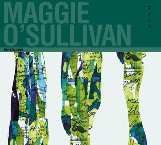
Stem recordings is Rob Holloway’s wonderful project which includes beautifully made CDs by beautiful poets including The Other Room reader’s Maggie O’Sullivan, Allen Fisher, as well as Peter Manson and Leslie Scalapino.
The Red Ceilings

“We are now inviting submissions for inclusion on the Red Ceilings. All we ask is that we like your work and that it is inventive, intriguing and unusual. Send your work in either the body of an email or an attachment to theredceilings@googlemail.com”
Poetry Wales
The summer issue of Poetry Wales features:
Lee Harwood’s memories of Frank O’Hara
New poetry from Slovenia
Angela Carr in dialogue with Samantha Wynne Rhydderch
Matthew Jarvis on Wales in the 90s
Reviews of John Wilkinson, Tim Atkins, Pascale Petit, Sheenagh Pugh, John Goodby, Steve Griffiths, Sarah Corbett, Meirion Jordan and Myrddin ap Dafydd, plus Peter Barry on Complicities by Robin Purves and Sam Ladkin and Origins of the Underground by Andrew Duncan.
Contributing poets include Robert Sheppard, Vahni Capildeo, David Foster-Morgan, Ian Seed, Angela Carr, Richard Gwyn and many more.
Call for submissions:
A special issue in 2010 will focus on poetry and the visual. Submissions of poems drawing on this relationship, as well as texts that incorporate visual elements, are welcome with SAE by December 1st 2009.
Editorial address: Zoë Skoulding, Poetry Wales, School of English, Bangor University, Gwynedd LL57 2DG, Wales.
To subscribe (£20 for 4 issues UK) or buy a single copy (£5.50), visit http://www.seren-books.com/poetry-wales or send a cheque to: Poetry Wales Press Ltd., 57 Nolton St, Bridgend, CF31 3AE, Wales.
Openned

 otherroom.org